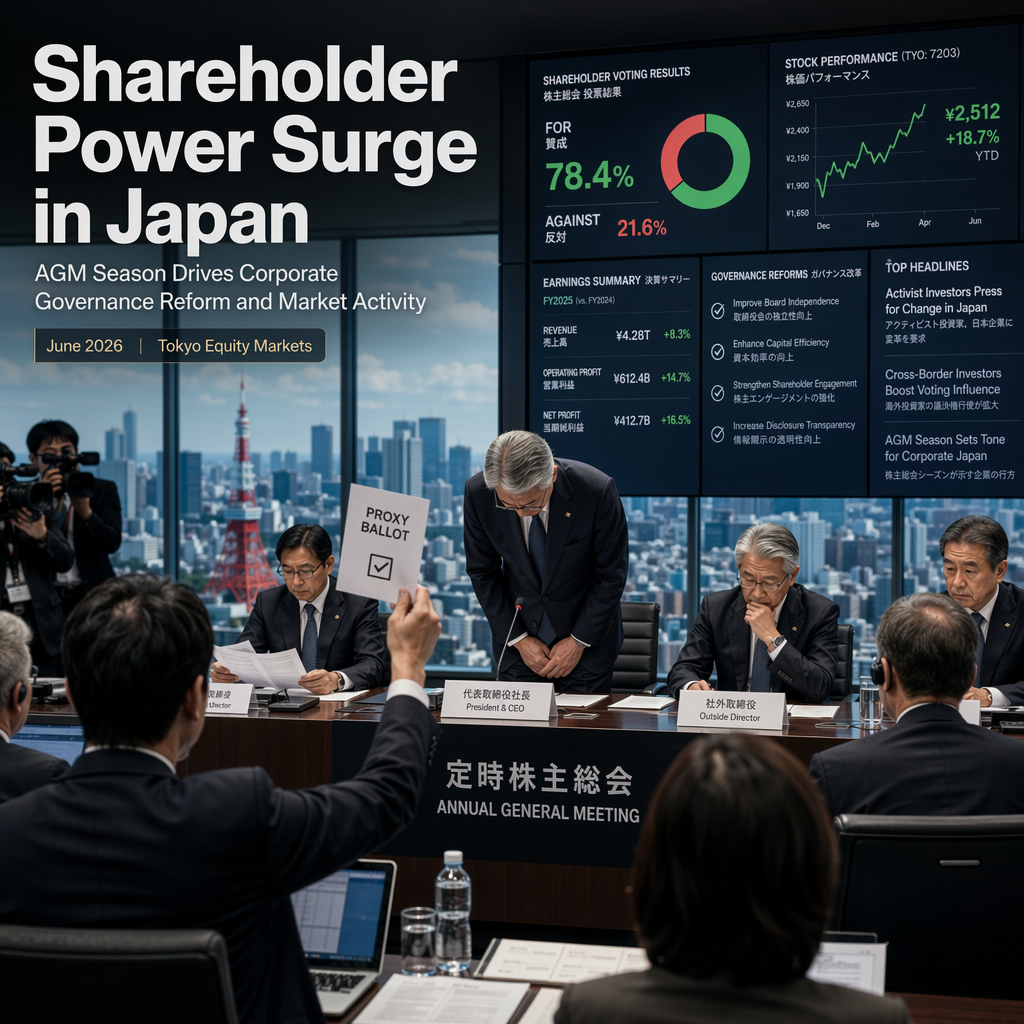
During Japan's peak annual general meeting (AGM) season, shareholders at listed companies have increased pressure on management regarding poor earnings and weak corporate governance, according to a report dated June 27, 2026 [1]. At Honda Motor's AGM, directors issued apologies for company losses in response to investor concerns about financial performance [1]. Ricoh and KDDI also experienced low shareholder support for their directors, signaling widespread dissatisfaction with both earnings and governance standards [1].
Asset managers and trust banks have heightened their scrutiny at shareholder meetings, demanding greater accountability and transparency from corporate management teams [1]. This increased activism has led to shareholders blocking key director appointments, as evidenced by a recent incident at Nissan where the appointment of a key outside director was rejected [1]. Foreign activist investors are also targeting larger Japanese corporations, aiming to drive governance reforms and enhance shareholder value [1].
These developments have contributed to a surge in market activity, including a significant rise in share buybacks, which have exceeded $100 billion, led by major companies such as Sony and Hitachi [1]. The shareholder pushback is also prompting political responses, with Japan considering new measures to allow companies to shield directors from large liability claims, in an effort to balance accountability with attracting qualified board members [1].
Market sentiment is shifting as investors call for improved dividend policies and stronger returns. Notably, there have been proposals for dramatic dividend increases, such as a suggestion for a Nissan unit to expand dividends 80-fold [1]. The ongoing AGM season continues to focus attention on the need for improved earnings, stronger governance, and enhanced shareholder value throughout Japan's equity markets [1].
CONCLUSION
Shareholders in Japan are taking a more active role in demanding better earnings and governance, leading to increased market activity and political consideration of director protections. The heightened scrutiny and calls for reform are likely to continue shaping Japan's corporate landscape and equity market dynamics.