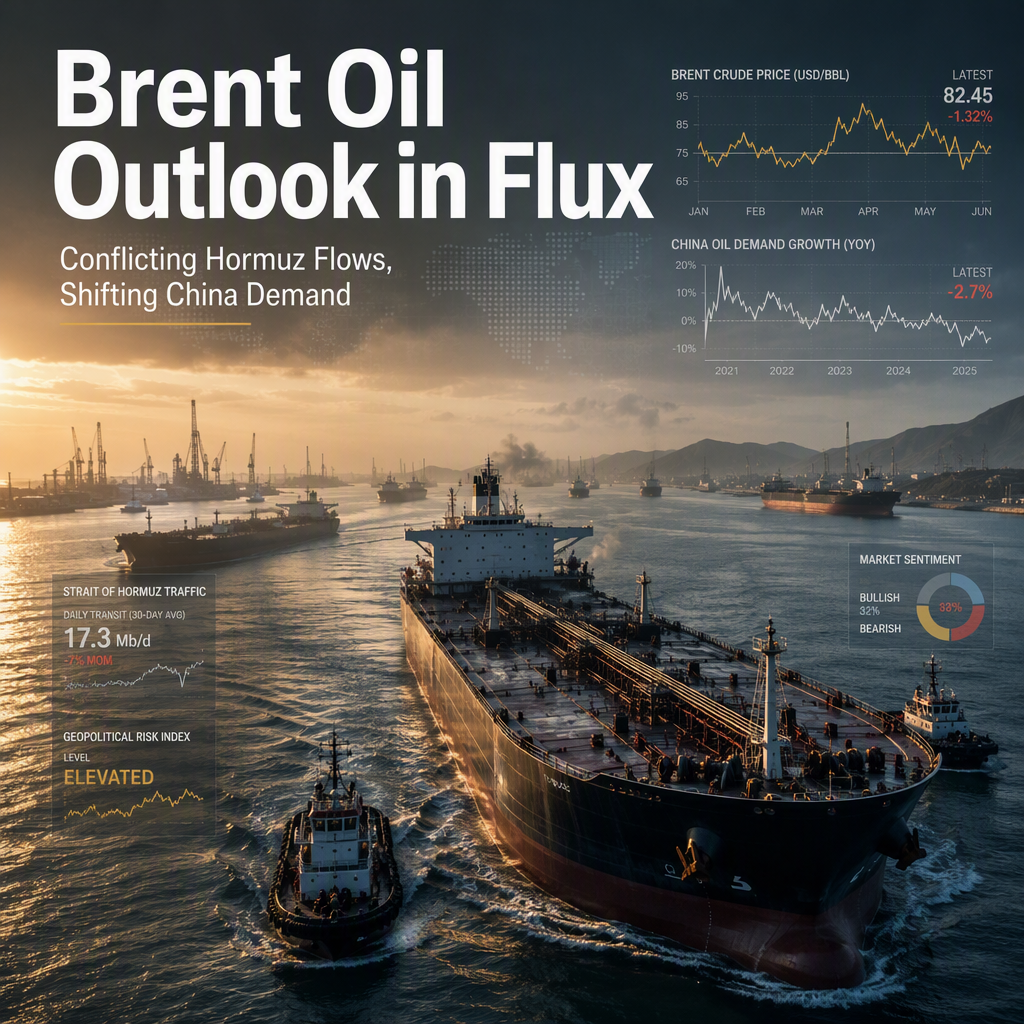
Commerzbank’s Commodity Research team, led by Barbara Lambrecht, highlights ongoing uncertainty regarding crude oil flows through the Strait of Hormuz, with conflicting reports clouding the outlook for Brent prices [1]. The team notes that upcoming reports from the US Energy Information Administration (EIA), International Energy Agency (IEA), OPEC, and China’s trade figures are expected to clarify both supply and demand dynamics [1]. A month ago, the EIA lowered its expectations for shipments through the Strait of Hormuz and projected larger production losses in the Gulf region for the third quarter compared to July [1]. However, recent reports about 'workarounds' such as ship-to-ship transfers suggest the EIA may adopt a more optimistic view in its next update [1]. Additionally, the EIA has slightly raised its forecast for US oil production next year, reflecting higher oil price assumptions [1]. If these trends continue, it could indicate that the Strait of Hormuz is becoming more passable, which would likely lead to a decline in oil prices [1]. The development of OECD inventories and the outlook for global oil demand remain key factors to watch, particularly as China’s energy crisis accelerates the shift towards electric mobility, dampening Chinese oil demand [1].
CONCLUSION
The outlook for Brent oil remains fragile due to uncertain flows through the Strait of Hormuz and conflicting transit data. Upcoming agency reports and China’s trade figures are expected to provide clarity, with potential implications for both supply and demand. If the Strait becomes more passable and Chinese oil demand continues to weaken, Brent prices may face downward pressure.