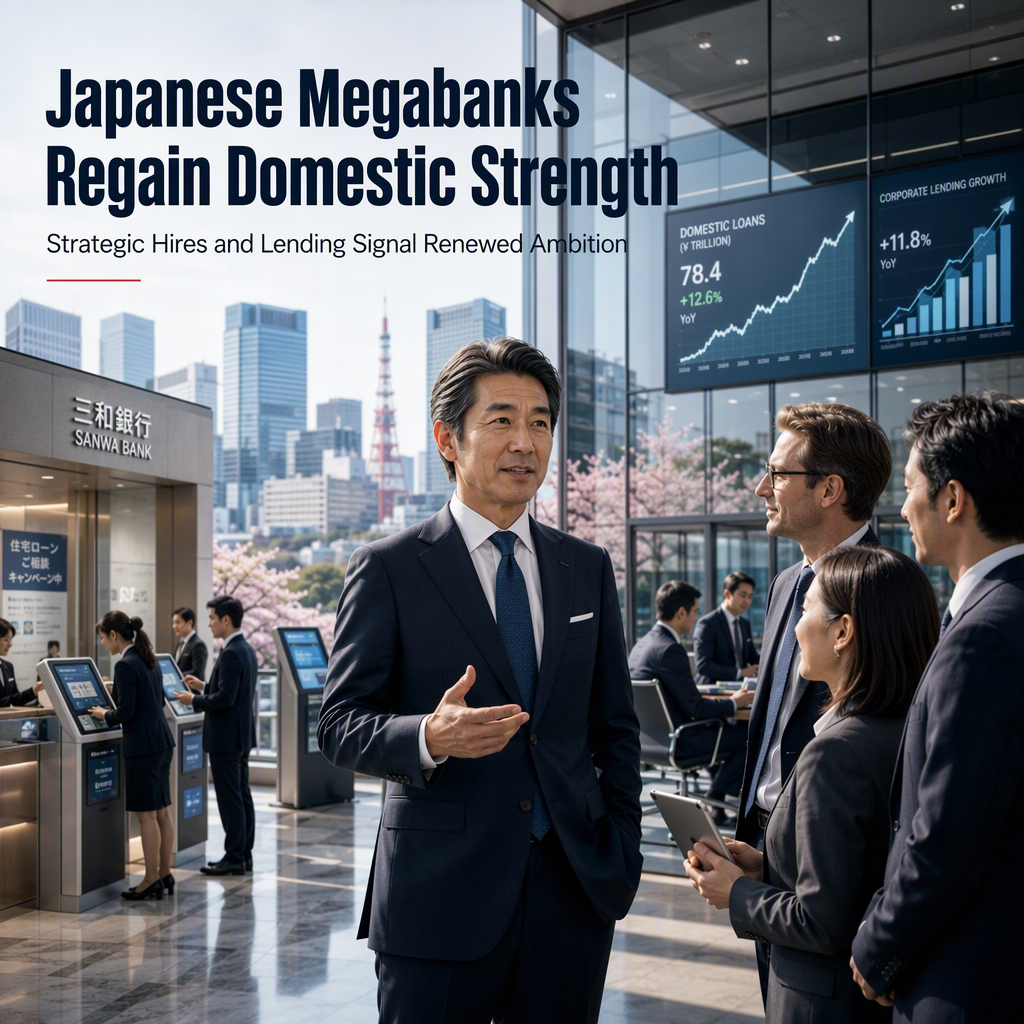
Major Japanese banks have marked a significant shift in their domestic lending strategies, with their share of domestic loans rising from a low of 45.5% in May 2025 to 46.8% in August 2026. This represents the first sustained increase in domestic loan share since the early 1990s, following decades of contraction after the collapse of Japan's bubble economy. The resurgence is attributed to higher lending margins and increased financing demand within Japan, prompting leading institutions such as MUFG to refocus on domestic markets after years of prioritizing overseas expansion [1].
Concurrently, Sumitomo Mitsui Financial Group (SMFG), the parent of SMBC, is actively hiring senior managers from outside the company, including a recent executive from Nomura. This recruitment drive is part of SMFG's broader strategy to diversify its business beyond traditional corporate lending and to prepare for its upcoming joint venture with Jefferies. The move reflects a broader trend among Japanese banks to seek external talent in order to compete globally and drive innovation [2].
Industry analysts and observers note that these developments signal renewed confidence in the Japanese banking sector and a willingness to adapt to changing market dynamics. The increase in domestic lending share is seen as a positive indicator for the Japanese economy, while the recruitment of outside executives is expected to strengthen banks' positions in global investment banking and broaden their financial services [1][2].
No explicit trading advice, technical indicators, or specific financial values related to the joint venture or hiring were provided in the articles [1][2].
CONCLUSION
Japanese megabanks are experiencing a notable rebound in domestic lending while simultaneously pursuing global expansion and innovation through strategic hires and partnerships. These shifts suggest a more confident and adaptive Japanese banking sector, with potential positive implications for both domestic and international markets.