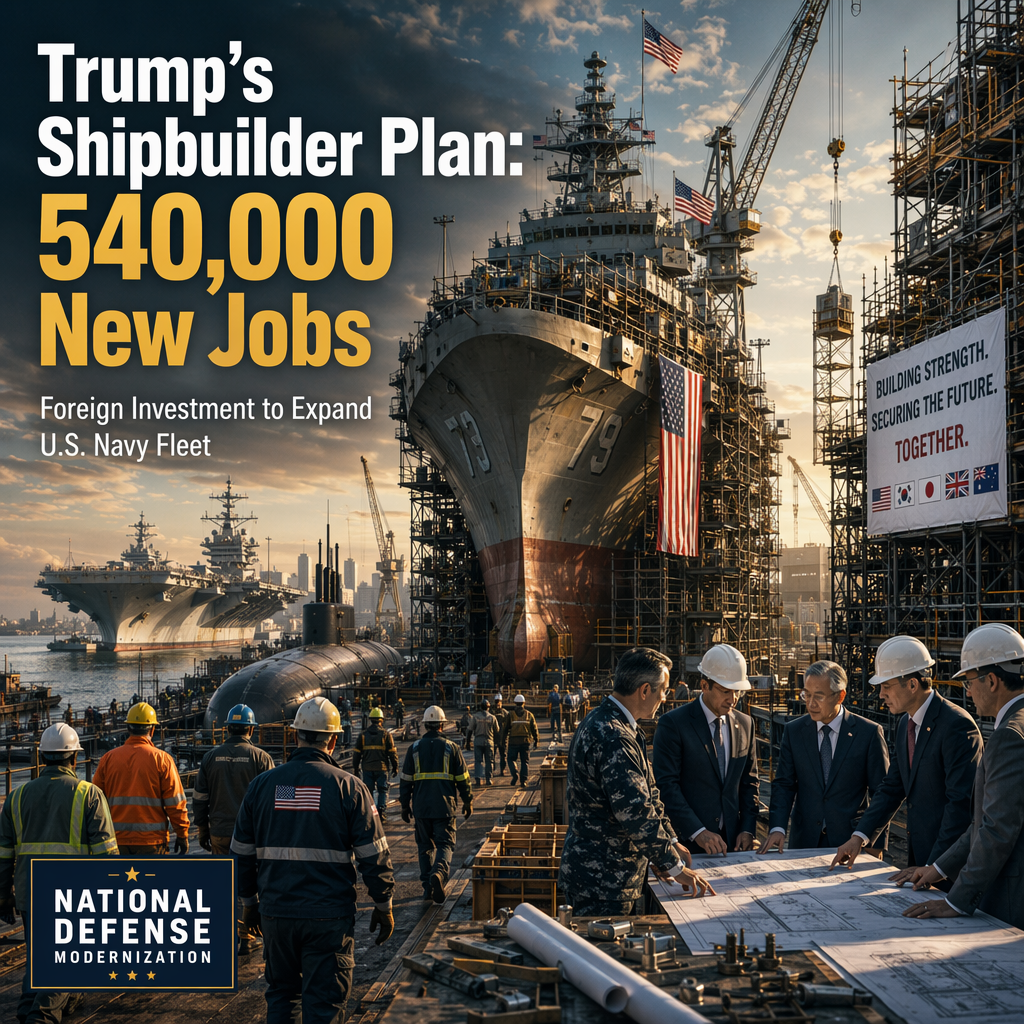
President Trump is proposing to invite foreign shipbuilders to establish operations in the United States as part of a strategy to rapidly expand the U.S. Navy's fleet, according to Acting Navy Secretary Hung Cao [1]. Cao stated that the initiative could create approximately 540,000 American jobs and strengthen national defense capabilities [1]. He clarified that the plan does not involve building foreign ships, but rather having foreign companies invest in U.S.-based shipbuilding, similar to how automakers like Toyota and Nissan manufacture vehicles domestically [1].
Cao emphasized that the U.S. currently relies on only two domestic ship manufacturers, which limits the Navy's ability to meet global demands. He cited the need for 350 ships to address current security challenges, including rising tensions in the Middle East and China's expanding military presence in the Indo-Pacific region [1]. The shortage of vessels has resulted in extended deployments for aircraft carriers such as the USS Gerald R. Ford, due to insufficient ships available for rotation [1].
To address these challenges, President Trump is advocating for a $1.5 trillion budget to fund the construction of the necessary ships, aircraft, and submarines to deter adversaries worldwide [1]. Cao highlighted the operational strain on aging assets, referencing the 32-year-old USS Charlotte submarine, which recently sank the Iranian frigate IRIS Dena off the coast of Sri Lanka in March, marking the first time a U.S. Navy submarine has sunk an enemy vessel in combat since World War II [1].
The proposal is positioned as a response to both immediate and long-term defense needs, with the dual goals of job creation and military modernization. No specific market reactions or analyst opinions were provided in the article [1].
CONCLUSION
President Trump's plan to bring foreign shipbuilders to the U.S. aims to create 540,000 jobs and expand the Navy's fleet to 350 ships, supported by a proposed $1.5 trillion budget. The initiative is framed as a strategic response to global security challenges and domestic industrial limitations, with significant implications for defense and employment.