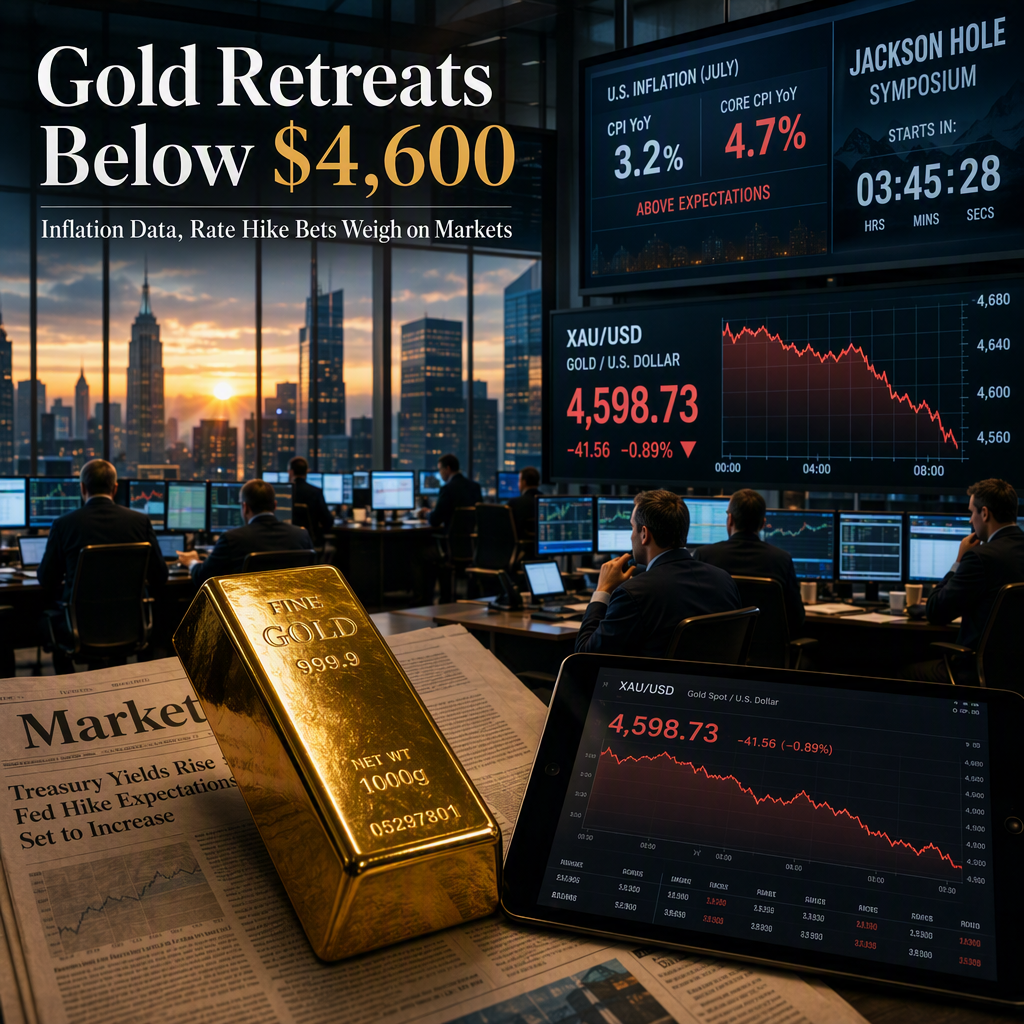
Gold prices (XAU/USD) edged lower to around $4,580 during Asian trading hours on Friday, retreating from a three-month high as traders digested in-line US inflation data and anticipated further Federal Reserve (Fed) rate hikes [1]. The US Bureau of Economic Analysis reported that the core Personal Consumption Expenditures (PCE) Price Index inflation, the Fed's preferred gauge, held steady at 3.3% year-over-year in July, matching market expectations. Both the headline and core PCE Price Index rose by 0.2% month-over-month in July [1].
Following the inflation data release, market participants increased their bets on a September Fed rate hike, with the CME FedWatch Tool showing the probability rising to 40% from 36% prior to the data. This heightened rate hike expectation weighed on gold, which is traditionally used as a hedge against inflation but becomes less attractive in a high interest rate environment due to its lack of yield [1].
Diplomatic efforts involving Iran and Oman to reopen the Strait of Hormuz may ease oil-driven inflation concerns, potentially capping the downside for gold. Iran’s Security Chief Mohsen Rezaei stated that Tehran is preparing a list of conditions to open the Strait in response to mediator requests, including ending the war in the region, according to Reuters [1].
TD Securities highlighted that a shift in tone from Fed Chair Kevin Warsh at the Jackson Hole Economic Symposium remains a key risk for bullion. The bank cautioned that a more hawkish tone could trigger a reversal in gold prices, but also noted that the bar is high for any policy surprise to materially undermine the current constructive sentiment in precious metals [1]. Technical analysis shows XAU/USD holding above its 100-day simple moving average and the 20-day Bollinger middle band, maintaining a bullish near-term bias despite the recent pullback. The Relative Strength Index (14) at 65 indicates positive momentum, though the advance may become more labored as price approaches overbought territory. Immediate resistance is seen at the 20-day Bollinger upper band near $4,760, while initial support is around $4,585 [1].
CONCLUSION
Gold has pulled back below $4,600 as US inflation data reinforced expectations for further Fed rate hikes, increasing market uncertainty ahead of the Jackson Hole Symposium. While technical indicators remain bullish and sentiment is resilient, a hawkish shift from Fed Chair Warsh could trigger further downside. Diplomatic developments in the Strait of Hormuz may also influence inflation and gold's trajectory in the near term.