
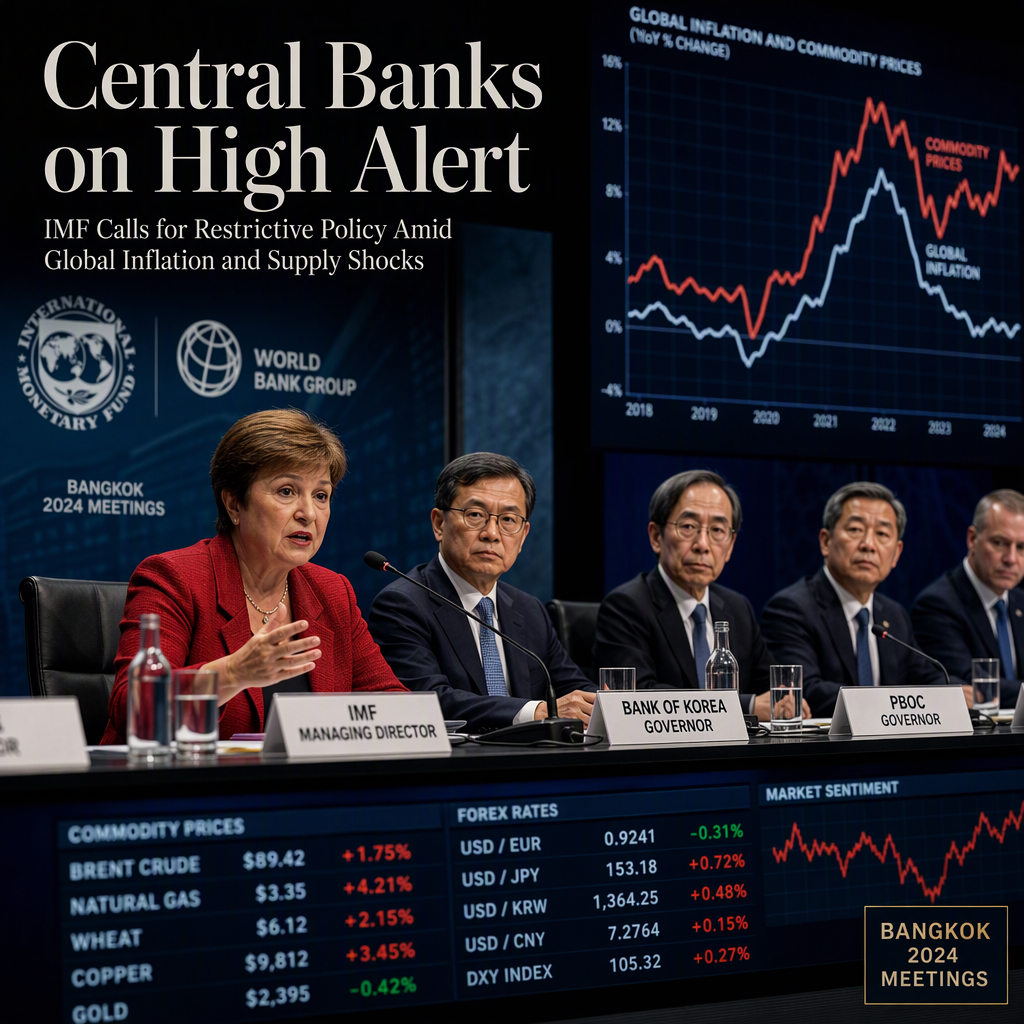
Central banks' responses to persistent inflation were a focal point at the International Monetary Fund (IMF) and World Bank annual meetings in Bangkok, where the effectiveness of conventional monetary policy was questioned amid ongoing supply shocks [1]. The IMF advocated for restrictive policy measures to address inflation, stressing the need for caution due to continued volatility in global supply chains [1]. Bank of Korea (BOK) Governor Shin Hyun-song emphasized the importance of exchange-rate stability, explaining that currency appreciation can enhance household purchasing power and shift economic momentum from the export sector to domestic demand, highlighting the multifaceted challenges of monetary policy management in the current environment [1].
Market participants are closely monitoring central bank actions, as policy shifts could significantly affect price levels and trading sentiment [1]. The IMF's call for restrictive policy is interpreted as a signal that further rate hikes or tighter monetary conditions may be imminent, particularly in economies with elevated inflation such as Japan and the Philippines [1]. Recent data shows Tokyo's core inflation rate has surged, supporting the case for additional Bank of Japan (BOJ) hikes, while inflation in the Philippines eased but remained high at 6.8%, suggesting a potential rate hike [1].
Commodity prices are near an 18-year high, intensifying global inflation risks and prompting greater scrutiny of central bank strategies [1]. Technical analysis points to the importance of support and resistance levels for major currencies and commodities, with traders advised to closely follow central bank statements and inflation data releases for cues on potential market moves and shifts in sentiment [1].
The meetings in Bangkok underscore the ongoing uncertainty and complexity facing central banks as they navigate inflation pressures, supply shocks, and volatile exchange rates [1].
CONCLUSION
The IMF's call for restrictive monetary policy and the focus on exchange-rate stability by central bank leaders signal heightened vigilance amid persistent inflation and supply shocks. With inflation rates elevated in key economies and commodity prices near historic highs, market participants should expect continued volatility and closely monitor central bank actions for future market direction.