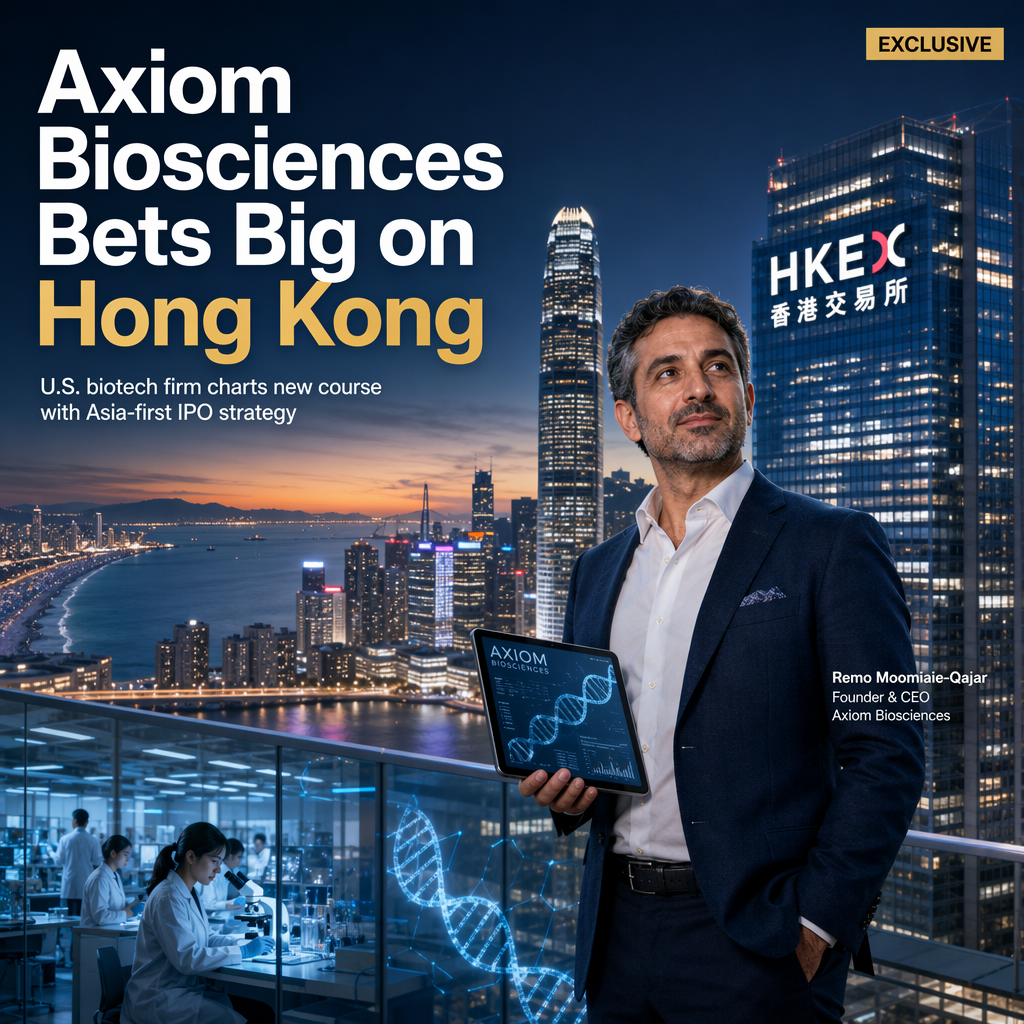
Axiom Biosciences, a San Diego-based developer of regenerative and genetic medicines, has announced plans to pursue a primary listing on the Hong Kong stock exchange in 2027, followed by a secondary U.S. listing in 2029, marking a notable departure from the traditional route taken by American biotech firms that typically prioritize U.S. markets for their IPOs [1]. The company aims to leverage Hong Kong's growing base of biotech-focused investors and its proximity to Chinese pharmaceutical partners, which could facilitate faster clinical trials and reduce operational costs [1].
Remo Moomiaie-Qajar, founder and CEO of Axiom, described the move as 'contrarian,' emphasizing that while the U.S. remains the deepest and most institutionalized biotech capital pool, the funding environment for biotech firms has become more challenging, especially for those without major early backers [1]. He noted that public markets like Hong Kong offer alternative fundraising avenues as clinical trials become increasingly expensive and venture capital becomes harder to secure [1].
Danny Xiang, founding partner at Fontus Capital, highlighted that Hong Kong's stricter listing standards and recent reforms have contributed to a more mature biotech ecosystem, making the city an attractive destination for global biotech listings [1]. According to LSEG data, the Hang Seng Biotech Index has surged more than 75% since January 2025, outperforming the ICE Biotechnology Index and the Nasdaq Biotechnology Index, which have posted gains of roughly 40%-50% over the same period [1].
The trend of Chinese biotech firms listing in Hong Kong has been supported by government initiatives and the growing financing needs of innovative drugmakers [1]. However, Xiang pointed out that it remains rare for a purely American biotech firm to choose Hong Kong as its primary listing venue, underscoring the significance of Axiom's decision [1].
CONCLUSION
Axiom Biosciences' decision to list in Hong Kong before the U.S. reflects shifting dynamics in global biotech fundraising, with Hong Kong emerging as a competitive hub. The company's strategy aims to tap into Asia's investor base and clinical ecosystem, signaling a potential new direction for American biotech firms seeking alternative capital markets.