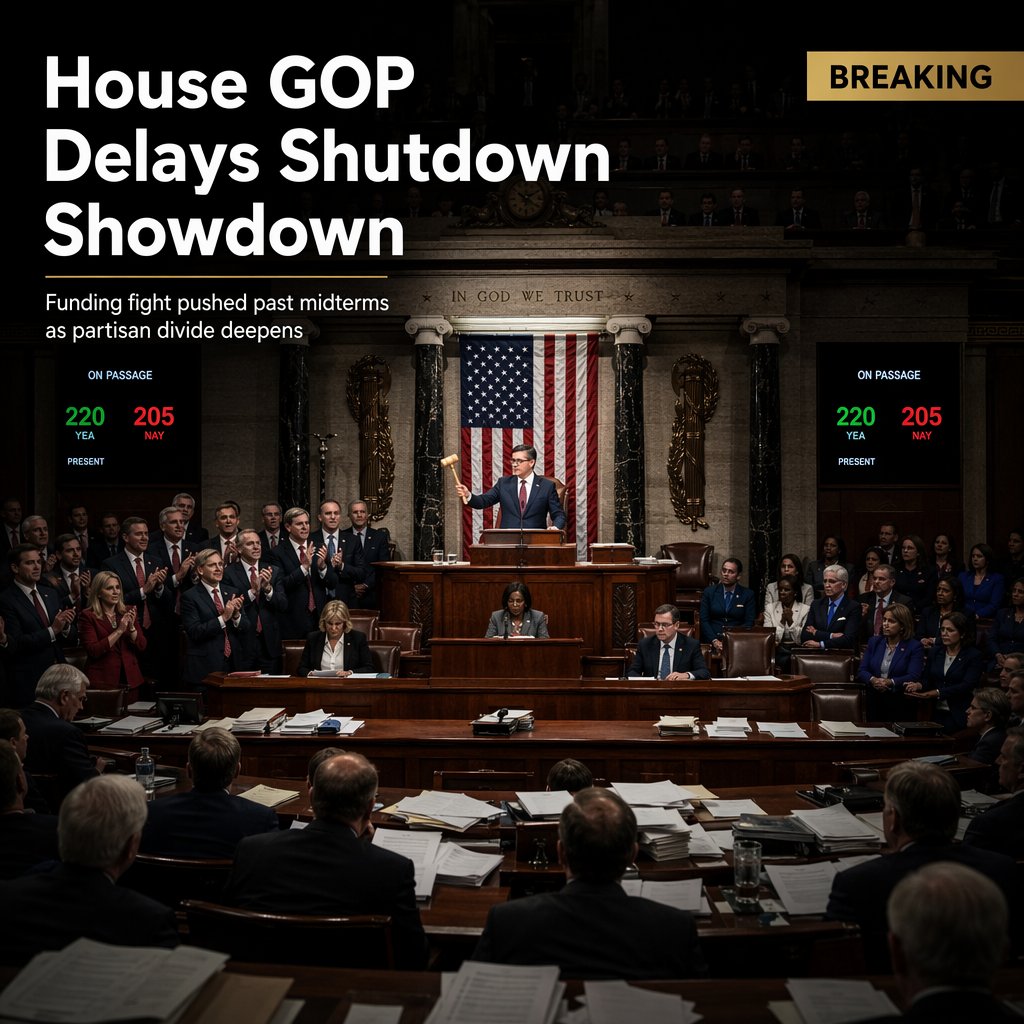
The House of Representatives voted on Tuesday night to delay the threat of another government shutdown until after the November midterm elections by passing a continuing resolution (CR) to extend current fiscal year's funding levels until December 4. The measure passed with a 220 to 205 vote, with only six House Democrats supporting the bill and 204 voting against it, while all but one House Republican voted in favor [1]. This legislative move is seen as a victory for Speaker Mike Johnson and House Republicans, who aim to avoid a contentious federal spending fight ahead of the midterms, which are expected to be challenging for their slim majority [1].
House Majority Whip Tom Emmer criticized Democrats for opposing the measure, stating that House Republicans are demonstrating their ability to govern and accusing Democrats of being the party of chaos and destruction [1]. Speaker Mike Johnson also accused Democrats of previously causing the two longest government shutdowns in American history during this Congress, including one lasting 78 days, and warned that Democrats would likely cause another shutdown before the election if the issue was not postponed [1].
On the Democratic side, House Democratic Caucus Chairman Pete Aguilar and the top Democrat on the House Appropriations Committee opposed the bill, citing concerns over drafting errors in the CR that would give Customs and Border Patrol flexibility to move funds, which they argue could create opportunities to transfer funds outside of intended purposes [1]. Despite the House's passage of the bill, the article notes that it is not clear what will happen next [1].
The current fiscal year included the longest government shutdown in history, lasting from October 1, 2025, until November 12, 2025, as Senate Democrats protested GOP-led spending cuts to federal healthcare programs [1]. The passage of the CR is intended to prevent a repeat of such a shutdown in the immediate pre-election period, but uncertainty remains regarding the bill's future and the potential for further partisan conflict [1].
CONCLUSION
The House GOP's passage of a continuing resolution delays the risk of a government shutdown until after the November midterms, aiming to avoid pre-election turmoil. While Republicans frame this as a responsible move, Democrats raise concerns about the bill's provisions and oppose its passage. The outcome in the Senate and the ultimate resolution of government funding remain uncertain.