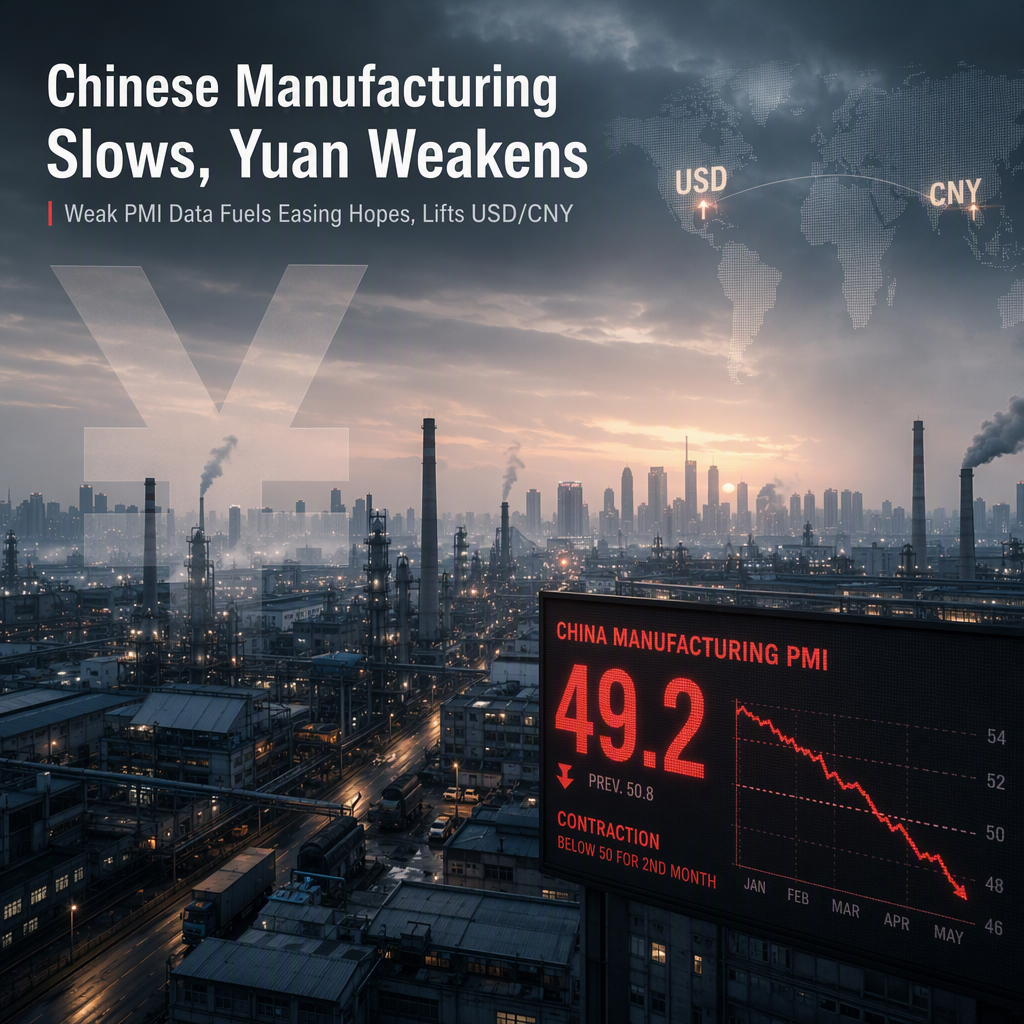
China's private manufacturing Purchasing Managers' Index (PMI) declined to 50.9 in July, marking a four-month low and signaling a slowdown in factory activity. This drop comes alongside the official National Bureau of Statistics (NBS) PMI, which registered at 49.2, further highlighting weakening momentum in the manufacturing sector across both large and private firms [1]. The breakdown of the RatingDog survey's sub-components also points to softness in the sector [1].
The weaker-than-expected PMI readings have materially strengthened expectations for near-term monetary easing in China. According to Commerzbank economist Dr. Henry Hao, markets are increasingly pricing in cuts to the Loan Prime Rate (LPR) and possibly the Reserve Requirement Ratio (RRR) as policymakers respond to the deteriorating industrial outlook [1].
In foreign exchange markets, the Chinese yuan weakened following the PMI releases. The onshore USD/CNY and offshore USD/CNH exchange rates both moved higher, rising by 30 pips and 60 pips respectively to reach around 6.76 yesterday [1].
No forward-looking statements or analyst opinions beyond the expectation of policy easing were provided in the source article.
CONCLUSION
The latest PMI data from China underscores a slowdown in manufacturing, prompting markets to anticipate imminent monetary easing measures. The Chinese yuan weakened in response, reflecting investor concerns over the economic outlook and policy direction.