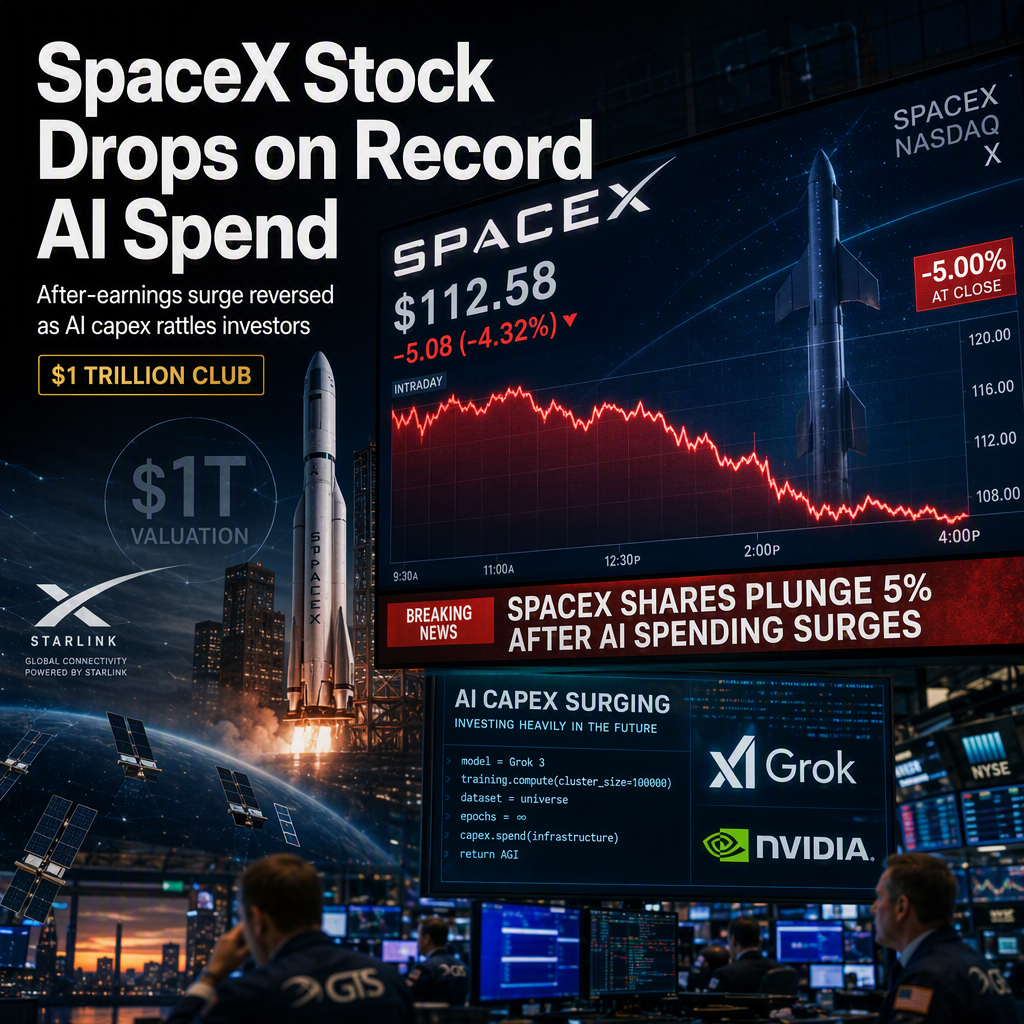
SpaceX reported its first-ever quarterly update as a public company, revealing revenues and earnings that surpassed analysts’ expectations, with most revenue attributed to its Starlink satellite offering [1]. However, investor attention quickly shifted to the company's capital expenditures, particularly those related to its xAI unit, which operates the Grok AI service. SpaceX's AI-related capital expenditures reached $15.8 billion, significantly exceeding expectations of $13.09 billion, according to Bloomberg News data. This AI spending made up the majority of SpaceX’s total $18.4 billion in quarterly capital expenditures [1].
The financial report triggered a sharp reversal in SpaceX’s stock price. After surging 9% during regular trading hours on Tuesday, the stock fell approximately 5% in after-hours trading as investors reacted to the higher-than-expected AI spending [1]. The company, which became a multi-trillion-dollar entity following its record-setting IPO on June 12, saw its market value drop by $1 trillion amid anticipation of insider stock sales and concerns over the rapid pace of AI investment [1]. Despite this, SpaceX maintains a market valuation exceeding $1 trillion, positioning it among the world’s most valuable companies [1].
The stock received a temporary boost after SpaceX announced a new deal with Nvidia to provide additional computing power, but investor concerns about capital allocation persisted [1]. There is also growing speculation among investors about a potential merger between SpaceX and Tesla, which could further consolidate Elon Musk’s control over his technology ventures [1].
CONCLUSION
SpaceX’s strong earnings and revenue performance were overshadowed by investor concerns regarding its surging AI-related capital expenditures, leading to a sharp decline in its stock price. While the company remains highly valued and continues to pursue strategic partnerships, market sentiment has turned cautious amid uncertainty over future spending and insider share sales.