
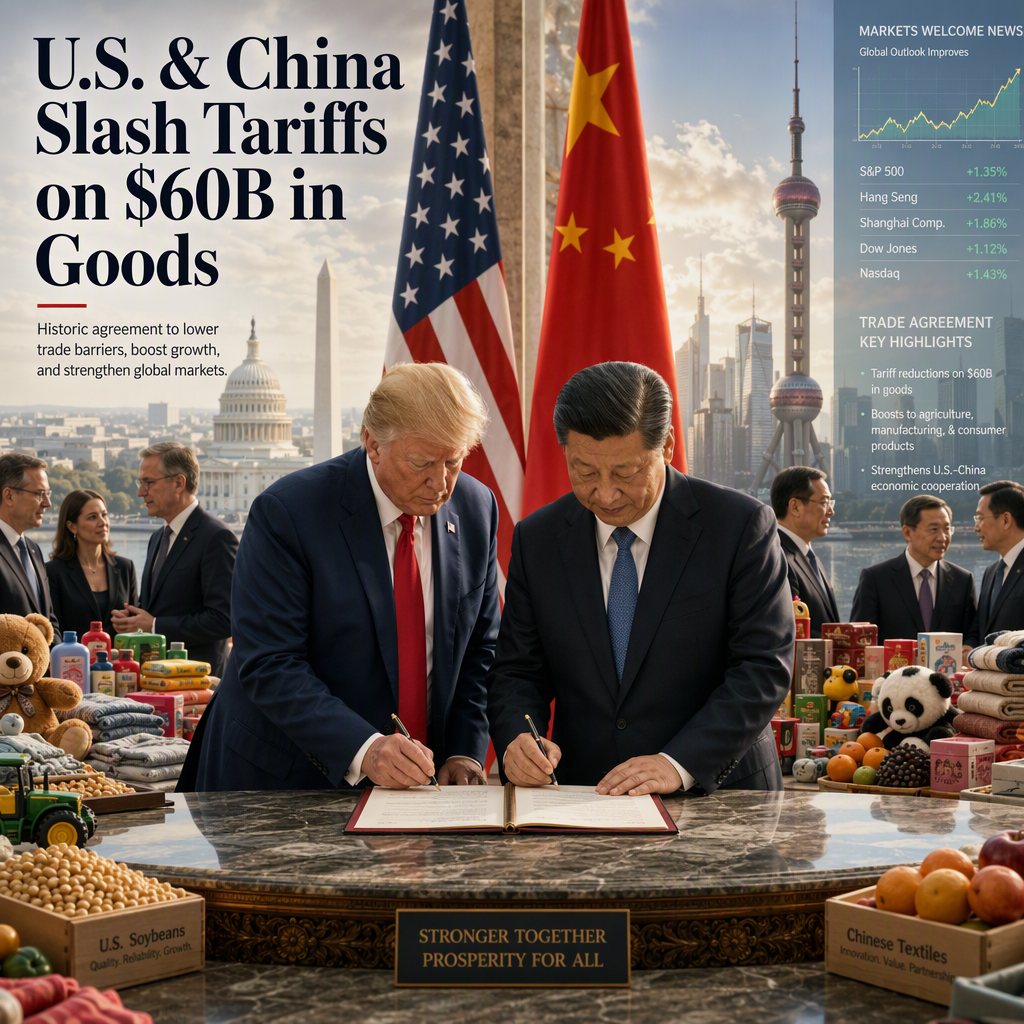
The United States and China have announced plans to reduce tariffs on $30 billion worth of goods from each country, following a summit between U.S. President Donald Trump and Chinese President Xi Jinping in Washington, D.C. last week [1]. According to government announcements from both sides, the U.S. will lower tariffs on a range of imports including toys, sports equipment, and Christmas decorations, while China will reduce tariffs on a longer list of American imports, with a significant focus on agricultural products [1].
The U.S. goods trade deficit with China was reported at more than $202 billion last year, highlighting the significance of these tariff reductions in addressing trade imbalances [1]. Jacob Cooke, CEO at WPIC, noted that if the tariff cuts are implemented before the holiday season, they could provide a boost to U.S. consumption and retailers, particularly in categories such as hair care and packaged pet food, where Chinese brands are highly competitive [1]. Home goods seller Ryan Zhao, director of Jiangsu Green Willow Textile, expects sales in the second half of the year to grow by 30% year-over-year if the tariff cuts are enacted [1].
Despite the announcement, details regarding the timing and the exact reduction in duties remain unclear. Last year, the U.S. and China imposed tariffs of over 40% and more than 30%, respectively, on each other's goods [1]. The two countries had previously agreed to a one-year truce on further tariff increases, which was recently extended to January, according to U.S. Treasury Secretary Scott Bessent [1].
The establishment of the U.S.-China 'Board of Trade,' which will include officials from both governments and meet at least quarterly, is expected to facilitate ongoing dialogue and potentially further trade liberalization [1].
CONCLUSION
The planned reduction of tariffs on $60 billion in goods marks a significant step in U.S.-China trade relations, with the potential to boost trade and benefit both countries' industries if implemented. However, uncertainty remains regarding the timing and scale of the tariff cuts, leaving markets awaiting further clarity.