
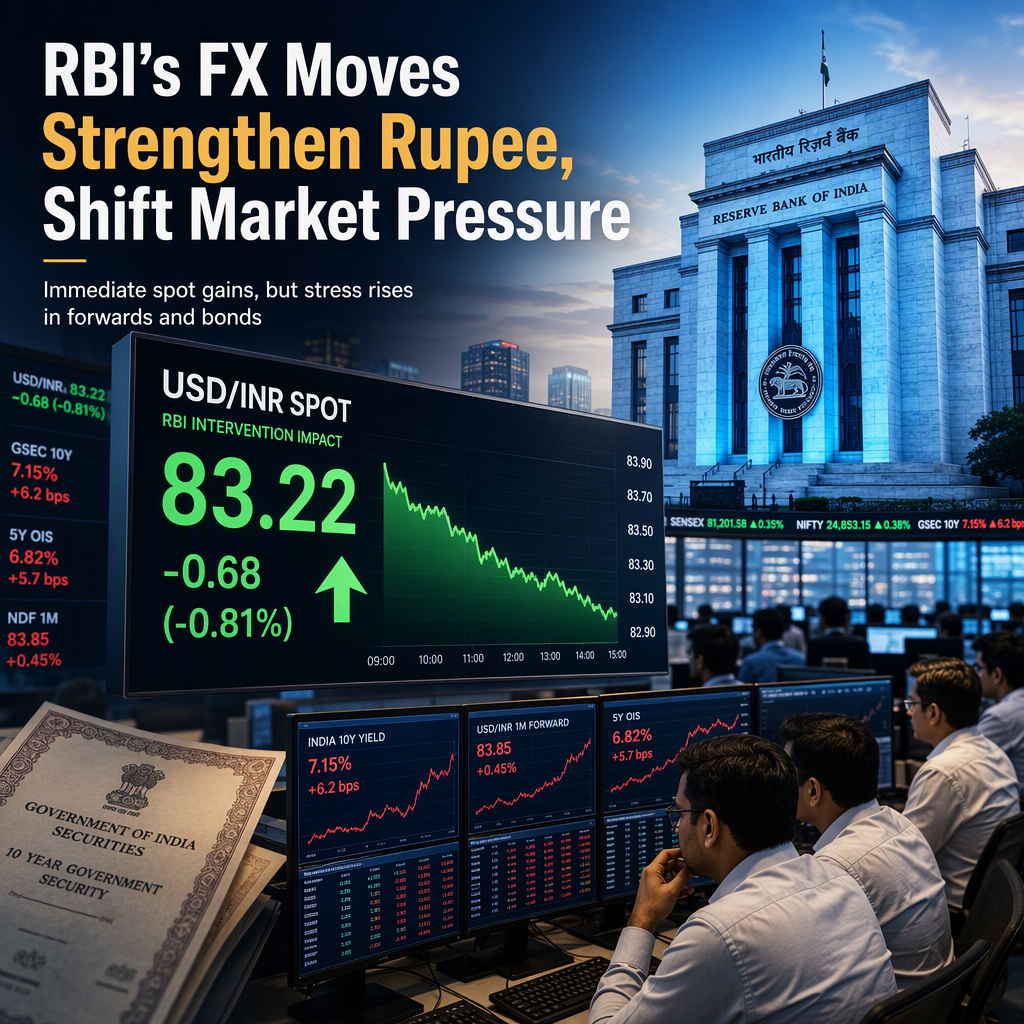
According to MUFG’s Michael Wan, the Reserve Bank of India (RBI) recently announced a new round of foreign exchange (FX) and liquidity measures aimed at curbing weakness in the Indian Rupee (INR) [1]. A key component of these measures is the introduction of a 20% Foreign Exchange Risk Reserve charge on FX derivatives used to hedge current account exposures, which Wan notes is similar to steps previously taken by China to manage currency depreciation [1].
These actions have resulted in a sharp strengthening of the spot USD/INR rate, indicating immediate support for the rupee in the spot market [1]. However, Wan highlights that this intervention has shifted market stress to other segments, including a rise in onshore forward premias, wider offshore INR NDF spreads, and higher INR bond yields, with the 10-year yield rising closer to 7.4% [1]. These developments reflect adjustments in hedging demand, positioning, and liquidity conditions following the RBI’s measures [1].
Despite the near-term support for the rupee, Wan points to India’s structural capital inflow imbalance and forecasts that USD/INR will gradually rise to 97.50 by the September quarter of next year [1]. He also suggests that the RBI is likely to implement further measures if the rupee weakens beyond current levels [1].
CONCLUSION
The RBI’s recent FX and liquidity measures have provided immediate support to the Indian Rupee in the spot market but have shifted pressure to forwards, offshore NDFs, and bonds. While the rupee has strengthened in the short term, MUFG forecasts a gradual depreciation over the coming year, with the possibility of further RBI intervention if needed.