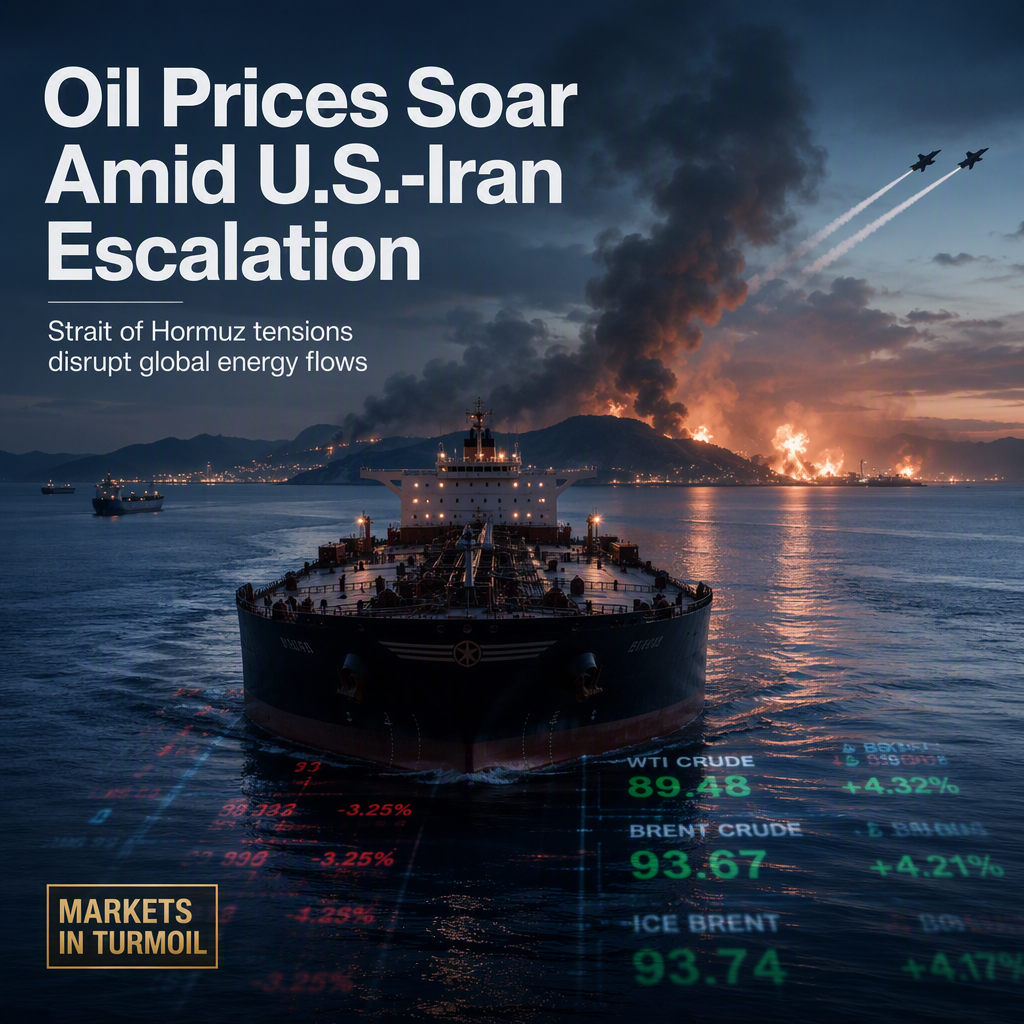
Oil prices climbed sharply in early Asian trading on Monday following a significant escalation in U.S.-Iran tensions. U.S. forces struck two Iranian rocket launchers on Larak Island on Sunday, with the U.S. Central Command confirming that the Islamic Revolutionary Guard Corps was preparing to launch rockets with sea mines into the Strait of Hormuz [2]. This marked the first direct U.S. attack on Iranian military positions in over a month, and the first publicly acknowledged strike since late July, according to the Associated Press [1][2].
In response, Iran launched a coordinated barrage of ballistic and anti-ship cruise missiles across multiple locations, including Tehran, Lorestan, Karaj, Khorramabad, and Shiraz, targeting positions toward the Strait of Hormuz [1]. Iran's Revolutionary Guards Corps reported that the U.S. attack killed and wounded several Iranian soldiers and stated that it had retaliated with attacks on American military bases in Jordan, according to Iranian media [2].
Market reaction was immediate: Brent crude futures for November delivery rose 1.54% to $89.46 per barrel, while U.S. West Texas Intermediate (WTI) futures for October advanced 1.44% to $84.60 per barrel [2]. WTI remained in positive territory, trading around $83.60 per barrel during Asian hours [1]. The conflict has severely disrupted vessel traffic through the Strait of Hormuz, a critical route for global energy shipments, which continues to see an estimated 6 to 8 million barrels of crude oil pass through daily [1][2].
Analysts highlighted ongoing supply risks and tightening market conditions. Tamas Varga of PVM Oil Associates warned that 'supply risk will persist and oil inventories will continue to deplete in the coming weeks and months,' noting that the Iranian crisis has likely altered the security status quo in the Middle East [2]. Goldman Sachs observed that rising strikes on refineries in the Middle East and Russia have further constrained global refining capacity, pushing refined product margins to new highs [2]. However, Brown Brothers Harriman cautioned that upside pressure on crude prices may be limited, citing Goldman Sachs estimates that Persian Gulf oil exports have recovered to about two-thirds of pre-war levels as more vessels transit the Strait of Hormuz [1].
Despite the escalation, diplomatic channels remain open, with an Iranian official indicating that talks with the U.S. could resume following constructive dialogue mediated by Qatar [1].
CONCLUSION
The U.S. strike on Iranian launchers and Iran's subsequent missile attacks have heightened supply concerns and driven oil prices higher, with both Brent and WTI futures posting gains. While analysts warn of persistent supply risks and tighter refining margins, some caution that improving Persian Gulf exports may cap further price increases. Diplomatic efforts remain possible, but the market is likely to remain volatile amid ongoing geopolitical tensions.