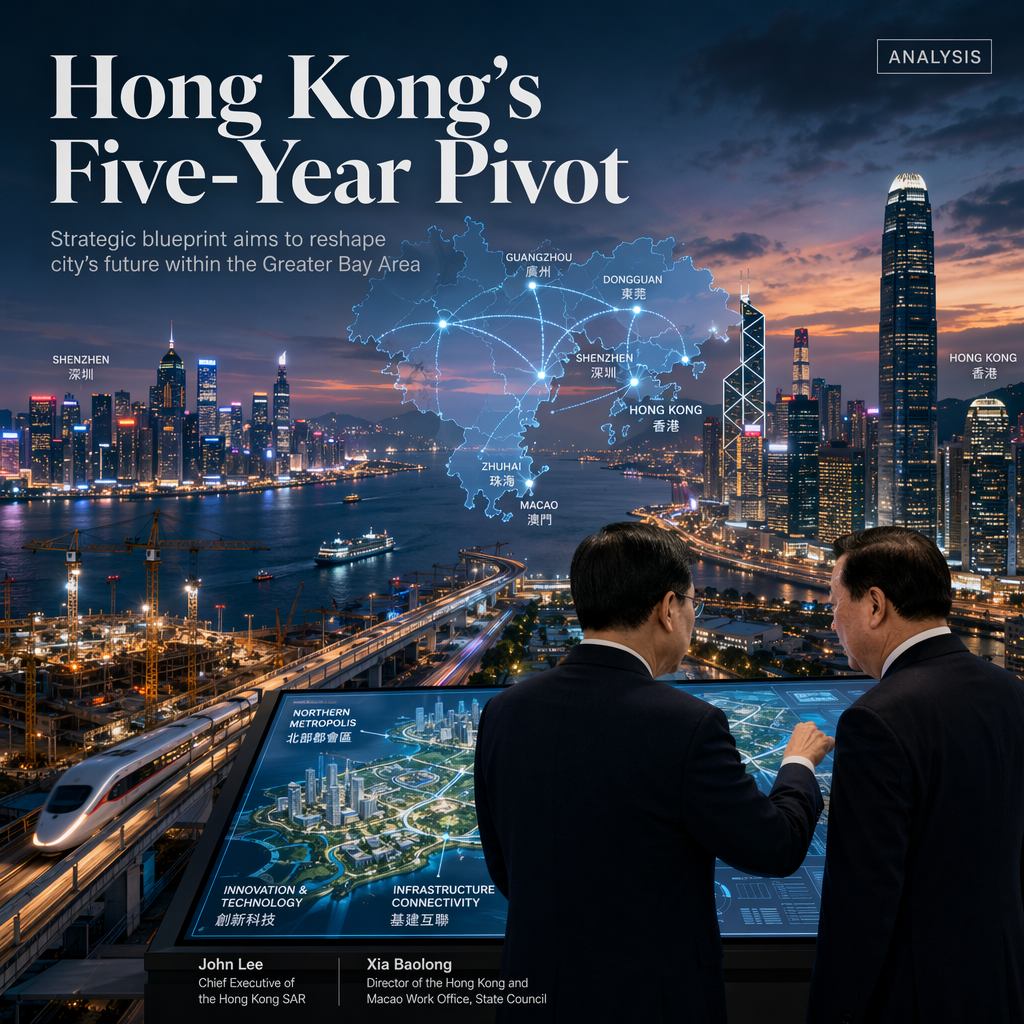
Hong Kong has initiated a two-month public consultation period for its inaugural Chinese-style five-year plan, with the aim of releasing the final blueprint in the third quarter of 2026. This move is designed to align Hong Kong's economic and urban development strategies more closely with Beijing's objectives, particularly the advancement of the Greater Bay Area, which encompasses major cities such as Shenzhen and Guangzhou [1].
The political significance of the initiative was underscored by the visit of Xia Baolong, director of the Hong Kong and Macao Work Office of the Communist Party of China Central Committee, alongside Hong Kong Chief Executive John Lee, to the Northern Metropolis development on June 16 [1]. The five-year plan represents a notable shift for Hong Kong, as it seeks deeper integration with mainland China while maintaining its unique legal and economic system [1].
The Greater Bay Area initiative is positioned as a key growth driver, aiming to enhance cross-border investment, financial collaboration, and innovation. However, some scholars and market observers have expressed concerns that closer alignment with Beijing's centrally planned approach could undermine Hong Kong's traditional free-market appeal, which has been a major draw for international investors and financial institutions [1].
No specific financial targets or projections have been disclosed at the start of the consultation period. Analysts anticipate that the plan will include major infrastructure projects, incentives for technology companies, and policies to attract global talent and capital. The results of the public consultation and the final content of the five-year plan are expected to shape Hong Kong's economic direction for the next five years [1].
CONCLUSION
Hong Kong's first five-year plan signals a strategic pivot toward deeper integration with the Greater Bay Area and Beijing's economic vision. While the initiative is seen as a potential growth driver, market participants are watching closely for details on how Hong Kong will balance integration with the mainland against preserving its free-market advantages. The outcome of the consultation and the finalized plan will be critical for the city's future economic trajectory.