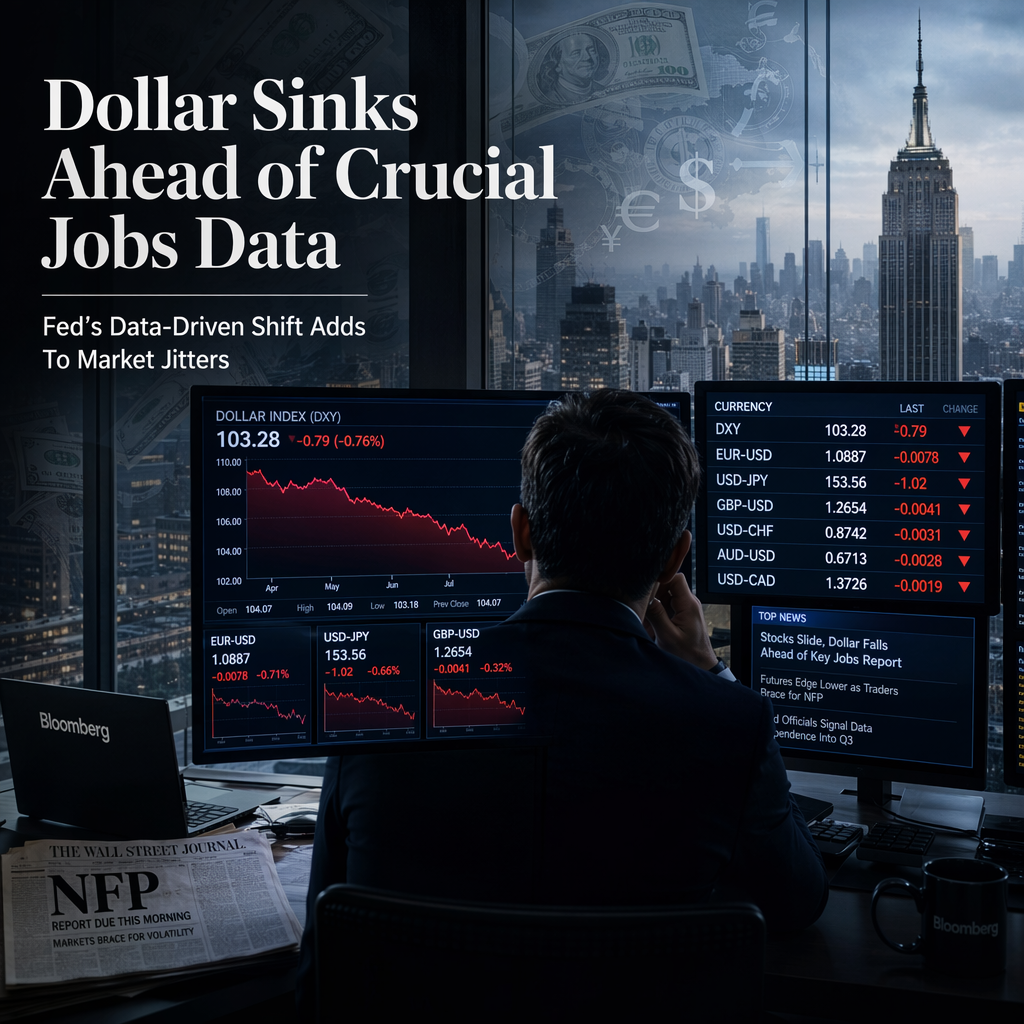
The US Dollar experienced notable volatility and overall weakness against major peers ahead of the release of the US Nonfarm Payrolls (NFP) data for June, with the Dollar Index (DXY) falling 0.4% to near 101.00 as investors awaited key labor market figures and digested recent Federal Reserve commentary [2]. The Greenback was the weakest against the Japanese Yen, declining 0.74%, and also lost ground to the Euro, Pound, and New Zealand Dollar [2][3]. The NZD/USD pair traded higher around 0.5680, up 0.16% on the day, as softer-than-expected US economic data and a less hawkish tone from Fed Chair Kevin Warsh contributed to the Dollar's underperformance [3].
Recent US data releases, including the ADP Employment Change report showing only 98K private sector jobs added in June and a weaker ISM Manufacturing PMI at 53.3, missed market expectations and tempered expectations for aggressive Fed tightening [3]. Market consensus for the official NFP was around 110K–140K new jobs, down from 172K in May, with the unemployment rate expected to remain steady at 4.3% and average hourly earnings estimated to rise 3.5% year-on-year [2][4].
Federal Reserve Chair Kevin Warsh, speaking at the ECB Forum in Sintra, reiterated the Fed's commitment to price stability but emphasized a shift away from forward guidance, stating, “Absent, also, is so-called forward guidance—which we agreed was not well suited to the current policy conjuncture” [1][2]. Warsh also noted that the Fed should not fear productivity-led growth and cautioned against raising rates during an AI-driven productivity boom, as such growth could help contain inflation even in a strong economy [1]. His remarks were perceived as less hawkish, adding to the Dollar's weakness, but ING’s Chris Turner noted that the initial sell-off after Warsh’s comments had already been retraced, with markets concluding the Fed is comfortable letting data drive expectations [4].
Looking ahead, analysts highlighted that a stronger-than-expected NFP could support the Dollar by reinforcing expectations for higher-for-longer interest rates, while a weaker report could extend the Greenback’s losses [3][4]. ING’s Turner expects the DXY to potentially return to the 101.50/80 area if NFP exceeds 100K, while also warning that soft data could prompt intervention in USD/JPY by Japanese authorities [4]. MUFG’s Michael Wan added that the Dollar is likely to stay supported in the near term pending clearer US macro data, with increased rate volatility and a potentially steeper yield curve as the Fed considers reducing its balance sheet [1].
CONCLUSION
The US Dollar is under pressure ahead of the June NFP release, driven by softer US data and a shift in Fed communication under Chair Warsh toward a more data-dependent stance. Market participants are closely watching the employment report for direction, with the potential for renewed Dollar strength if the data surprises to the upside, but further weakness if labor market figures disappoint.