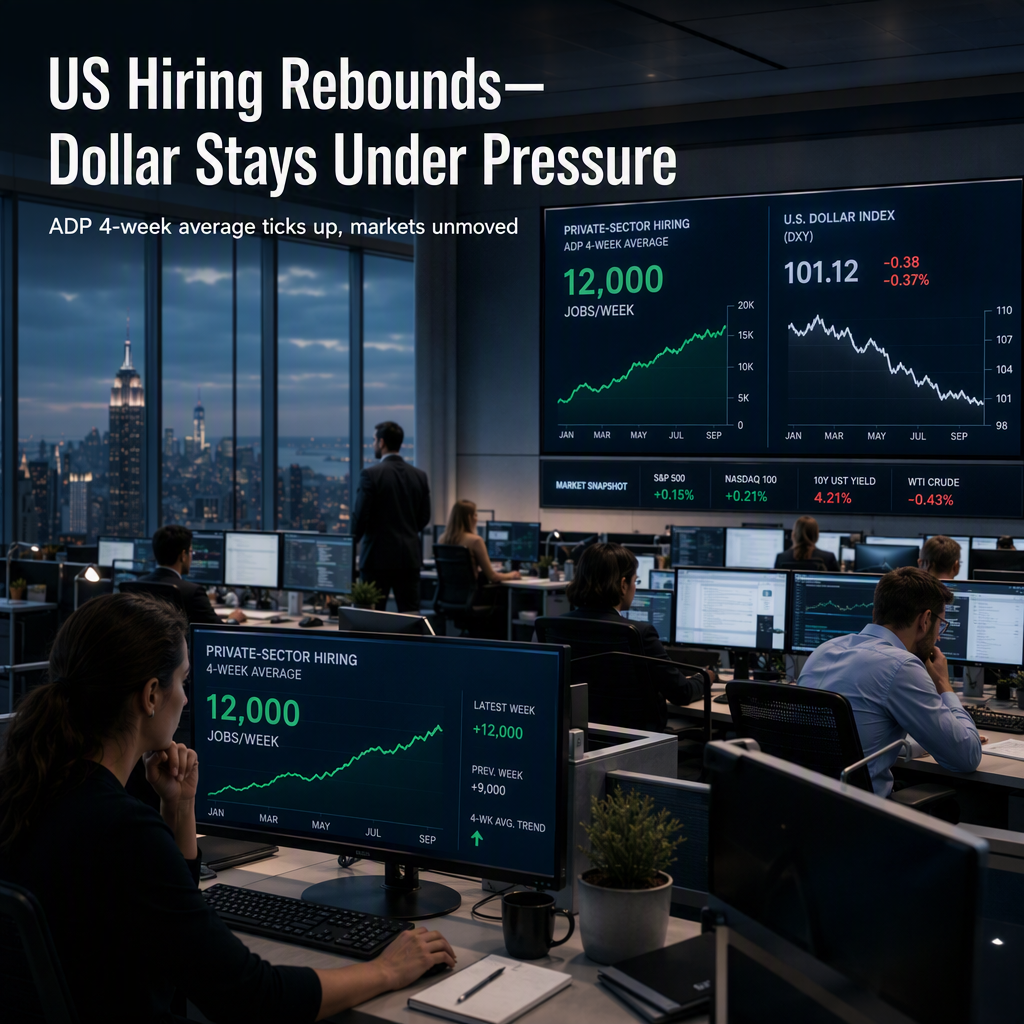
The latest data from the NER Pulse, the weekly companion to the ADP National Employment Report, indicates that US private-sector hiring has experienced a modest rebound in late August. Specifically, companies added an average of 12,000 jobs per week in the four weeks ending August 22, up from the previous four-week average of 10,000 jobs per week. This increase suggests a slight recovery in hiring activity during the period [1].
Despite the uptick in employment, the market reaction has been muted. The US Dollar Index (DXY) remains under pressure, trading near four-month lows around 98.60 and continuing its recent losses. This indicates that the modest improvement in hiring has not been sufficient to boost confidence in the US dollar [1].
The article also highlights the broader significance of employment data for currency valuation and monetary policy. Labor market conditions are a key indicator of economic health and influence central bank decisions, particularly for the US Federal Reserve, which has a dual mandate to promote maximum employment and stable prices. Wage growth, as a component of employment data, is closely monitored by policymakers due to its impact on inflation [1].
No forward-looking statements or analyst opinions are provided in the article.
CONCLUSION
US private-sector hiring showed a modest improvement, with the ADP 4-week average rising to 12,000 jobs per week. However, the US dollar remained weak, suggesting limited market optimism in response to the data. The employment figures are being closely watched for their implications on economic health and monetary policy.