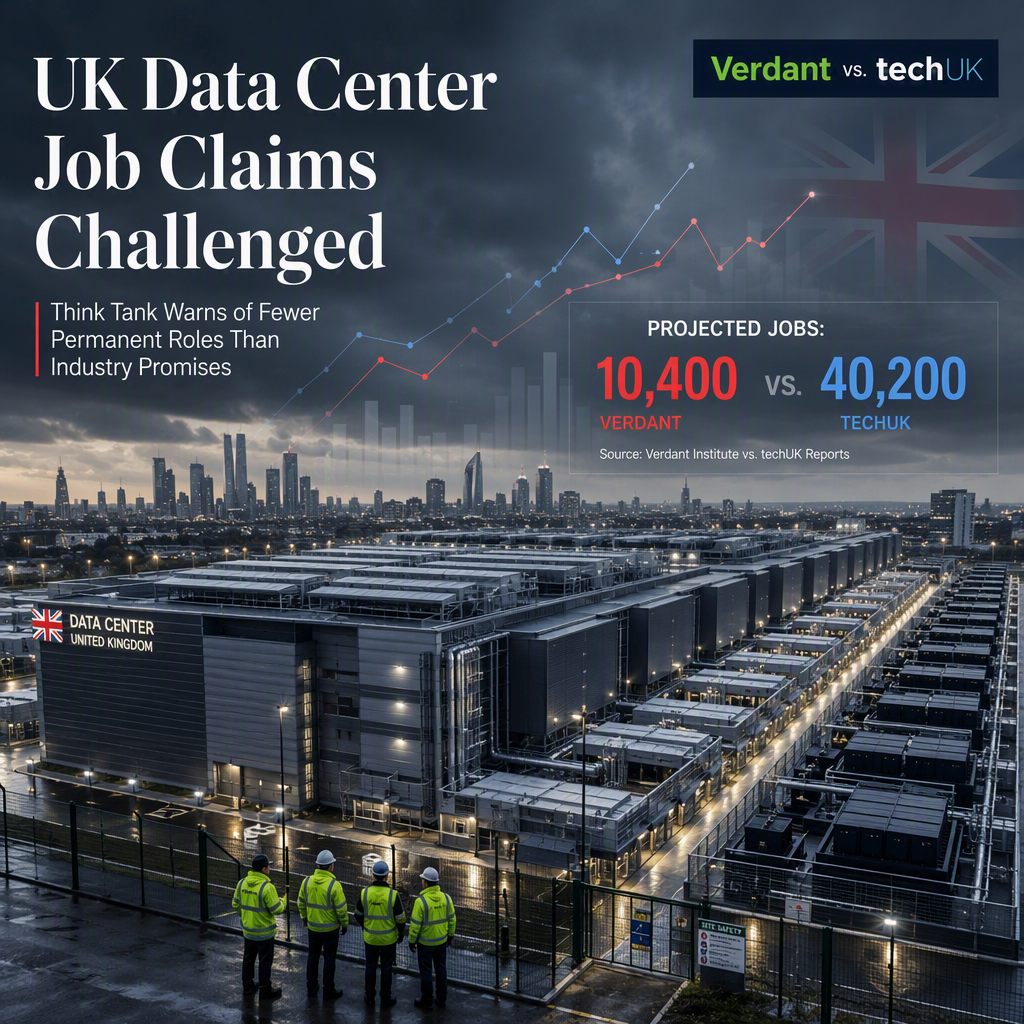
A new report from economic think tank Verdant challenges industry projections regarding job creation from the expansion of AI data centers in the UK, warning that the actual number of permanent roles may be significantly lower than previously suggested by tech sector advocates [1]. Verdant estimates that existing UK data centers support about 4,400 direct jobs, in stark contrast to techUK's figure of 24,300. Looking ahead, Verdant projects that planned developments will create approximately 10,400 permanent operational jobs by 2035, which is only about a quarter of techUK's forecast of 40,200 roles [1].
The discrepancy arises from differing methodologies: techUK's estimate is based on an assumed staffing level of 8.5 jobs per megawatt, a figure Verdant claims is inflated due to reliance on data from older, smaller data centers that require more staff. Verdant's analysis, which examined 20 planned UK data centers using planning applications and public staffing figures, suggests a capacity-weighted average closer to 1.2 operational jobs per megawatt [1]. The think tank also notes that newer, larger sites will be more automated and thus require fewer permanent workers. Additionally, Verdant argues that data centers create fewer jobs per unit of electricity than other major UK installations such as steelworks, car plants, hospitals, or schools [1].
In response, techUK defended its estimates, stating that they were built transparently from the best available industry data and standard economic impact assessment techniques. TechUK criticized Verdant's report for using a small sample size and for focusing solely on direct employment within data centers, ignoring the broader economic impact and jobs supported by data center operations and services [1].
A UK government spokesperson also disputed Verdant's findings, calling the report's jobs-per-megawatt metric misleading and its comparisons with hospitals and schools inappropriate. The spokesperson further argued that the report confuses electricity capacity with actual consumption and discounts the wider economic value, national security, and sovereignty benefits provided by increased compute capacity [1].
CONCLUSION
The debate over job creation from AI data centers in the UK highlights significant differences in methodology and interpretation between industry groups and independent analysts. While Verdant projects far fewer permanent roles than techUK, both sides agree on the sector's broader economic importance. The market should monitor further developments and clarifications as the UK continues its data center expansion.