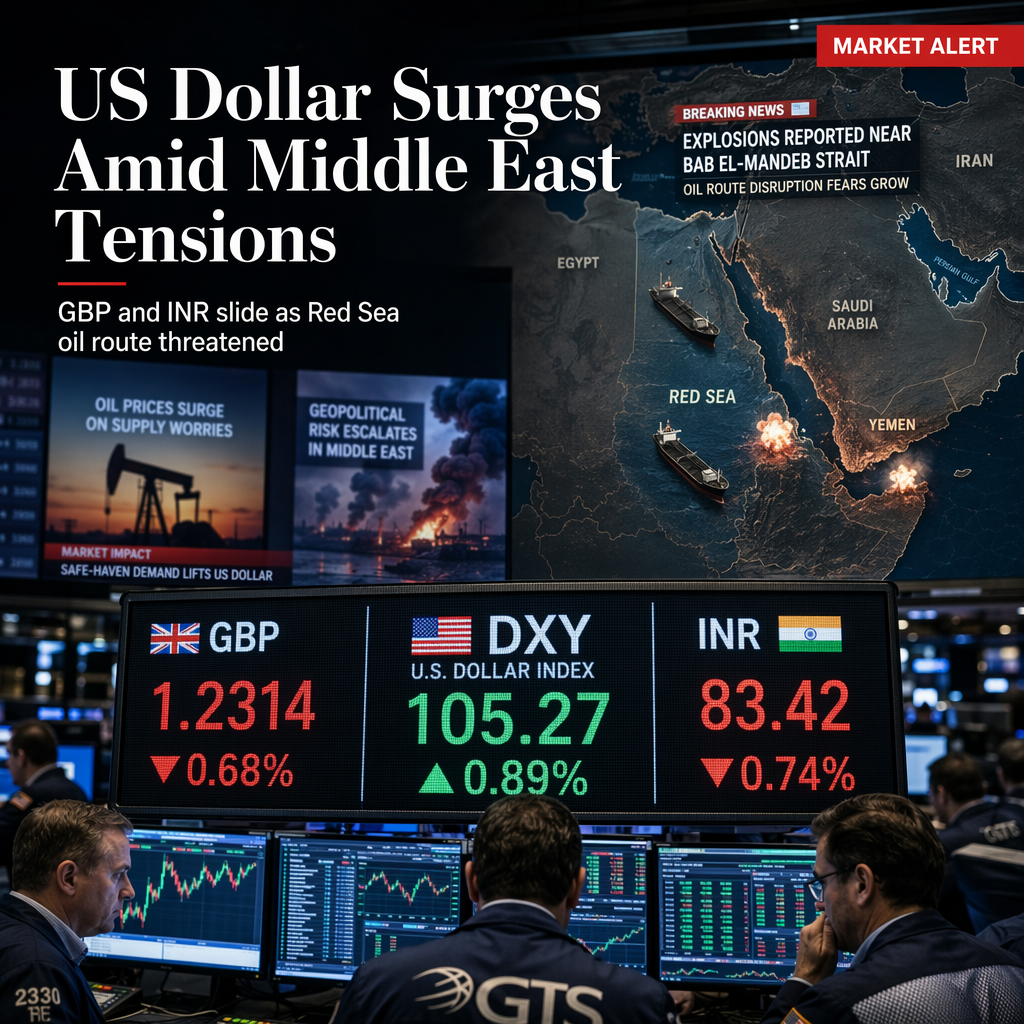
The US Dollar strengthened against both the British Pound and the Indian Rupee amid rising risk aversion triggered by escalating geopolitical tensions in the Middle East. Specifically, Iran has reportedly instructed Yemen’s Houthi militia to prepare to block the critical Red Sea oil route if the United States attacks Iranian power infrastructure, according to Reuters. This threat has heightened global energy supply anxieties, with explosions reported in Bandar Abbas, Qeshm, and Ahvaz, and blasts heard as far as Kuwait and Basra [1][2].
In currency markets, GBP/USD extended its losses for a second consecutive day, trading around 1.3460 during Asian hours on Friday. The Pound's underperformance was attributed to the US Dollar's safe-haven appeal amid the geopolitical turmoil. However, the Greenback's gains were tempered by softer US economic data, including lower-than-expected June consumer inflation and a surprise decline in producer prices, even as initial jobless claims fell to a two-month low. As a result, traders have largely ruled out a Federal Reserve rate hike this month, with market participants divided on the likelihood of a policy move in September [1].
Similarly, the Indian Rupee opened marginally higher against the US Dollar, with USD/INR ticking down to near 96.30, following likely intervention by the Reserve Bank of India (RBI) to limit the Rupee's fall. The RBI has reportedly been intervening almost daily in both spot and non-deliverable forward markets, though the scale has been measured given the pressure on the currency. Despite this support, the Rupee's recovery may be short-lived due to concerns over further global energy supply disruptions. The MCX Crude Oil contract expiring July 20 rose 1.16% to near Rs. 7,700, close to its monthly high, reflecting these supply fears. Currencies from oil-importing economies like India tend to underperform when oil prices are high [2].
Market sentiment remains cautious, with the US Dollar Index (DXY) up 0.1% to near 100.80 at press time, reflecting increased demand for safe-haven assets. However, the Greenback is expected to end the week lower as traders have reduced their expectations for a near-term Fed rate hike, with the CME FedWatch tool showing odds for a July hike dropping to 10.2% from 24.6% a week ago [2]. In the UK, Bank of England Governor Andrew Bailey acknowledged the geopolitical risks but stated that they have not yet materially affected the UK inflation outlook. Money markets are still fully pricing in a BoE rate hike by November, with a second hike projected by April 2027 [1].
Analysts note that efforts by likely incoming UK Prime Minister Andy Burnham to emphasize continuity and include figures from the right of the Labour party have been positively received by financial markets. Meanwhile, technical analysis suggests USD/INR remains on track to revisit its all-time high around 97.10, maintaining a bullish near-term bias [1][2].
CONCLUSION
Escalating US-Iran tensions and the threat to the Red Sea oil route have driven safe-haven flows into the US Dollar, weakening both the British Pound and Indian Rupee. While central banks in the UK and India are responding to market pressures, the outlook remains uncertain amid ongoing geopolitical risks and shifting expectations for US monetary policy.