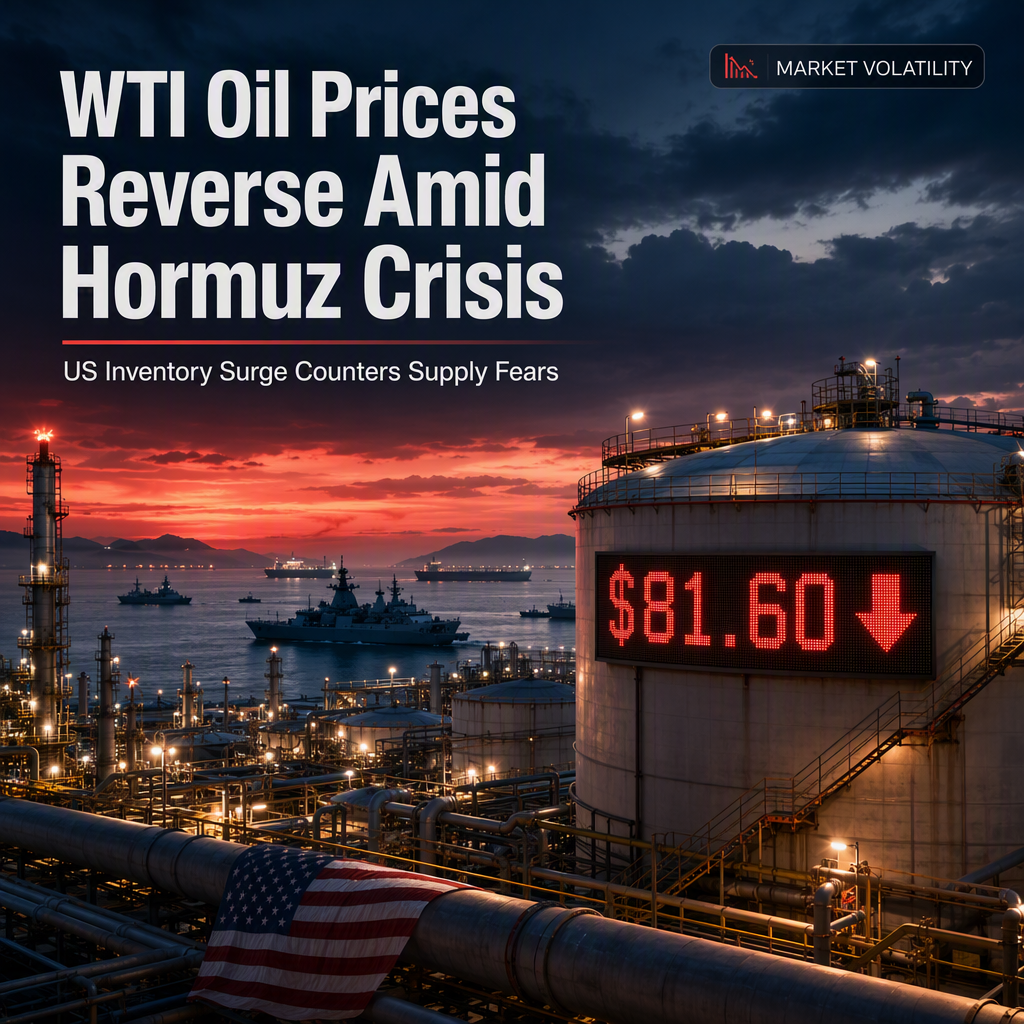
West Texas Intermediate (WTI) oil prices reversed lower on Wednesday, trading around $81.60, down 0.77% on the day, as a sharp increase in US crude inventories offset mounting concerns about global supply disruptions linked to the ongoing tensions in the Strait of Hormuz [1]. Brent and WTI had previously firmed, with Brent closing at $88.91 and WTI at $83.20, as markets reassessed the prospects for a deal to reopen the Strait [2].
The geopolitical situation remains tense, with Iran insisting that the Strait of Hormuz will remain closed until its conditions are met, including an end to the US war and blockade, the release of frozen Iranian assets, and a regional ceasefire [1][2]. US President Donald Trump stated that the situation with Iran is “going fine” and claimed US forces are in “total control” of the Strait, but Tehran maintains its demands [1]. Recent incidents have heightened risks, including US forces disabling a Panama-flagged cargo ship attempting to reach an Iranian port by firing two Hellfire missiles at its steering gear, and a US Navy helicopter firing on a cargo vessel trying to breach the US blockade [1][2]. Additional incidents involving commercial vessels were reported in the Gulf of Oman and off Yemen's Red Sea coast [2].
Diplomatic efforts are ongoing, with Pakistan’s Interior Minister Mohsin Naqvi traveling to Tehran for talks, and Pakistan referencing a 14-point memorandum of understanding with Qatar as a potential peace template, though this agreement unraveled shortly after signing [1]. Despite some suggestions from Pakistan that Washington and Tehran were “close to some sort of arrangement,” Commerzbank analysts note that negotiations are progressing but a deal restoring normal shipping through the Strait does not appear imminent [2].
The International Energy Agency (IEA) forecasts global oil supply to decline by 4.3 million barrels per day (bpd) this year to 102.02 million bpd, a larger contraction than the 3.7 million bpd decline projected in July, due to supply losses from the Middle East and Russia and continued shipping restrictions [1]. Global oil inventories fell by 2.2 million bpd last month, dropping total stocks below 7.9 billion barrels for the first time since April 2025, and the IEA expects a global oil market deficit of 1.8 million bpd in the third quarter, more than double its July estimate [1]. However, the IEA also forecasts global oil demand to decline by 1.6 million bpd this year, about 47% more than projected in July, as higher fuel prices and supply constraints weigh on consumption [1].
Market implications include the potential for renewed upward pressure on US inflation due to tight energy markets and the rebound in oil prices, despite lower energy prices in July providing some temporary relief [2]. European diesel prices have surged amid disruptions to refining capacity, further reinforcing concerns over already-tight energy markets [2].
CONCLUSION
Oil markets remain highly volatile as a surge in US crude inventories temporarily outweighs escalating supply risks from the Strait of Hormuz. While diplomatic efforts continue, no imminent resolution is in sight, and both supply and demand forecasts point to ongoing market tightness. The situation is likely to keep energy prices and inflation pressures elevated in the near term.