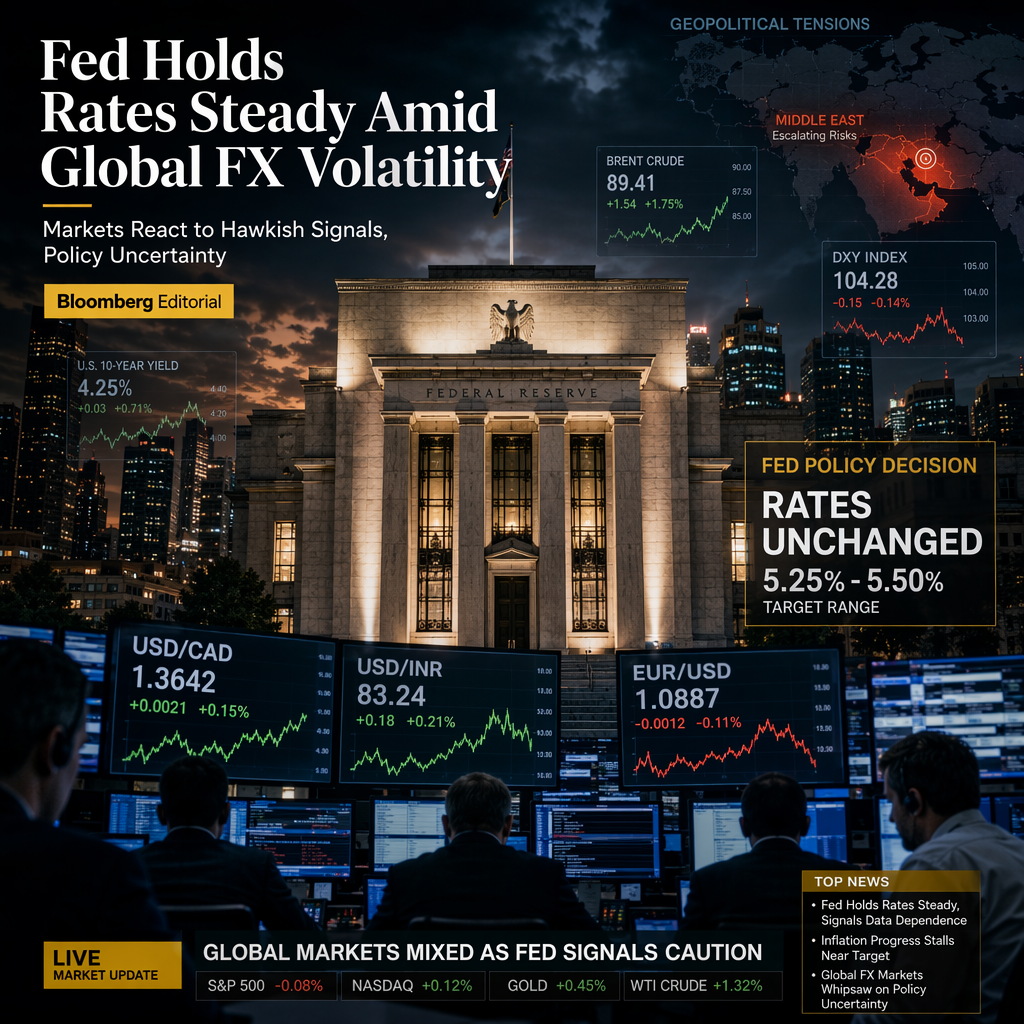
The US Federal Reserve (Fed) maintained its Federal Funds Rate in the 3.50%–3.75% target range at its July policy meeting, marking the fifth consecutive hold, as widely anticipated by markets [1][2][3][4]. However, the decision revealed a hawkish divide within the central bank, with Dallas Fed President Lorie Logan, Cleveland’s Beth Hammack, and Minneapolis Fed President Neel Kashkari dissenting in favor of a 25 basis point rate hike [1][4]. Fed Chairman Kevin Warsh emphasized the committee's readiness to act swiftly if inflation pressures accelerate, stating, 'only one target and it is 2%,' and that the committee 'will not hesitate to act' to achieve price stability [1][3][4].
The Fed's hawkish tone and commitment to its 2% inflation target have influenced global currency markets. The US Dollar (USD) strengthened against the Canadian Dollar (CAD), with USD/CAD trading near 1.4050 and maintaining a constructive outlook above the 100-day simple moving average [1]. Technical resistance is noted at 1.4110 and 1.4225, with support at 1.4000 and 1.3900 [1]. Strategists at Scotiabank caution that unresolved trade tensions and the threat of 50% tariffs next month could limit CAD gains, as Canada considers possible retaliation if no agreement is reached [1].
In Asia, the Indian Rupee (INR) edged higher against the USD, with USD/INR near 95.60, despite surging US Treasury yields, which rose 1.8% to 4.71%, the highest in 18 months [3]. The US Dollar Index (DXY) was up 0.12% to 100.93 at press time [3]. MUFG Bank analysts noted that markets expect the Fed to eventually 'walk the talk' on inflation, suggesting further rate hikes may be needed [3]. Meanwhile, the Indonesian Rupiah (IDR) found support from Bank Indonesia's intensified market stabilization efforts following the unexpected departure of Governor Perry Warjiyo, including direct FX intervention and the issuance of rupiah-denominated securities [4].
Geopolitical tensions in the Middle East, including renewed military escalation and attacks involving the US and Iran, have added to market volatility and impacted oil prices [1][3][4]. While higher oil prices typically support the CAD, they pose risks for oil-importing economies like India, where the INR tends to underperform in such environments [1][3].
Across other major currencies, the Euro (EUR) traded marginally lower near 1.1455 against the USD, with investors awaiting German and Eurozone Q2 GDP data and the German HICP inflation print, expected at 2.8% YoY versus 2.4% previously [2]. The British Pound (GBP) drifted lower against the Japanese Yen (JPY), with GBP/JPY above 218.00, as markets awaited policy decisions from the Bank of England (BoE) and Bank of Japan (BoJ). The BoE is expected to keep rates at 3.75%, with inflation at 2.6% in June, still above target [5].
Analyst opinions highlight ongoing uncertainty. Scotiabank strategists warn that the CAD may struggle due to trade tensions and potential tariffs [1]. MUFG Bank suggests the Fed's rhetoric alone may not be sufficient, and markets anticipate further action on inflation [3]. Bank Indonesia's proactive measures are seen as supportive for the IDR, but the Fed's hawkish stance and geopolitical risks continue to drive global FX volatility [4].
CONCLUSION
The Fed's decision to hold rates steady, coupled with a hawkish tone and internal dissent, has reinforced expectations of potential future tightening. Global currency markets remain volatile, influenced by central bank policy signals, trade tensions, and geopolitical risks. Market participants are closely watching upcoming economic data and central bank meetings for further direction.