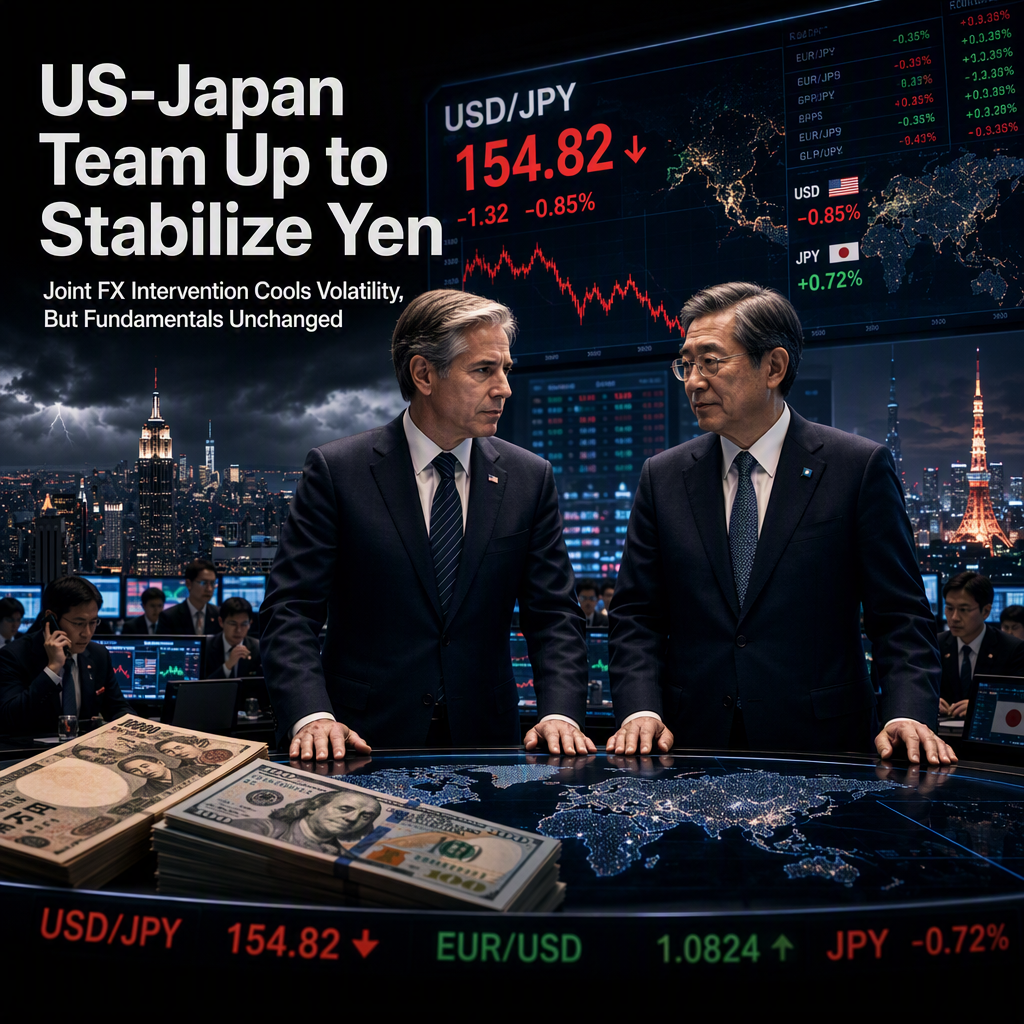
A rare coordinated foreign exchange intervention was conducted by the United States and Japan, with both countries jointly buying Japanese Yen to counter excessive volatility and disorderly moves in the USD/JPY currency pair. Japan's Ministry of Finance confirmed the joint action, which followed a solo intervention by Japan the previous day. According to Bank of Japan money market data cited by Reuters, Japan may have spent approximately $58.97 billion on the initial intervention and an additional $36.58 billion during the joint operation with the US [2].
The intervention led to a sharp decline in USD/JPY, with the pair hitting an intraday low of 155.23, its lowest since May 6, before stabilizing around 156.80, down 0.35% on the day [2]. Despite the intervention, analysts from ING and Rabobank argue that the move is primarily a containment exercise rather than a shift in underlying market fundamentals. ING's Chris Turner notes that the intervention is unlikely to drive USD/JPY sustainably below 155, as the fundamental backdrop of a near-hiking Federal Reserve and Japan's loose monetary and fiscal policies remains unchanged [3]. Rabobank analysts also highlight that while JPY net shorts had reached their highest levels since 2024 prior to the intervention, it is too early to determine if Japan's fundamentals have improved enough for the Yen to hold stronger levels against the Dollar in the medium term [2].
Market sentiment towards the US Dollar has weakened following the July FOMC meeting, where Fed Chairman Kevin Warsh focused on institutional reforms and scaling back forward guidance instead of signaling further rate hikes. This unsettled investors who had built long USD positions, leading to a steepening of the US Treasury yield curve and fading confidence in US monetary policy [1][2]. The US Dollar Index (DXY) rebounded slightly to 99.83 after hitting its lowest level since June 15 at 99.42, indicating some stabilization but ongoing vulnerability [2].
Both Japanese Finance Minister Satsuki Katayama and US Treasury Secretary Scott Bessent have warned that further joint interventions are possible if needed [2]. ING highlights that Japan utilized the Fed's FIMA repo facility to raise dollars against Treasuries for the intervention, allowing it to avoid outright sales of Treasuries [3]. Looking ahead, analysts suggest that while the intervention may cap USD/JPY moves toward 160 and buy time for Tokyo to introduce more yen-positive policies, it does not address the core drivers of Yen weakness, such as Japan's loose financial conditions and low interest rates [2][3].
CONCLUSION
The coordinated US-Japan intervention has temporarily stabilized the Yen and capped USD/JPY's upward momentum, but analysts agree that the move does not alter the fundamental drivers of currency weakness. Market participants remain cautious, with the potential for further interventions if volatility persists, but the underlying policy divergence between the US and Japan continues to weigh on the Yen.