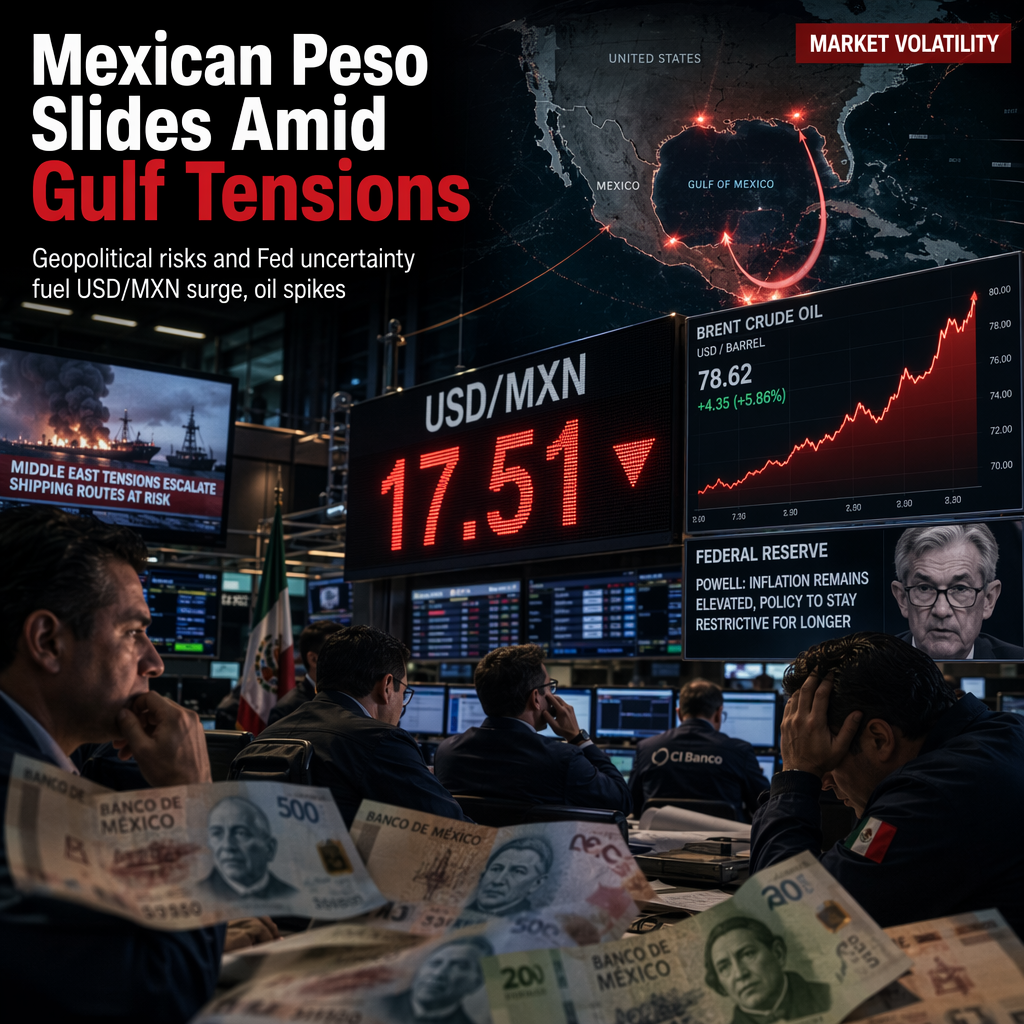
The Mexican Peso weakened against the US Dollar on Wednesday, with the USD/MXN pair rising 0.47% to trade at 17.51, as risk sentiment deteriorated following an escalation in the Gulf War. This shift in mood was triggered by Iran launching attacks on US assets within the Gulf States, prompting a response from the White House. US President Donald Trump stated that talks with Iran would continue but warned, 'we’ll be hitting Iran hard' [1].
The geopolitical tensions pushed oil prices sharply higher, with West Texas Intermediate (WTI) crude rising nearly 7% to $84.62. Crude prices are now almost 20% above June’s closing price, complicating the Federal Reserve’s efforts to achieve consecutive positive inflation readings [1].
Market participants are closely watching the Federal Reserve’s upcoming monetary policy decision. The Fed is widely expected to keep rates unchanged, given softer June inflation data and a resilient labor market. However, the surge in oil prices has increased the probability of a rate hike, with money markets now pricing in a 41% chance of a 25-basis-point increase, up from a 59% probability for a hold, according to Prime Terminal data. Analysts at Wells Fargo suggest that Fed Chair Kevin Warsh could influence the board to delay hikes but may signal a possible rate increase for the September meeting during the press conference [1].
In Mexico, the economic calendar was light, and ongoing USMCA negotiations failed to provide clarity for President Claudia Sheinbaum’s administration. President Trump downplayed the importance of the agreement, stating, 'Mexico and Canada need us. We don't need them. The deal is important for them. It's not important for us.' Fitch Ratings maintains Mexico’s investment-grade rating at 'BBB/stable outlook,' but warns that a rising debt burden or economic crisis could alter this perspective [1].
Technically, USD/MXN remains supported above key moving averages and trend lines, maintaining a constructive near-term outlook [1].
CONCLUSION
The Mexican Peso's decline reflects heightened geopolitical risks and uncertainty around US monetary policy. With oil prices surging and the Fed's next move unclear, market volatility is likely to persist. Mexico's investment-grade rating remains stable, but future risks could impact the outlook.