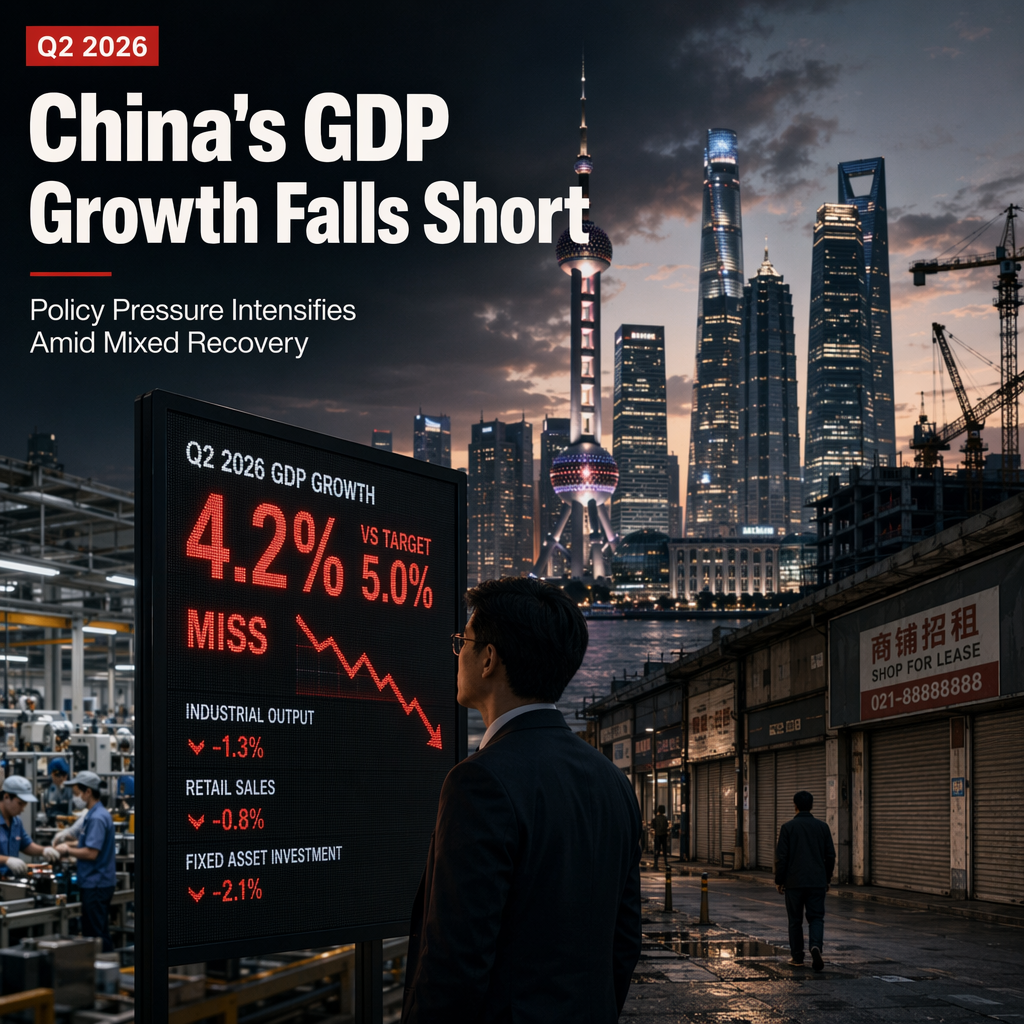
China's Q2 2026 GDP growth slowed to 4.3% year-on-year, marking the weakest reading in more than three years and falling below both the official 4.5%-5% target range and the consensus forecast of 4.5% [1]. This represents a sharp step down from the 5.0% expansion recorded in Q1 2026 [1]. Fixed-asset investment contracted 5.7% in the first half of the year, deepening from prior months and highlighting persistent weakness in domestic consumption and investment [1]. Despite these challenges, June industrial output and retail sales surprised on the upside, offering partial relief and reinforcing a K-shaped growth dynamic where export-oriented and technology-linked manufacturing outperformed, while other sectors lagged [1].
The GDP deflator turned positive for the first time in three years, rising 1.6% in Q2, attributed to higher oil prices ending a prolonged streak of economy-wide deflation [1]. With H1 GDP at 4.7% year-to-date, policymakers face mounting pressure to accelerate support in the second half to avoid missing the annual growth target [1]. The People's Bank of China (PBoC) has recently pledged to keep monetary policy moderately loose, enhance counter-cyclical adjustments, and strengthen support for domestic demand and technological innovation [1].
Analyst Dr. Henry Hao from Commerzbank emphasized that the current growth figures shift focus toward policy action, as the pace of activity has not collapsed outright but remains insufficient to meet targets [1]. The market implication is clear: with GDP now below the official target floor, expectations for further policy stimulus and support are rising [1].
CONCLUSION
China's Q2 2026 GDP growth fell short of official targets, intensifying pressure on policymakers to implement additional support measures. While certain sectors showed resilience, overall economic momentum remains subdued, raising expectations for further monetary and fiscal stimulus in the second half of the year.