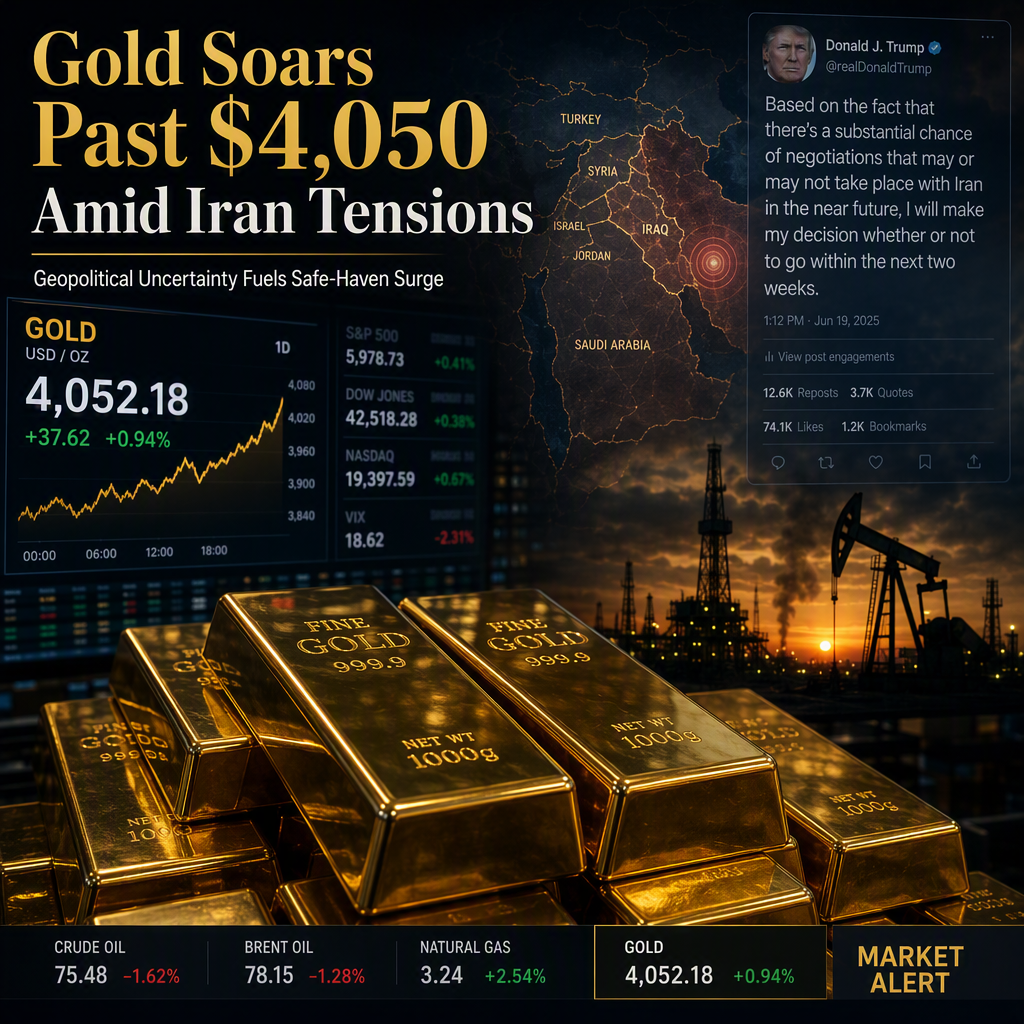
Gold prices (XAU/USD) climbed to around $4,060 during the early Asian session on Monday, recovering above the $4,050 mark as US President Donald Trump paused planned military strikes against Iran. The decision was reportedly made in anticipation of a potential breakthrough on Iran's nuclear program and the reopening of the Strait of Hormuz, according to Bloomberg. Trump stated on his Truth Social platform that the pause was in response to requests from Tehran and other regional countries, although Iranian officials disputed this claim, labeling it 'nothing but a new lie' and asserting that their armed forces remain 'on high alert and ready for any eventuality' [1].
The ongoing tensions in the Middle East are influencing both gold and oil markets. Commerzbank’s FX Research team highlighted that the renewed escalation has reversed the recent sharp decline in oil prices, reigniting inflation concerns. This combination of a Brent oil rebound, persistent inflation risks, and the US Federal Reserve's focus on price stability is encouraging investors to re-engage with gold as a hedge against inflation and market volatility, especially given higher long-end US yields [1].
Last week, the US Federal Reserve left interest rates unchanged in the target range of 3.50% to 3.75%. Fed Chair Kevin Warsh reiterated the central bank's commitment to reducing inflation. Gold, often used as a hedge against inflation, becomes less attractive when interest rates are high since it does not yield interest. However, the current geopolitical uncertainty and inflation worries are supporting gold demand despite elevated rates [1].
Traders are closely monitoring US-Iran developments, as any positive progress could further support gold prices. Nevertheless, the uncertainty surrounding the situation and the potential for further escalation in the Middle East may cap gold's upside, as rising crude oil prices could prompt central banks to maintain higher rates for longer [1].
CONCLUSION
Gold has rebounded above $4,050 following President Trump's decision to pause military action against Iran, with ongoing geopolitical tensions and inflation concerns driving investor interest. The interplay between oil prices, inflation risks, and central bank policy is likely to keep gold in focus as a safe-haven asset. Market participants remain vigilant for further developments in US-Iran relations, which could significantly impact gold and broader financial markets.