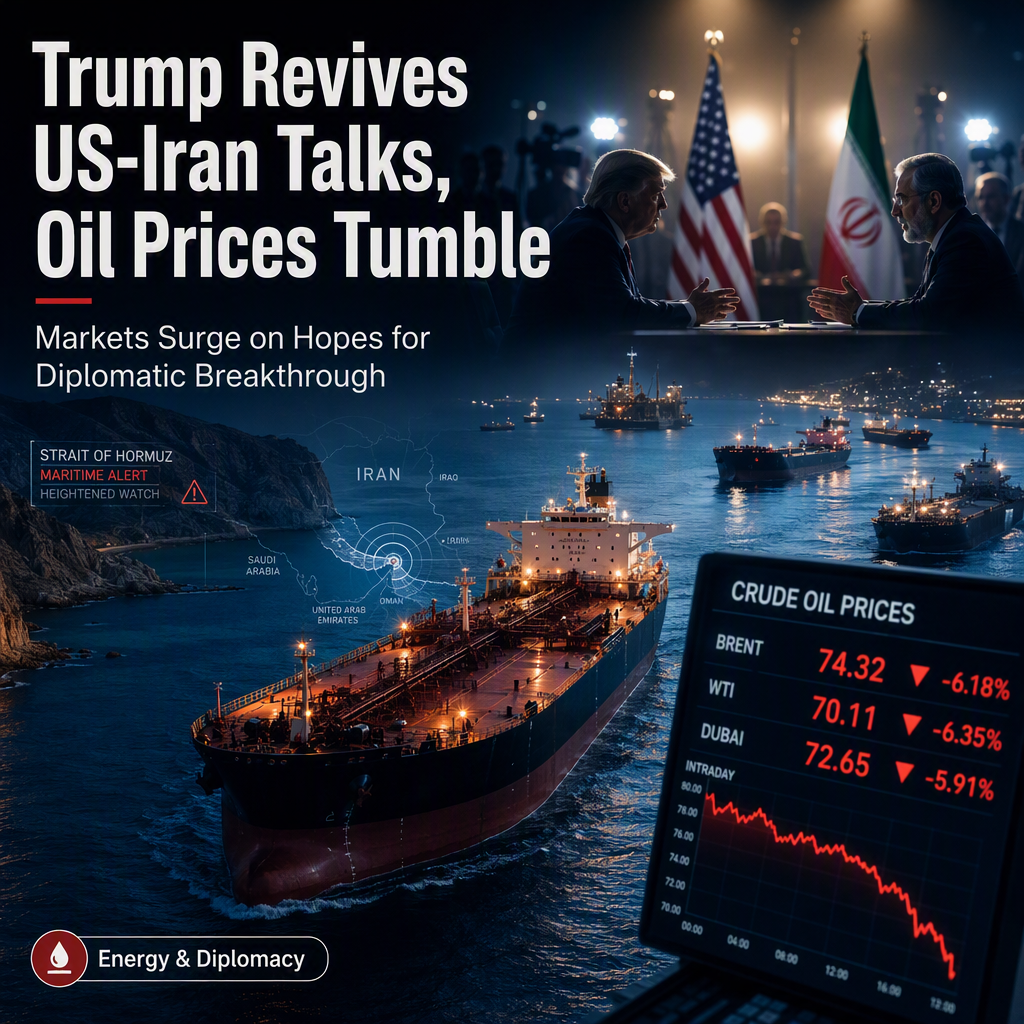
U.S. President Donald Trump announced that negotiations between the United States and Iran are set to resume on Monday, following his decision to call off planned military strikes against Iran. Trump stated that the strikes were halted at the request of Saudi Arabia, the United Arab Emirates, Qatar, and Iran, and described a potential deal covering the Hormuz Strait and Iran's denuclearization as 'imminent' [1]. He also noted that the planned operation would have been the largest since World War II, emphasizing the seriousness of the situation and the significance of the diplomatic turn [1].
The announcement of renewed talks has had an immediate impact on energy markets. Brent crude prices fell 4.6% to around $83.96 per barrel, while U.S. crude dropped about 4.7% to $80.6, reflecting market optimism for a diplomatic resolution to the conflict that has disrupted global energy supplies [1]. The Strait of Hormuz, which previously handled about one-fifth of global oil supply before the war, has seen a significant reduction in traffic, with only sporadic increases in ship transits on positive diplomatic headlines [1].
Despite the diplomatic progress, shipping risks remain. The United Kingdom Maritime Trade Operations reported an incident involving a tanker near the mouth of the Hormuz Strait, where an explosion occurred close to the vessel, though the crew remained safe and authorities are investigating the event [1]. The UKMTO has advised ships to transit the area with caution [1].
According to a regional official involved in mediation efforts, the latest proposal includes reopening the Hormuz Strait, halting attacks across the region—including those by Iranian-backed militias in Iraq on Arab Gulf countries and Jordan—and the U.S. ending its naval blockade on Iran to allow Tehran to export oil. However, no final deal has been reached, and mediation efforts are ongoing [1]. Parallel diplomatic efforts with Oman are also advancing, with Iranian diplomats indicating that Tehran is close to a new arrangement with Oman to manage shipping through the Strait of Hormuz, a move seen as critical to preventing further escalation [1].
Kuwait reported that Iranian forces launched a wave of drones within its airspace, targeting critical infrastructure in the country's north, but its military destroyed multiple aircraft [1].
CONCLUSION
President Trump's decision to resume negotiations with Iran has eased immediate market fears, leading to a sharp drop in oil prices. While diplomatic efforts are advancing and market sentiment has improved, persistent shipping risks and ongoing mediation mean the situation remains fluid and unresolved.