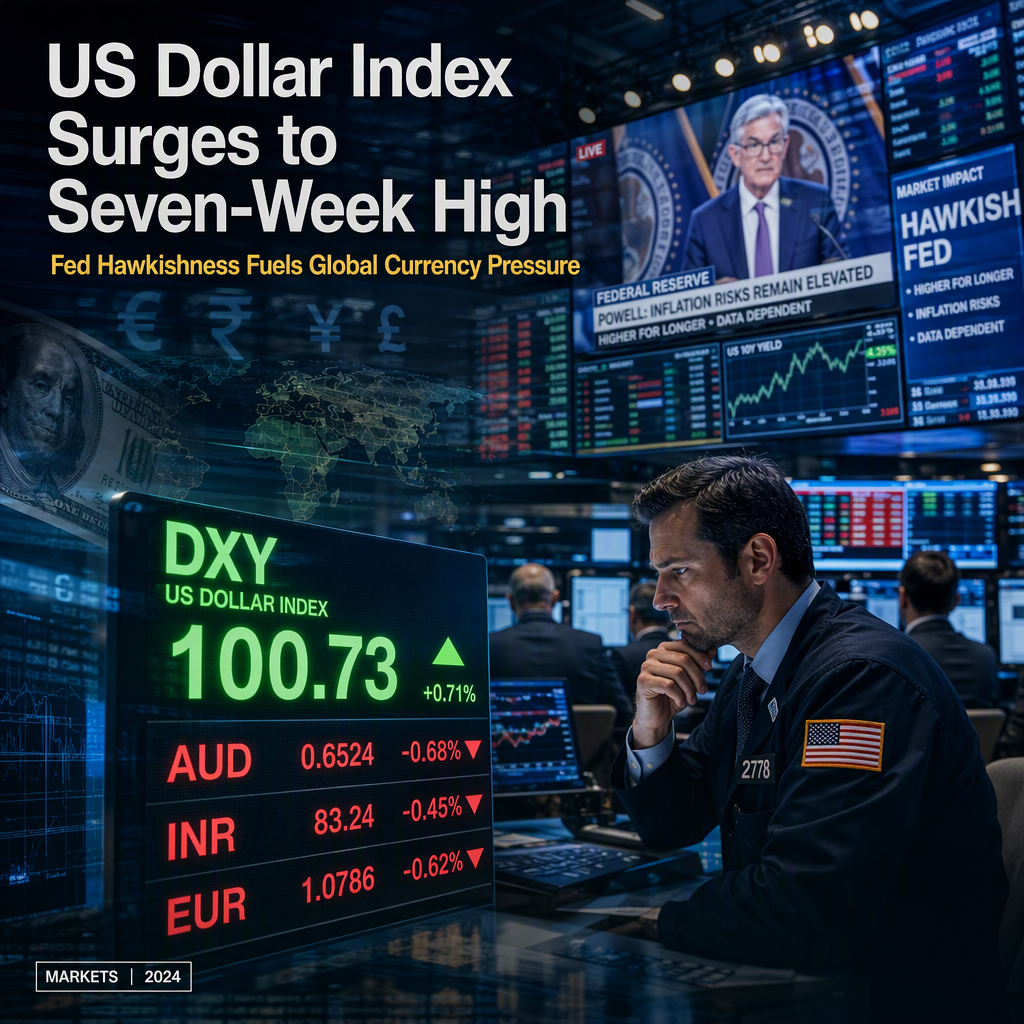
The US Dollar Index (DXY), which measures the value of the US Dollar against six major currencies, has gained for the third consecutive day, trading around 100.70 during Asian hours and reaching 100.73 in early European trade, marking its highest level in over seven weeks [1][2][3]. This surge is attributed to a hawkish policy outlook from the Federal Reserve (Fed), following a recent 25 basis point rate hike that brought the benchmark interest rate target to the 3.75%–4.00% range [1]. Fed policymakers have signaled that another rate hike remains possible before the end of the year, with the CME FedWatch Tool indicating an almost 89.2% probability of a December rate increase [1][3].
Hawkish commentary from Fed officials, including Chicago Fed President Austan Goolsbee and St. Louis Fed President Alberto Musalem, has reinforced expectations for persistent inflation risks and further tightening. Goolsbee warned that supply shocks and strong spending, including AI-related investment, could keep inflation persistent, cautioning that the path back to 2% inflation may not be painless [2][3]. Musalem advocated for front-loaded gradual tightening, emphasizing that policy remains accommodative and suggesting the possibility of two additional hikes this year, although he is a non-voting member [2]. Richmond Fed Bank President Thomas Barkin also stated that more rate hikes may be required to tame inflation, but did not specify how many [1][3].
The US Dollar's strength has pressured other currencies, with the Australian Dollar (AUD) down 0.15% to around 0.7100 against the USD, and the Indian Rupee (INR) trading slightly lower, with the USD/INR pair marginally up to near 95.62 [2][3]. The US Dollar was the strongest against the New Zealand Dollar, up 0.43%, and gained 0.21% against both the Euro and the Australian Dollar [2].
Market analysts at ING and MUFG highlight that hawkish Fed commentary is the clearest driver of Dollar strength, supporting US front-end rates [2][3]. TD Securities projects that headline CPI may be lifted by an almost 8% jump in gasoline and firmer food prices, while core CPI is expected to slow, with services inflation mean-reverting and supercore easing after August’s surge [1]. The FXS Fed Sentiment Index fell by 2.11 points to 148.39, indicating a mild pullback in perceived hawkishness, but the overall stance remains firmly above the neutral threshold, suggesting markets should still treat the Fed as solidly hawkish [1].
Lower oil prices, with the MCX Crude Oil contract down 1.43% to near Rs. 8,520, are seen as positive for oil-importing economies like India, potentially offsetting some currency pressure [3]. However, the dominant narrative remains the Fed's hawkish stance and its impact on global currency markets.
CONCLUSION
The US Dollar Index's climb to a seven-week high reflects strong market confidence in continued Fed tightening, driven by persistent inflation concerns and hawkish commentary from Fed officials. This has led to broad-based Dollar strength and pressure on major currencies such as the AUD and INR. With another rate hike likely priced in, global markets remain sensitive to upcoming US economic data and further Fed signals.