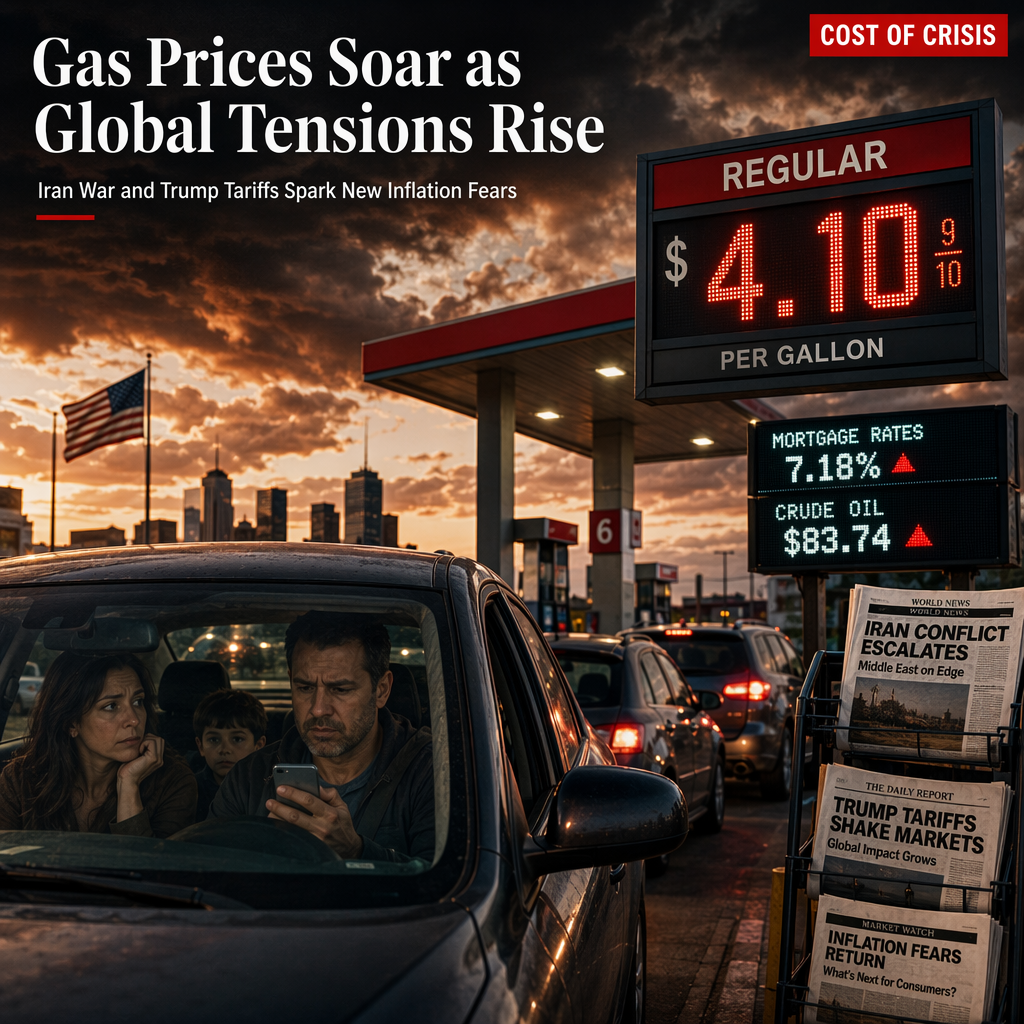
The ongoing war in Iran and President Donald Trump’s global tariff agenda are fueling a renewed affordability crisis in the United States, with gas prices, mortgage rates, and inflation all climbing higher and raising consumer fears [1]. Gas prices surged to $4.10 per gallon on Friday and are expected to rise further, driven by a spike in global oil prices following a reported attack on at least two tankers in the Red Sea. Brent crude oil briefly exceeded $100 per barrel for the first time in two months, while U.S. crude oil reached as high as $92 per barrel this week [1].
These increases in fuel costs have put financial markets on edge, with inflation concerns resurfacing despite a recent easing to 3.5% last month [1]. U.S. Treasury yields, which reflect inflation expectations, have risen, with the 10-year government bond yield hovering just below 4.7% on Friday, marking its highest level since January 2025. The average interest rate on a 30-year U.S. mortgage also climbed to 6.85% on Thursday, its highest since June 2025, before ticking down slightly to 6.81% on Friday [1].
Mark Zandi, chief economist at Moody’s Analytics, estimates that the war is costing the average American household more than $1,200, with gas prices alone adding $360, groceries $240, other transportation $110, and higher interest rates $205 to household expenses [1]. Zandi emphasized that the Iran War is significantly impacting American household budgets and warned that costs are set to rise further as the conflict continues and military expenses mount [1].
Patrick DeHaan, analyst at GasBuddy, noted that the upcoming hurricane season could further complicate gas prices, suggesting that uncertainty and potential impacts may drive prices higher in the coming weeks. DeHaan predicted that the national gas price average could eventually rise to $4.20 to $4.30 per gallon, despite a 3% drop in oil prices on Friday. He also cautioned that Labor Day will be difficult to predict due to these variables [1].
CONCLUSION
The Iran war and Trump’s tariffs are exerting significant upward pressure on gas prices, mortgage rates, and inflation, intensifying financial strain on American households. Analysts warn that these trends are likely to persist, with additional risks posed by the hurricane season and ongoing geopolitical tensions. Market sentiment remains negative, and the impact is expected to be high as consumers and financial markets brace for further volatility.