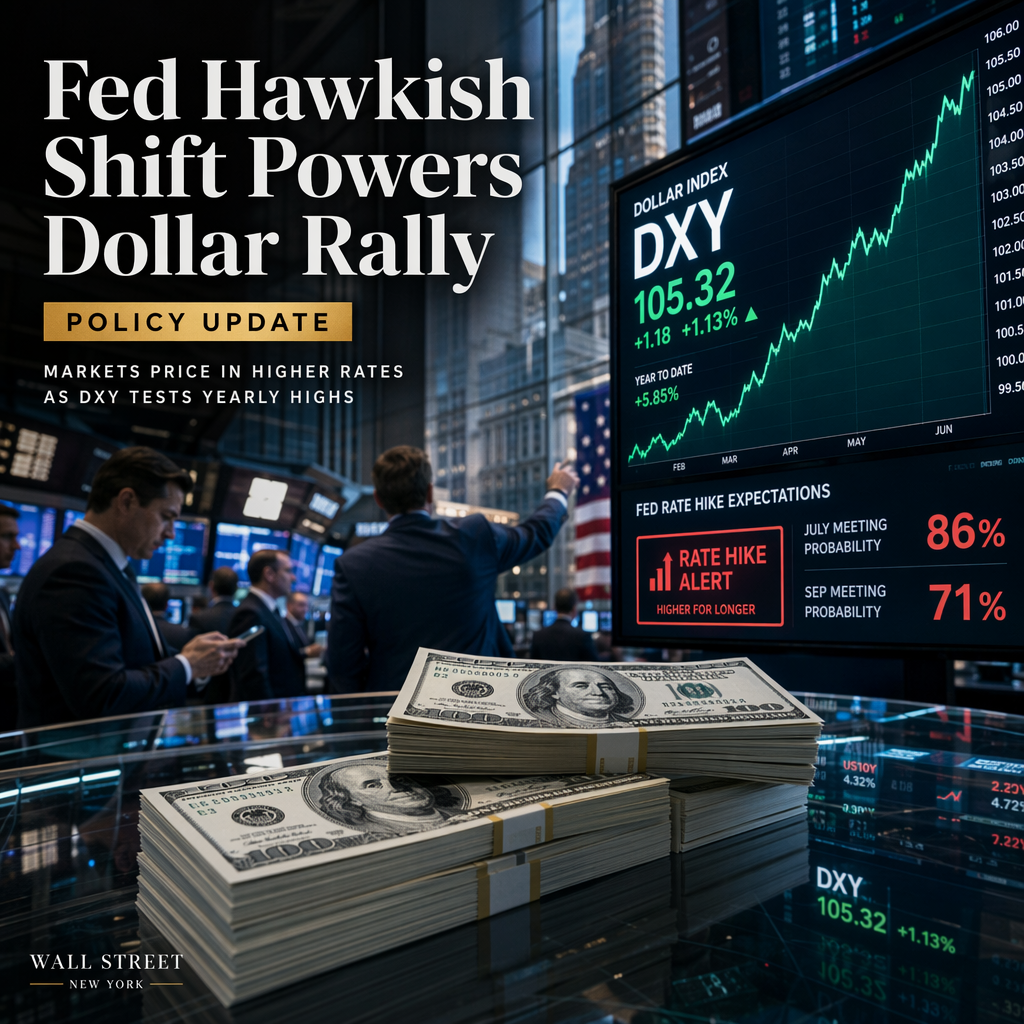
The US dollar has strengthened sharply following the Federal Reserve's latest policy update, which signaled a more hawkish stance and prompted markets to price in multiple rate hikes. According to MUFG, the Dollar Index (DXY) climbed back above the 100.00 level, approaching its year-to-date high of 100.643 recorded on March 31, as market participants moved to anticipate the possibility of a rate hike as early as the next policy meeting in July, with a probability of around one in three [1]. The updated DOT plot from the Fed marks a significant shift from March, with FOMC participants now more open to tightening in response to the recent energy price shock, though MUFG still expects no hike this year and sees upside risks to its weaker USD forecast for 2027 [1].
ING's Chris Turner also highlights that the dollar is holding gains after the Fed's hawkish shift under Chair Kevin Warsh, with markets pricing in about 44 basis points of tightening by the second quarter of 2026 [3]. ING notes that nine of the 18 Fed members now see at least one hike this year, and while the DXY tested the top of its 12-month range at 100.50/60, ING does not anticipate a major upside breakout, especially given lower energy prices following the US-Iran deal and a supportive risk environment [3]. ING's house view is that US inflation may edge lower later this year, potentially allowing the Fed to avoid a full tightening cycle and keeping the DXY capped near its recent highs [3].
Both MUFG and ING agree that the Fed's hawkish policy update has supported the US dollar and lifted US rates, with market participants bringing forward expectations for the timing of the first hike to September or October [1][3]. However, while MUFG acknowledges a higher risk of a rate hike in the second half of the year, it is not convinced that a hike will be required [1]. ING adds that, despite the hawkish shift, the lack of forward guidance in the FOMC statement and press conference leaves future policy moves somewhat uncertain, with Fed member speeches next week expected to provide further clarity [3].
The stronger dollar has also weighed on other currencies, with ING noting that the British pound is under pressure as the Bank of England is expected to keep policy unchanged in a 7–2 vote while sounding hawkish, but ultimately avoiding tightening. ING anticipates further downside for GBP/USD toward 1.3200 and sees EUR/GBP biased higher, as markets reward currencies backed by more proactive central banks [2].
CONCLUSION
The Federal Reserve's hawkish shift has driven the US dollar higher, with markets now pricing in increased odds of rate hikes and the DXY testing recent highs. While both MUFG and ING see upside risks for the dollar, they also note that the Fed may ultimately avoid a full tightening cycle if inflation moderates. The stronger dollar is putting pressure on currencies like the British pound, as central banks perceived as less proactive face market headwinds.