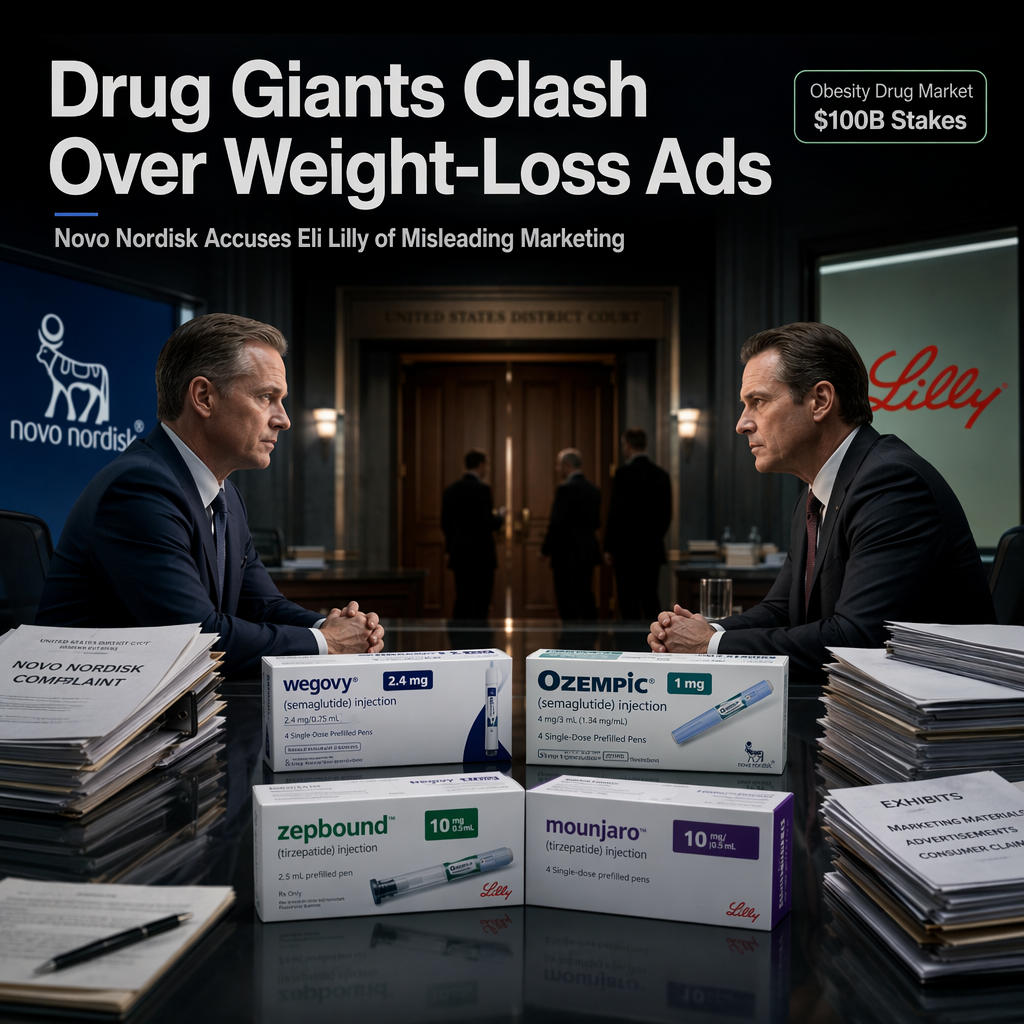
Novo Nordisk has filed a lawsuit against Eli Lilly in federal court in New Jersey, alleging that Lilly's advertisements for its weight-loss drugs Zepbound and Mounjaro are misleading consumers by claiming superior efficacy over Novo's competing treatments, Wegovy and Ozempic [1]. According to Novo Nordisk, the ads compare the highest doses of Lilly's drugs with lower doses of Novo's medicines and rely on 'outdated' clinical trial data [1]. Novo asserts that these advertisements are 'maliciously and deceptively false' because they cite older trials and do not reflect the most current dosing options, specifically noting that the FDA approved a higher 7.2 mg dose of Wegovy in March 2024 [1].
Eli Lilly has rejected Novo Nordisk's claims, stating that its advertisements are based on the SURMOUNT-5 trial, completed in 2024, which directly compared 10 mg or 15 mg doses of Zepbound with 1.7 mg or 2.4 mg doses of Wegovy [1]. A Lilly spokesperson emphasized that SURMOUNT-5 is the only head-to-head, randomized clinical trial directly comparing tirzepatide (the active ingredient in Zepbound) and semaglutide (the active ingredient in Wegovy) for weight management, and described the company's advertising as 'truthful,' 'transparent,' and 'grounded in the most direct scientific evidence available' [1]. Lilly stated it will 'defend against this lawsuit vigorously' and continue to focus on the science [1].
Novo Nordisk is seeking a court order to force Lilly to remove the ads, run corrective advertising, and pay damages related to any profits Lilly may have earned from the campaign [1]. Novo claims it sent a cease-and-desist letter to Lilly in April but received no response, and alleges that Lilly's revised ads have been shown more than 700 million times since late April [1].
The lawsuit highlights the intense competition between Novo Nordisk and Eli Lilly for dominance in the rapidly expanding U.S. obesity drug market, which analysts estimate could exceed $100 billion in value by the end of the decade [1]. No immediate comment was available from Novo Nordisk regarding the lawsuit [1].
CONCLUSION
Novo Nordisk's lawsuit against Eli Lilly underscores the fierce rivalry in the lucrative obesity drug market, with both companies defending their products and advertising practices. The outcome of this legal dispute could have significant implications for market share and advertising standards in the weight-loss drug sector.