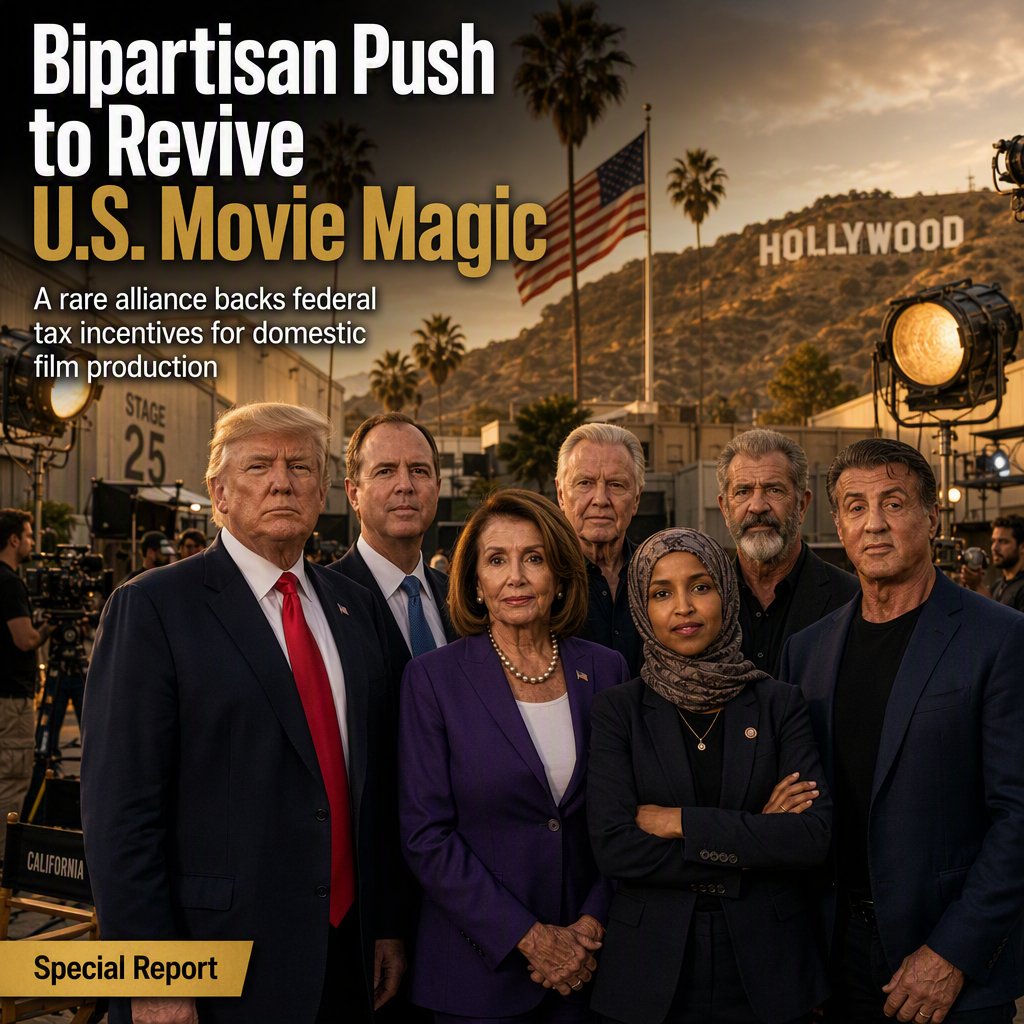
A bipartisan coalition has emerged in support of President Donald Trump's initiative to bring motion picture production back to California through a federal tax incentive plan. Notably, the alliance includes former political adversaries such as Sen. Adam Schiff, D-Calif., who led Trump's first impeachment trial, as well as Reps. Ilhan Omar, D-Minn., and Nancy Pelosi, D-Calif. Schiff publicly expressed his strong agreement with the president, emphasizing the need for Republicans and Democrats to collaborate to 'bring the movie magic back to America' and urging Congress to 'immediately take up and pass a federal film tax incentive to bring back these good-paying jobs that we've lost to other countries' [1].
Nancy Pelosi commented that she and her colleagues have been promoting such incentives for a long time and welcomed Trump's support for the plan [1]. Ilhan Omar highlighted her previous efforts to attract film projects to Minneapolis, referencing notable productions like 'Fargo' and 'The Mighty Ducks' series, and lamented the recent end of state subsidies in Minnesota, which she said diminished local film production opportunities [1].
President Trump has also appointed actors Jon Voight, Mel Gibson, and Sylvester Stallone as special envoys to Hollywood. Mel Gibson cited cost disparities, noting it was cheaper to fly a crew to Europe for three days than to shoot for one day in Los Angeles, underscoring the economic challenges facing domestic film production [1]. Former California Governor Arnold Schwarzenegger's previous attempts to address these issues were reportedly met with obstacles [1].
California Governor Gavin Newsom has also voiced support for federal involvement, stating, 'California built the film industry – and we’re ready to bring even more jobs home… Now it’s time for a real federal partnership to Make America Film Again' [1].
CONCLUSION
A rare bipartisan consensus is forming around the push for federal tax incentives to revive U.S. film production, with support from both political rivals and industry figures. The initiative is seen as a potential driver for job creation and economic growth in states like California and Minnesota, though past efforts have faced significant challenges. The market impact is medium, as the proposal could reshape the competitive landscape for film production if enacted.