
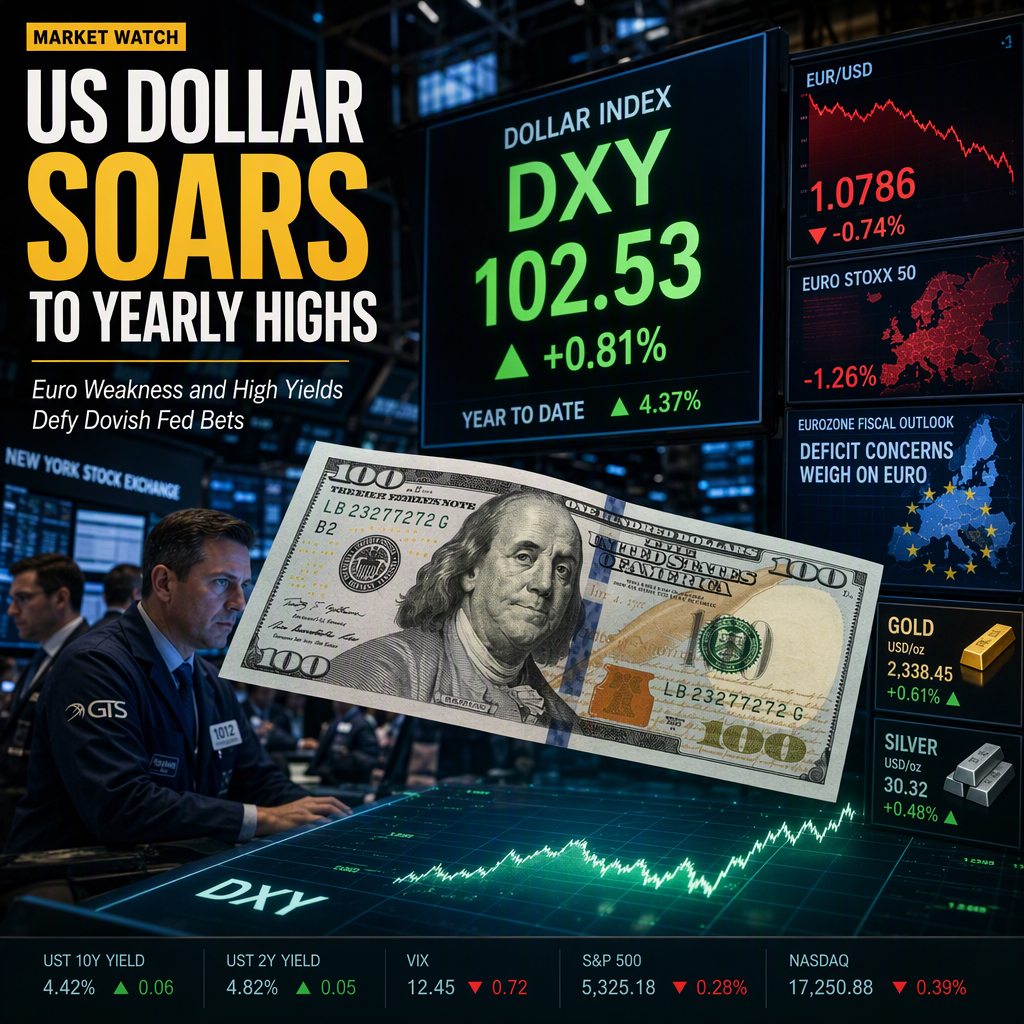
The US Dollar Index (DXY) surged to fresh yearly highs near 102.53 during the European trading session on Monday, despite a significant reduction in expectations for a Federal Reserve (Fed) rate hike at the upcoming October meeting, following weaker US labor market data and softer inflation readings [1][2][3][4]. The US Bureau of Labor Statistics reported that Nonfarm Payrolls (NFP) increased by only 29K in September, well below the 90K forecast and the previous reading of 133K, which was revised down from 162K. The Unemployment Rate rose to 4.2%, above the expected 4.1%, and annual wage growth slowed to 3.0% [1][2][4]. These figures, combined with a disappointing August Personal Consumption Expenditures (PCE) inflation report, led traders to scale back the probability of a Fed rate hike in October to 19.4% from 70.9% a week ago, according to the CME FedWatch Tool [1][2].
Despite the dovish repricing, the US Dollar remained broadly firm, supported by elevated US Treasury yields, which held near 5.29% after reaching 5.34% last week, the highest level since 2002 [2][3]. Analysts attributed the Dollar's strength to heavy selling in the Euro (EUR), driven by growing political and fiscal concerns in France, and fragmentation fears within the Eurozone that are complicating the European Central Bank's (ECB) tightening path [3][4]. The Euro fell to its weakest level since May 2025, with EUR/GBP down more than 0.3%, EUR/JPY losing 0.6%, and EUR/CAD declining 0.4% in the European morning [4].
Market strategists are divided on the sustainability of the Dollar's rally. Philip Wee at DBS Group Research cautioned that the Dollar's momentum may be running out of monetary policy impetus, as senior Fed officials push back against an October rate hike and elevated yields are increasingly driven by fiscal deficits and term premia rather than central bank tightening [3]. Chris Turner at ING, however, emphasized that relative yield differentials and ongoing Euro weakness should continue to support the DXY toward 102.85, with markets comfortable with an October hold followed by a potential December Fed rate hike [3].
The impact of the Dollar's strength was felt across commodities and currencies. Silver (XAG/USD) jumped 2.3% to near $61.80, benefiting from receding hawkish Fed bets, but remained pressured by a firm Dollar and technical resistance at the 20-day EMA ($63.24). The immediate support zone for Silver is at $60.00, with further downside risk to $56.57 if this level fails [1]. Gold (XAU/USD) traded around $4,158, up 0.35% on the day, but its upside was capped by elevated yields and a stronger Dollar, which make the metal more expensive for overseas buyers [2].
Looking ahead, Deutsche Bank economists maintained that the broader labor market remains resilient despite the disappointing payroll headline, and continue to expect two further 25 basis points Fed hikes over the next couple of quarters [1][2]. The US economic docket features the ISM Services PMI and FOMC minutes, which could further influence market direction [2][3][4].
CONCLUSION
Despite weaker US labor data and diminished Fed rate hike odds, the US Dollar surged to yearly highs, driven by Euro weakness and elevated Treasury yields. Analysts remain divided on whether the Dollar's rally can be sustained, but relative yield differentials and ongoing Eurozone concerns continue to support its strength. Commodities like Silver and Gold saw mixed reactions, with upside limited by the firm Dollar and high yields.