
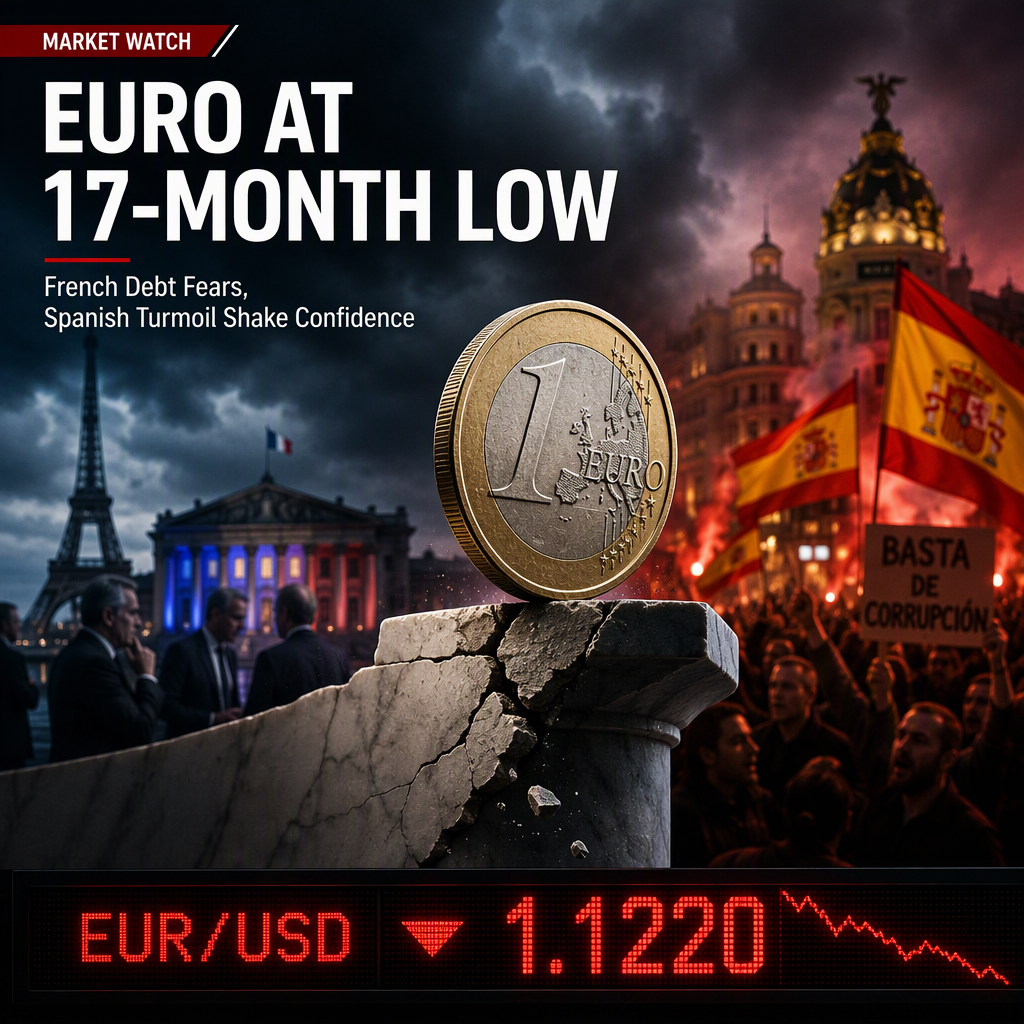
The EUR/USD pair declined to around 1.1220 during early Asian trading hours on Tuesday, marking a near 17-month low for the Euro against the US Dollar amid escalating concerns over France’s debt position [1]. French Prime Minister Sébastien Lecornu's minority government recently announced a €54 billion savings plan aimed at preventing a catastrophic downgrade or sovereign default. Lecornu stated that these measures are intended to reduce the budget deficit from 5.5% of GDP this year to 5% next year, warning that without intervention, the deficit could reach 6.5% [1]. The market's anxiety is heightened by France’s rising debt costs and efforts to control public finances ahead of next year’s presidential election, which has exerted selling pressure on the Euro [1].
Political instability in Spain has further contributed to the Euro’s weakness. Spanish Prime Minister Pedro Sanchez called a snap election for November 29 after lawmakers rejected proposals to address a nationwide housing crisis, intensifying investor concerns about the Eurozone’s political landscape [1]. Kathleen Brooks, research director at XTB, noted, “Europe is taking the spotlight at the start of the week, as fiscal and political concerns hit the bloc. France is the epicentre of the concerns; however, Spain is also set to get ready for an early election, which is adding to investor worries” [1].
On the US side, reduced expectations for a Federal Reserve rate hike this month could potentially support the Euro, but recent labor market data has been mixed. The US Nonfarm Payrolls (NFP) rose by 29,000 in September, significantly below the market consensus of 90,000 and the 133,000 increase seen in August. The unemployment rate climbed to 4.2% in September from 4.1% in August [1]. Markets are now pricing in a 22.7% probability that the Fed will raise rates at its October meeting, according to the CME FedWatch tool [1].
Strategists at Brown Brothers Harriman (BBH) highlighted that the ECB’s Transmission Protection Instrument, designed as a backstop against disorderly spread widening, is not an automatic shield for Eurozone debt markets. Activation depends on member states pursuing sound fiscal and macroeconomic policies, a condition France’s deteriorating finances may not meet. BBH argues this complicates the case for ECB intervention, even as the risk of broader contagion across Eurozone bond markets could increase pressure on the central bank to act. ECB Chief Economist Philip Lane recently emphasized that the rise in long-term interest rates represents a material tightening of financial conditions for the euro area [1].
CONCLUSION
The Euro's sharp decline reflects mounting fiscal and political risks in France and Spain, with market participants increasingly concerned about the Eurozone’s stability. Uncertainty over ECB intervention and mixed US economic data add to the volatility, suggesting continued pressure on the Euro in the near term.