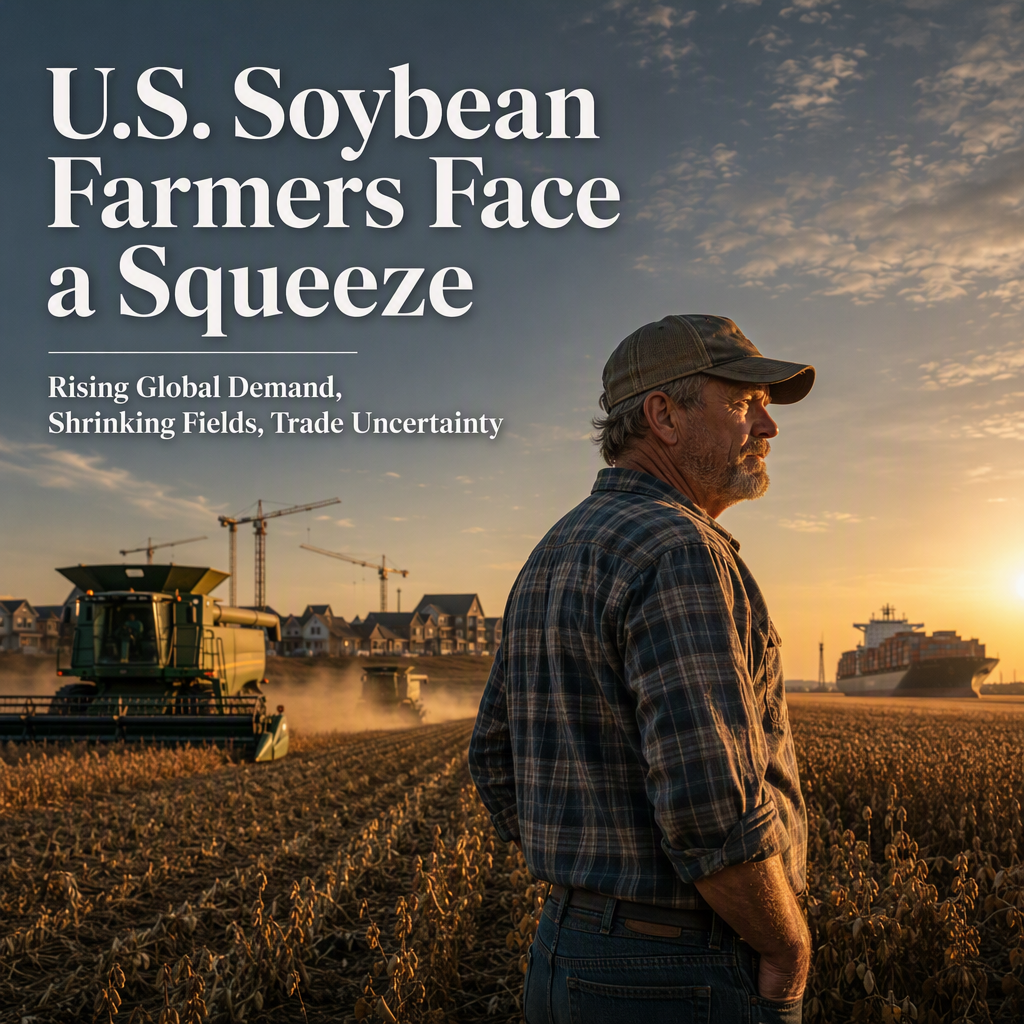
U.S. soybean farmers are working to satisfy increasing global demand for their crops, despite facing a reduction in available farmland and a declining number of farms. According to the Department of Agriculture, U.S. farmland has decreased from approximately 943 million acres in 2000 to 874 million acres, a 7% drop, with about 307,000 farms lost during the same period [1]. This contraction in farmland comes as global demand for American agricultural products, especially soybeans, continues to rise. Farmers are responding by seeking new markets and increasing productivity per acre [1].
Barry Alexander, a seventh-generation farmer in Cadiz, Kentucky, noted that while he has not personally lost farmland to urban development, he has observed the trend of shrinking farms as cities expand into rural areas. He emphasized the irreplaceable nature of farmland and the growing need for food as the population increases [1]. Kentucky’s soybean harvest typically runs from September to October, with a significant portion of the crop exported overseas, particularly to China, which is the largest customer for U.S. soybeans [1].
In 2025, China agreed to purchase 25 million metric tons of U.S. soybeans annually, but initially failed to meet this target due to trade tensions during President Donald Trump’s administration. The American Soybean Association reported that China later increased its purchases as prices rallied, but the U.S. has not yet fully reached the agreed-upon export levels. Caleb Ragland, chairman of the American Soybean Association, stated, "We're on a positive trend, but we still got a long ways to go to completely hit the targets that they've agreed to" [1].
China currently imposes a 10% tariff on all U.S. agricultural products, which has made American soybeans less competitive compared to South American producers. Chinese officials have discussed removing this tariff, a move that could enhance the competitiveness of U.S. soybeans in the global market. Ragland described the tariff as a "10% tax that has made us uncompetitive when it comes to the cash price that the Chinese customers would pay for soybeans" [1].
A portion of soybean profits is allocated to a checkoff program managed by the United Soybean Board, which funds research and development to support the industry [1].
CONCLUSION
U.S. soybean farmers are navigating the dual challenges of shrinking farmland and international trade barriers while striving to meet robust global demand, particularly from China. The potential removal of Chinese tariffs could improve U.S. competitiveness, but reaching export targets remains a work in progress. The market outlook is cautiously optimistic as farmers and industry leaders continue to adapt.