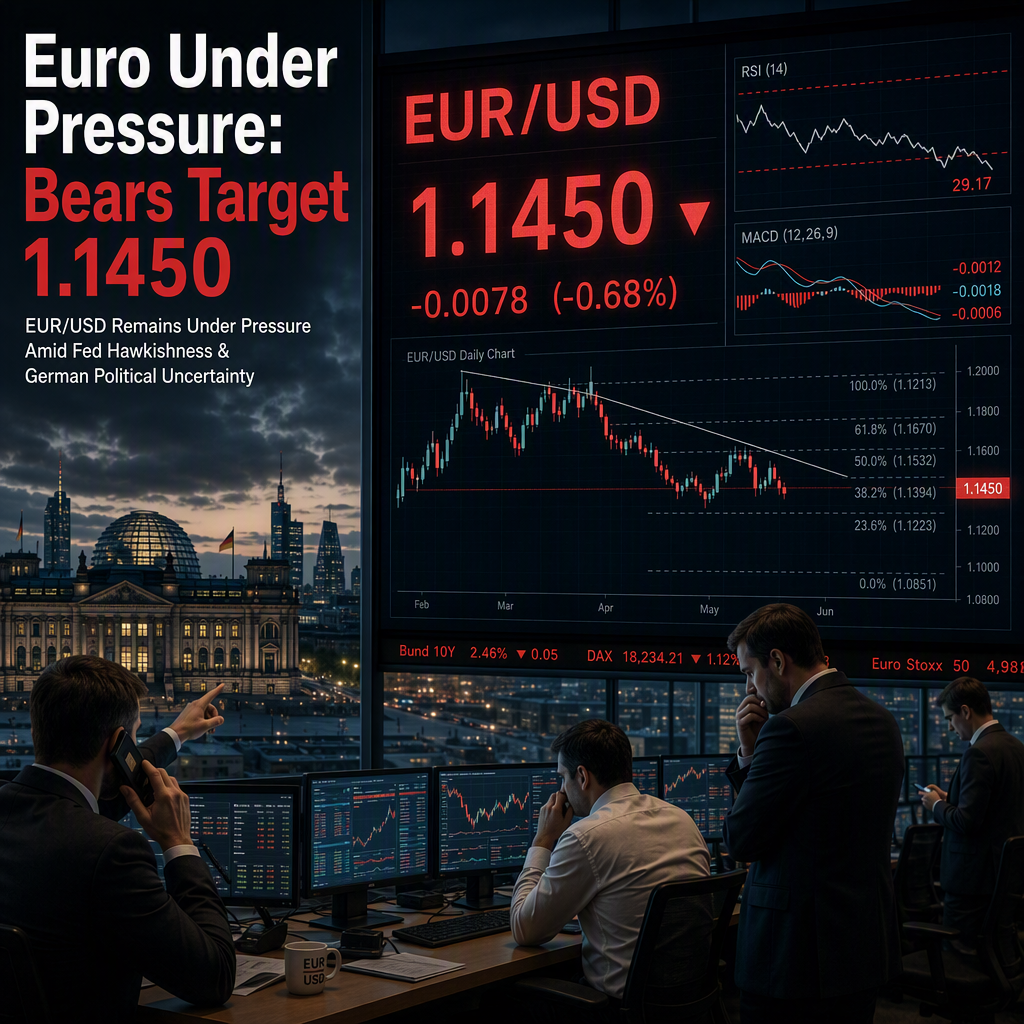
The Euro (EUR) continued to consolidate last week’s decline against the US Dollar (USD) on Monday, with price action remaining capped below the 1.1500 level and the seven-week low in the mid 1.1400s still in focus for bearish traders [1]. Despite a decline in oil prices, the Euro failed to gain significant support and remained on the defensive, pressured by the Federal Reserve’s hawkish repricing and increasing political uncertainty in Germany [1]. Chicago Fed President Austan Goolsbee reinforced the Fed’s hawkish stance, stating at a Monetary Policy forum in London that the US central bank 'right now does not have an employment problem; it does have an inflation problem' [1].
Political developments in Germany added further pressure to the Euro. German Chancellor Friedrich Merz’s CDU party suffered significant defeats, being beaten in Berlin by the left and experiencing its worst postwar result in Mecklenburg-Western Pomerania’s state elections against the Eurosceptic and pro-Kremlin Alternative for Germany (AfD). Although Merz has vowed to remain in office to pursue economic reforms, questions about his support are likely to arise [1].
Technical analysis indicates that EUR/USD failed to breach the 200-day simple moving average (SMA) last week and depreciated further before finding some support around the 1.1450 area. Momentum indicators on 4-hour charts remain negative, with the Relative Strength Index (RSI) just above oversold levels and the Moving Average Convergence Divergence (MACD) below zero, suggesting that any bounces are likely to be capped [1]. Upside attempts remain limited below 1.1500, while a clear break below Friday’s lows at 1.1456 could find support at the 78.6% Fibonacci retracement of the August recovery at 1.1410, ahead of the June-July trough in the 1.1325-1.1365 area [1].
In terms of market performance, the Euro was the strongest against the Japanese Yen, gaining 0.23% on the day, but lost 0.09% against the US Dollar [1]. The main focus for the week will be on the preliminary Purchasing Managers Index (PMI) figures from the Eurozone and the US, due on Wednesday, which are expected to provide further clues about the economic momentum of their respective economies [1].
CONCLUSION
EUR/USD remains under bearish pressure, with technical and fundamental factors pointing to further downside risks. The combination of Fed hawkishness and German political uncertainty has weighed on the Euro, while upcoming PMI data could provide additional direction for the pair. Market sentiment remains cautious as traders await further economic signals.