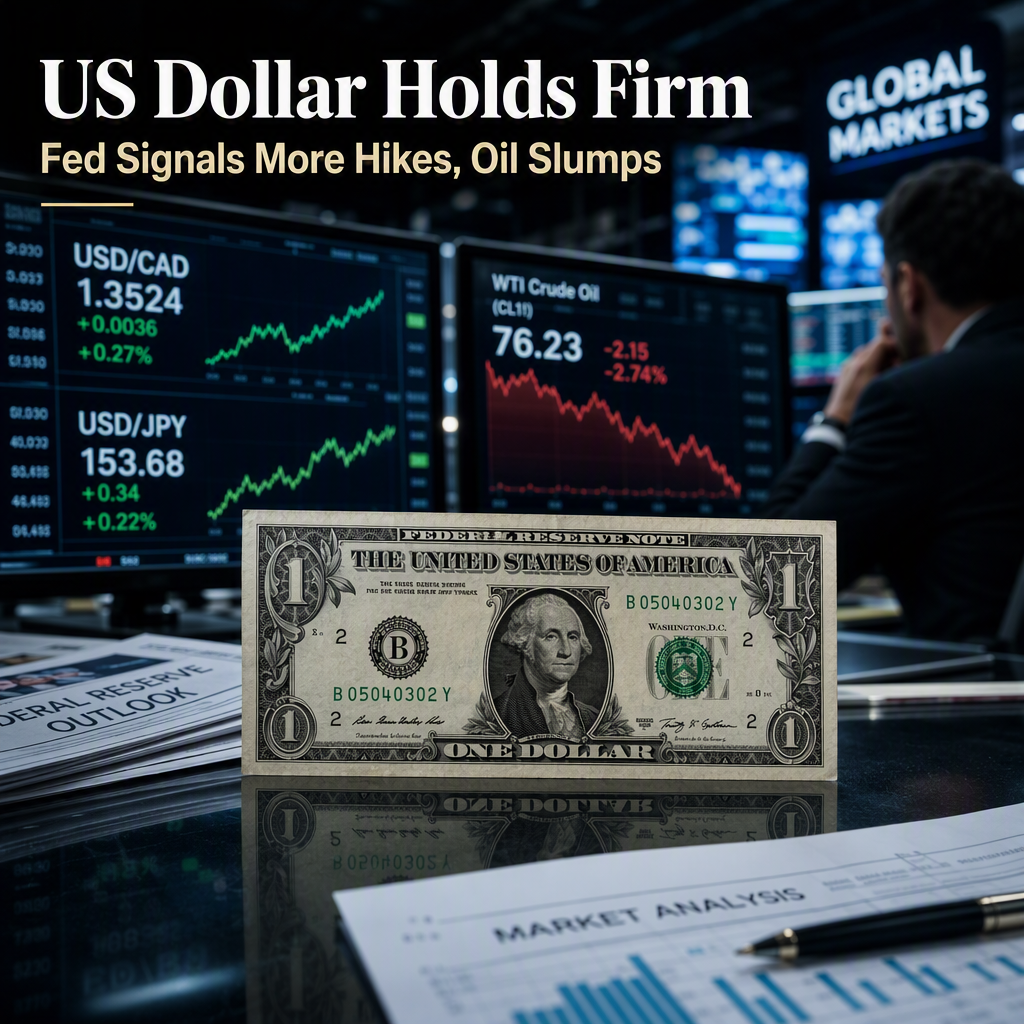
The US Dollar (USD) remained resilient at the start of the week, buoyed by expectations of further Federal Reserve (Fed) tightening and a widening interest rate differential with other major central banks, notably the Bank of Canada (BoC) and the Bank of Japan (BoJ) [1][2][4]. The USD/CAD pair hovered near the 1.4000 psychological mark, with the Canadian Dollar (CAD) under pressure due to the Fed's hawkish outlook and falling oil prices, which are particularly impactful given Canada's status as a major crude exporter [1]. West Texas Intermediate (WTI) oil traded around $93.50, marking its fourth consecutive day of declines and reaching its lowest level in over a week [1].
The Fed raised its policy rate by 25 basis points to a range of 3.75%-4.00% at its September meeting, while the BoC kept its rate unchanged at 2.25% for the seventh consecutive meeting [1][4]. The updated Fed dot plot revealed that 16 of 18 policymakers expect at least one more rate hike this year, and the CME FedWatch tool indicated that markets assign an 88% probability to another hike in 2023 [1][4]. ING strategists now expect the Fed to deliver a final hike in December, citing the proximity of the October meeting to the midterms and the potential for stronger data or higher energy prices to influence market expectations [2]. HSBC analysts noted that the Fed's path is more hawkish than a 'one-and-done' scenario but still below current market pricing [4].
The US Dollar Index (DXY) traded around 100.25–100.30, slightly below Friday’s seven-week high of 100.56, and has gained 0.5% since the Fed's latest policy announcement [1][4]. Over the past week, the USD was the strongest against the Japanese Yen (JPY), appreciating by 2.36%, and gained 0.96% against the CAD [4]. Analysts emphasized that while the Fed's hawkish bias underpins USD strength, further gains will depend on upcoming US economic data [4].
Oil prices and diplomatic developments are also key market drivers. Crude prices have softened, and investors are watching for outcomes from US President Donald Trump's meetings with Gulf state representatives and Chinese President Xi Jinping, which could influence both oil and currency markets [1][2]. ING maintains a gradually negative longer-term view on the USD, expecting a sharp decline in oil prices in Q4, but acknowledges near-term upside risks remain [2].
In contrast, the BoJ's recent 25 basis point hike to 1.25% failed to provide strong support for the JPY, as limited guidance on further normalization disappointed hawkish expectations. The USD/JPY pair remains driven by US Treasury–Japanese Government Bond yield spreads and thin liquidity, with the USD gaining 2.36% against the JPY over the past week [3][4].
CONCLUSION
The US Dollar remains supported by expectations of further Fed tightening and a widening interest rate differential, particularly against the Canadian Dollar and Japanese Yen. However, analysts caution that the sustainability of USD strength will depend on upcoming US economic data and developments in oil prices. Market participants are closely monitoring central bank signals and geopolitical events for further direction.