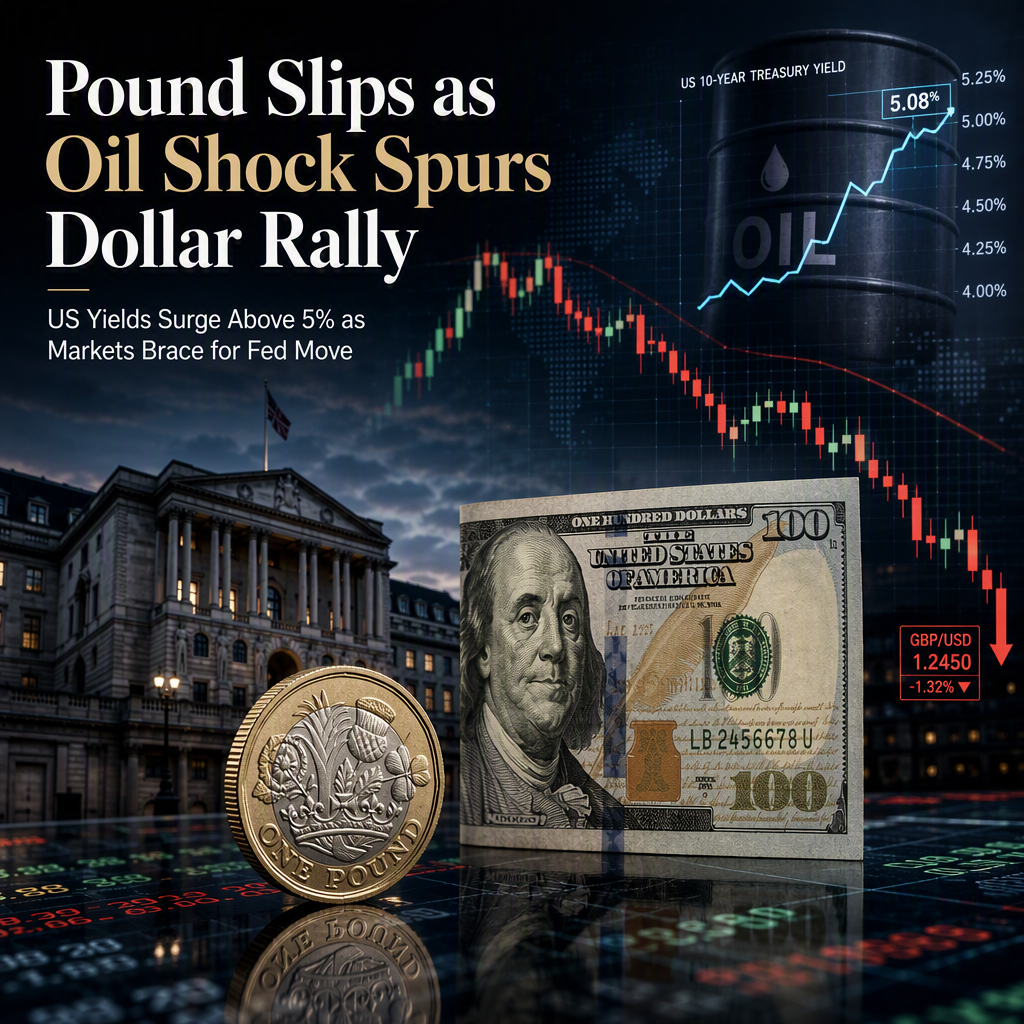
The British Pound (GBP) edged lower by approximately 0.07% against the US Dollar (USD) on Tuesday, with the GBP/USD pair trading at 1.3487 after reaching a peak of around 1.3505 earlier in the session [1]. This decline was attributed to increased demand for the US Dollar's haven status amid escalating fears of a potential oil supply shortage, as the Middle East conflict intensified and both Brent and West Texas Intermediate (WTI) crude oil benchmarks rose by over 2.40% and 1.10%, respectively [1].
The surge in oil prices triggered a sharp rise in US Treasury yields, with the 10-year yield climbing to 5.041%, a level not seen since 2007 [1]. Investors responded by sending bond yields higher, driven by concerns over a possible second round of inflation [1]. The US Dollar Index (DXY), which tracks the greenback against a basket of six major currencies, increased by 0.16% to 99.62 [1].
Market participants are closely watching central bank decisions, with the Federal Reserve expected to raise rates by 25 basis points on Wednesday, an outcome with a 95% probability according to Prime Terminal [1]. In contrast, the Bank of England is anticipated to keep rates unchanged on Thursday, although money markets are pricing in one rate hike towards the end of 2026 and another the following year [1].
US economic data showed continued labor market strength, as the ADP Employment Change 4-week average rose by 16.25K above the previous week's revised figure of 12.25K [1]. In the UK, jobs data was weaker, with wages excluding bonuses rising by 3.5% in the three-month period to July, but vacancies fell to a near six-year low [1].
Technically, GBP/USD is trading at 1.3478, with a neutral to slightly bearish near-term bias. The pair is just below the clustered simple moving average composite around 1.3483, and the Relative Strength Index (14) has eased toward the low-40s, indicating fading bullish momentum [1]. Key resistance is at 1.3483 and 1.3691, while support lies at 1.3476, 1.3460, and 1.3351 [1].
CONCLUSION
The British Pound weakened against the US Dollar as rising oil prices and surging US Treasury yields boosted demand for the greenback. With the Federal Reserve expected to hike rates and the Bank of England likely to hold steady, market sentiment favors the USD in the near term. Technical indicators suggest GBP/USD may remain under pressure unless key support levels hold.