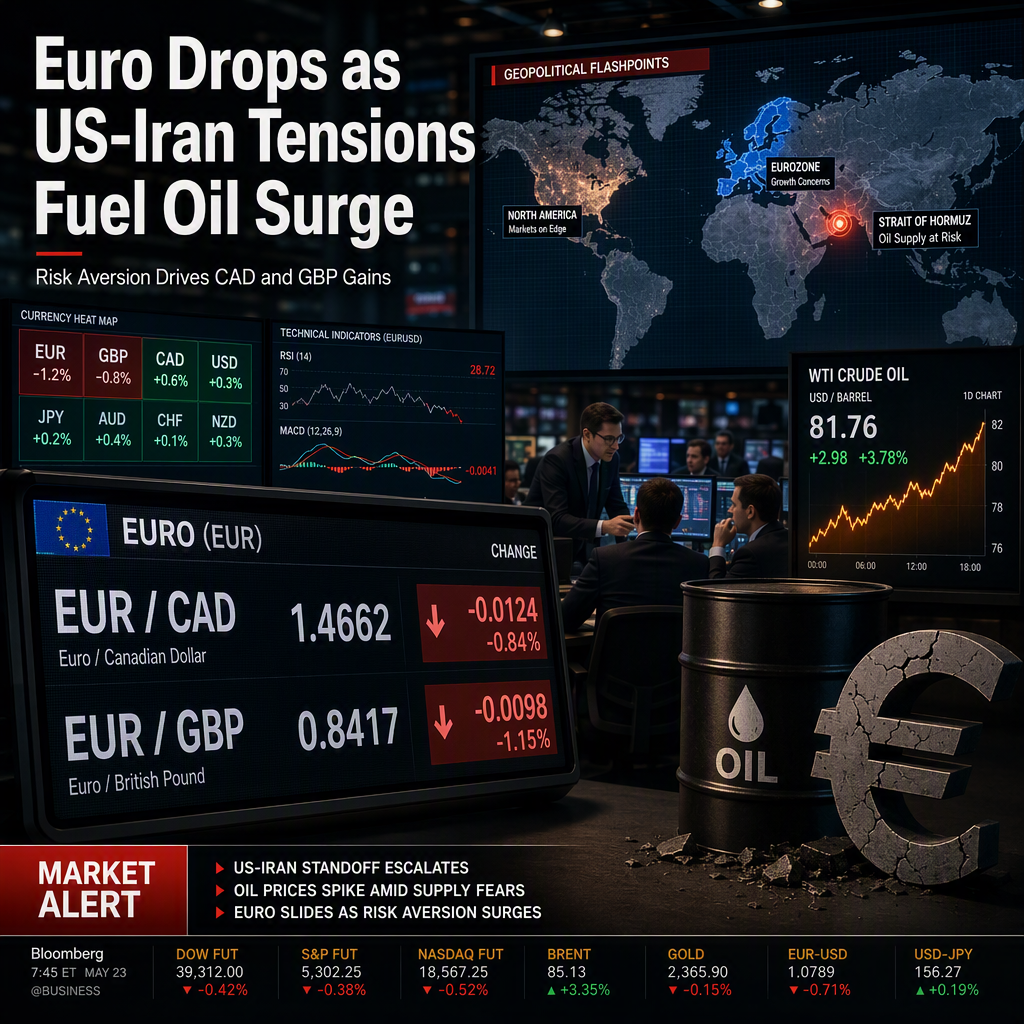
The Euro (EUR) experienced notable declines against both the Canadian Dollar (CAD) and the British Pound (GBP) on Tuesday, as heightened US-Iran tensions fueled risk aversion and drove oil prices higher [1][2]. The EUR/CAD pair extended its losing streak for the fifth consecutive day, trading around 1.6080 during European hours, pressured by fears of oil supply disruptions and renewed inflation concerns in the Eurozone [1]. The Canadian Dollar benefited from its commodity-linked status, with West Texas Intermediate (WTI) crude oil trading at approximately $83.30 per barrel, marking its second day of gains [1].
Geopolitical developments were central to market movements, with Iran explicitly ruling out negotiations with US President Donald Trump until the end of his term on January 20, 2029, according to statements from Iranian officials [1]. This stance, alongside the breakdown of the US-Iran peace agreement, has intensified concerns over energy supply and inflation, particularly for energy-dependent Eurozone economies [1][2]. Rabobank strategists highlighted that the closure of the Strait of Hormuz and the ongoing conflict pose downside risks to Eurozone growth and upside risks to inflation [2].
In currency markets, the Euro extended losses against the British Pound, remaining below the 0.8550 level after hitting two-week lows at 0.8536 on Monday [2]. Technical indicators for EUR/GBP, including a mid-30s Relative Strength Index (RSI) and negative MACD, reinforced the bearish outlook, with initial support at 0.8530 and further downside potential to 0.8510 [2]. A heat map of major currencies showed the Euro was weakest against the New Zealand Dollar but also underperformed against the CAD and GBP [2].
Meanwhile, the US Dollar Index (DXY) traded slightly higher near 99.90, supported by rising oil prices and persistent inflation expectations [3]. However, the outlook for the Dollar was tempered by dovish signals from recent US labor market data, with ING strategists emphasizing that the Federal Reserve is likely done with rate hikes [3]. The CME FedWatch tool indicated a 48.3% probability of the Fed leaving rates unchanged in September, up from 30.4% a month ago [3]. Technical analysis showed the DXY maintaining a bearish near-term tone below its 20-day EMA at 100.32, with downside risks toward 99.00 if support at 99.40 fails [3].
Analysts at Commerzbank noted that while the Canadian economy shows signs of recovery, it remains vulnerable to US trade policy, with a potential 50% tariff on certain Canadian goods looming if no agreement is reached by August 19th [1]. This adds another layer of uncertainty to the broader market environment.
CONCLUSION
The Euro's decline against major currencies is being driven by escalating geopolitical tensions and rising oil prices, which have reignited inflation concerns and weighed on risk sentiment. While the Canadian Dollar and US Dollar have found some support from these developments, the outlook remains clouded by trade risks and dovish central bank expectations. Market participants are closely watching upcoming economic data and geopolitical developments for further direction.