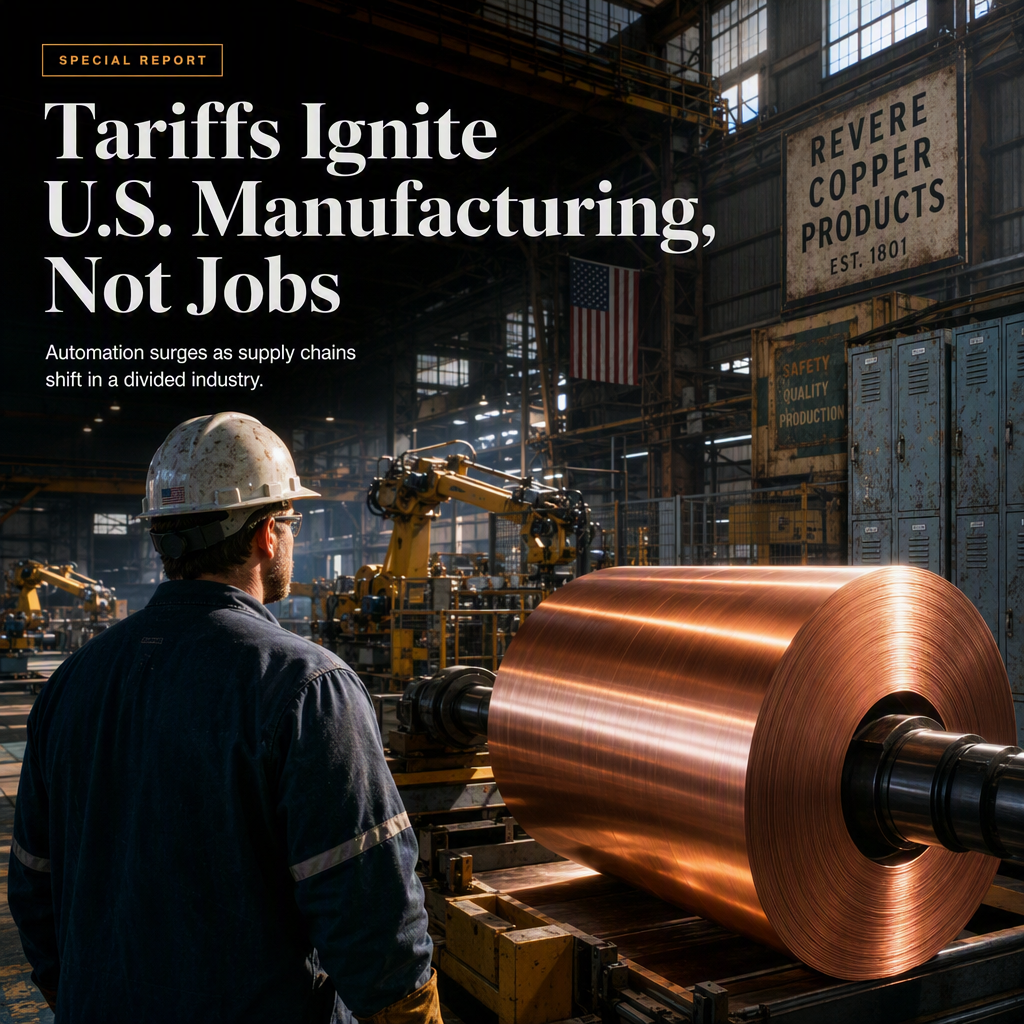
U.S. President Donald Trump's tariff-heavy trade policy has significantly altered the supply chain landscape for American manufacturers, particularly since the first broad tariffs were imposed in 2016. At Revere Copper Products, America's oldest copper rolling mill, decades of losing customers to lower-priced Chinese copper began to reverse as tariffs made domestically produced copper more competitive, resulting in a resurgence of orders for the company [1].
Despite increased activity in certain sectors, such as metals and machinery, the tariffs have not led to a substantial return of jobs to American manufacturing. Market analysis indicates that employment gains have been muted, with automation and technological advancements playing a larger role in shaping workforce trends than trade policy alone [1]. A senior executive at Revere Copper Products commented, "The tariffs have helped us regain some lost market share, but the reality is that the jobs haven't come back in the numbers many hoped for. We are more competitive, but we are also more automated than ever" [1].
The tariffs have also resulted in higher input costs and retaliatory measures from trade partners, complicating supply chains for some manufacturers. While some companies benefited from reduced competition from foreign imports, others struggled with increased prices for raw materials [1]. Financial data shows that U.S. imports of Asian goods increased during the first half of the year amid tariff uncertainty, highlighting ongoing complexities in global supply chains. Additionally, copper prices have approached near-record highs, driven by U.S. and China AI demand [1].
Overall, Trump's tariffs have unevenly reshaped American manufacturing, creating winners and losers across different sectors. The policy has altered market dynamics and supply chains but has not fully delivered on promises to restore manufacturing jobs, leaving the industry landscape complex and evolving [1].
CONCLUSION
Trump's tariffs have boosted competitiveness and activity for some U.S. manufacturers, but job growth has remained limited due to automation and supply chain complexities. While certain sectors have benefited, the overall impact on employment and market stability is mixed. The manufacturing landscape continues to evolve, with ongoing challenges and uneven outcomes across industries.