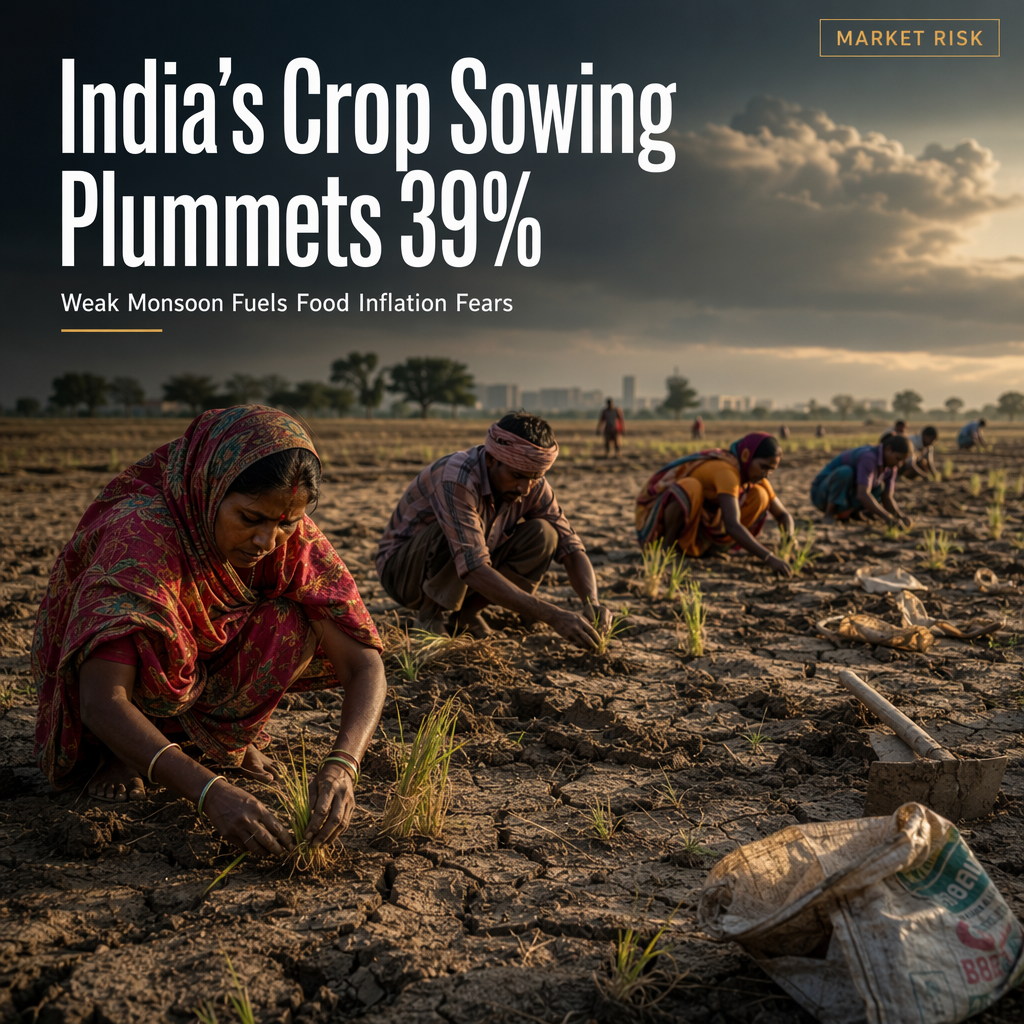
India is facing below average and uneven rainfall during its monsoon sowing season, resulting in a significant reduction in the planting of key crops, with sowing down by as much as 39% compared to last year [1]. This shortfall is particularly pronounced for paddy, a staple crop crucial to food price stability, and has forced farm workers to replant saplings in affected regions such as the outskirts of Ahmedabad and drought-prone Karnataka [1].
Market analysts are warning that the decrease in crop sowing could lead to supply constraints and push up food prices in the coming months, raising fears of increased food inflation [1]. States already vulnerable to drought are expected to face greater difficulties, potentially exacerbating inflationary pressures across the broader economy [1].
A Mumbai-based agricultural economist emphasized that if rainfall patterns do not improve soon, the impact on crop yields and food prices could be significant [1]. The 39% decline in planting is viewed as a major concern for policymakers, who are already contending with inflation [1].
While there are no technical chart descriptions or trading advice in the article, the overall sentiment among analysts is cautious, with a focus on closely monitoring rainfall patterns and crop sowing data for further signs of food price risk [1].
CONCLUSION
India's weak monsoon has led to a sharp 39% drop in crop sowing, especially for staple crops like paddy, heightening concerns about food inflation. Analysts and policymakers are closely watching rainfall patterns, as continued deficits could significantly impact crop yields and prices. The situation poses a high risk to market stability and inflation in the coming months.