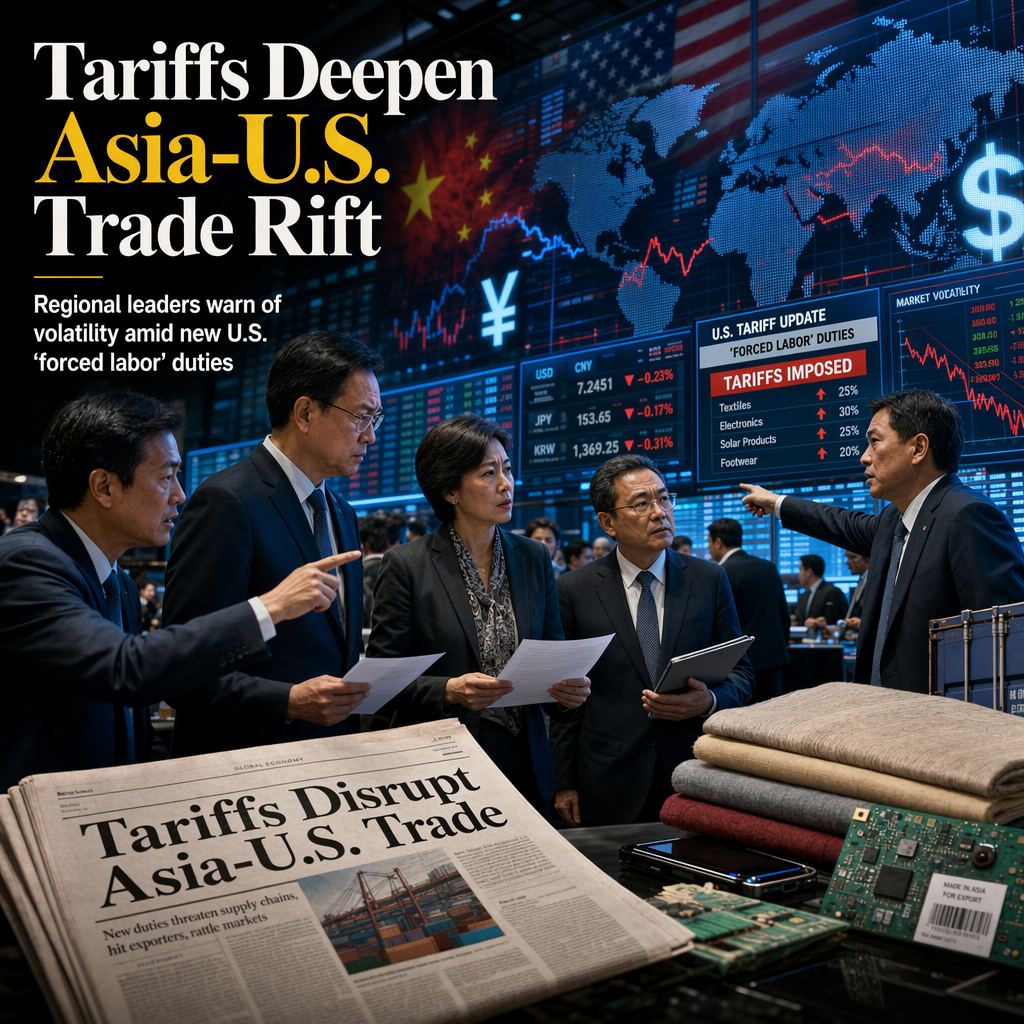
The White House has announced new tariffs ranging from 10% to 12.5% on 60 economies, citing U.S. standards for forced labor as the justification for these duties [1]. This move has been met with disappointment and skepticism by Asian governments and analysts, who argue that the tariffs are based on criteria disconnected from international legal norms and existing multilateral agreements [1]. Officials from India, South Korea, and Singapore have voiced concerns that the measures could destabilize regional trade ties and undermine established frameworks [1].
A senior trade official from India stated, 'The basis for these tariffs appears arbitrary and disconnected from international legal norms. We need clarity on how forced labor is being assessed and why U.S. standards are being prioritized' [1]. Financial analysts highlighted that the tariffs could create volatility for Asian export markets, particularly those with significant exposure to U.S. demand, such as textiles and electronics [1]. A Singapore-based economist noted that a 10% to 12.5% duty will force exporters to reassess pricing and supply chains, with potentially significant impacts if the U.S. does not recognize local compliance standards [1].
Market participants are closely monitoring the situation, with some warning of possible retaliatory actions from affected economies [1]. Technical analysis indicates that export-oriented stocks in Asia may face resistance at current levels and could experience downside risk if the tariffs are not revised or clarified [1]. Trading sentiment remains cautious, with investors seeking further signals from Washington regarding future policy direction [1].
No specific chart data or price levels were provided, but analysts advise vigilance for headline-driven market moves and recommend avoiding overexposure to sectors most impacted by the new tariff regime [1].
CONCLUSION
The U.S. tariffs based on forced labor standards have introduced significant uncertainty and concern among Asian economies, with potential for increased market volatility and trade disruptions. Investors and analysts are adopting a cautious stance, awaiting further clarification from the U.S. administration and monitoring for possible retaliatory measures.