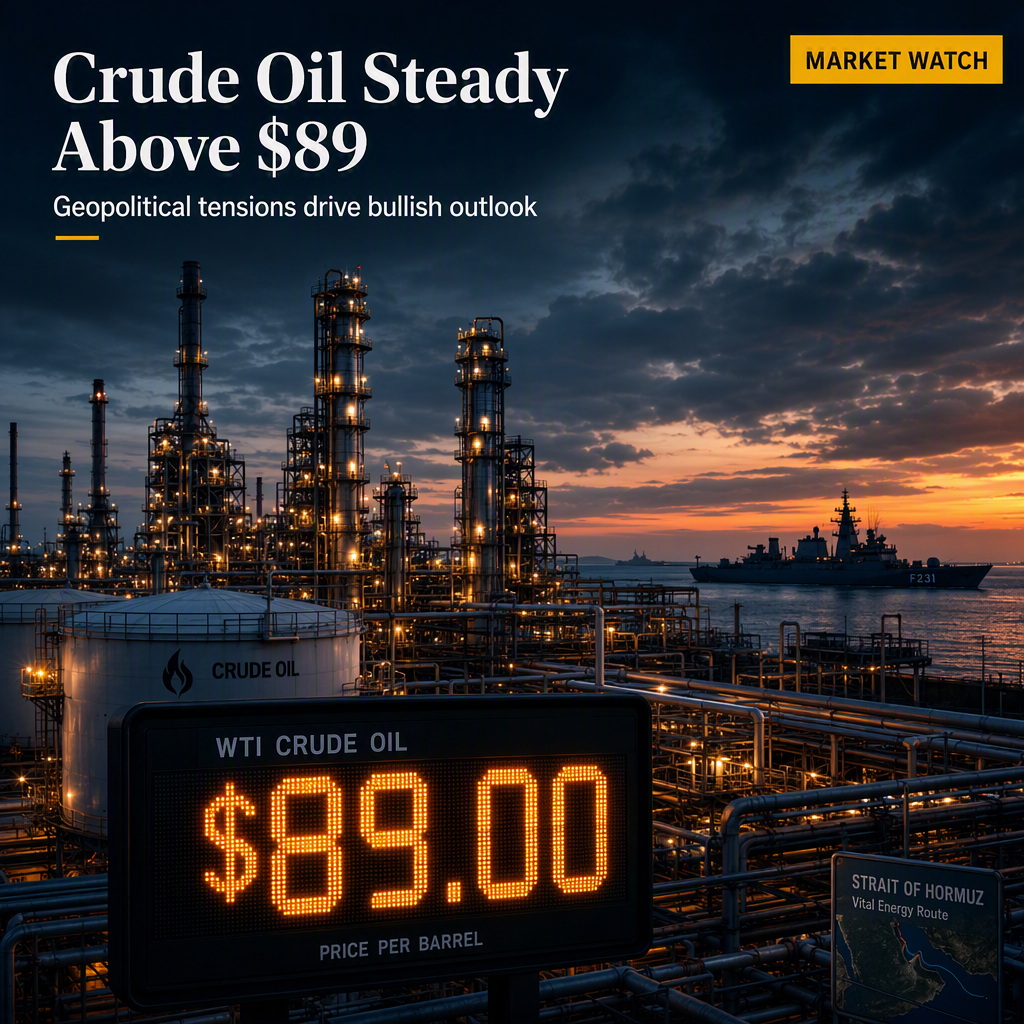
West Texas Intermediate (WTI), the benchmark for US crude oil, is consolidating just above the $89.00 mark, remaining unchanged for the day after a modest uptick during the Asian session. This price level keeps WTI near its highest point since July 24, a position reached on Wednesday, as ongoing geopolitical tensions between the US and Iran over the Strait of Hormuz continue to support a risk premium in the market [1].
From a technical analysis perspective, WTI maintains a bullish near-term bias, trading above the 100-day Simple Moving Average (SMA) at $85.10 and the 50.0% Fibonacci retracement at $86.86. Momentum indicators reinforce this positive outlook, with the Relative Strength Index (RSI) at 62 and the MACD showing a positive and expanding histogram, suggesting that buyers are still in control and any corrective declines are likely to attract renewed buying interest [1].
Immediate resistance is identified at the 61.8% Fibonacci retracement level of $91.58. A decisive break above this level could trigger further bullish momentum, with the next resistance levels at $98.31 (78.6% retracement) and the cycle high at $106.87. On the downside, support is seen at $86.86, followed by the 100-day SMA at $85.10, with deeper pullbacks potentially targeting $82.14, $76.29, and $66.84 as structural support levels [1].
The article notes that geopolitical instability, such as the current US-Iran tensions, is a key driver of oil prices, alongside supply-demand dynamics, OPEC decisions, and the value of the US dollar. However, no specific market reactions or analyst forecasts beyond the technical outlook are provided in the source [1].
CONCLUSION
WTI crude oil remains supported above $89, with technical indicators and geopolitical risks maintaining a bullish bias. Key resistance and support levels are clearly defined, and the market continues to monitor developments in the US-Iran situation for further direction.