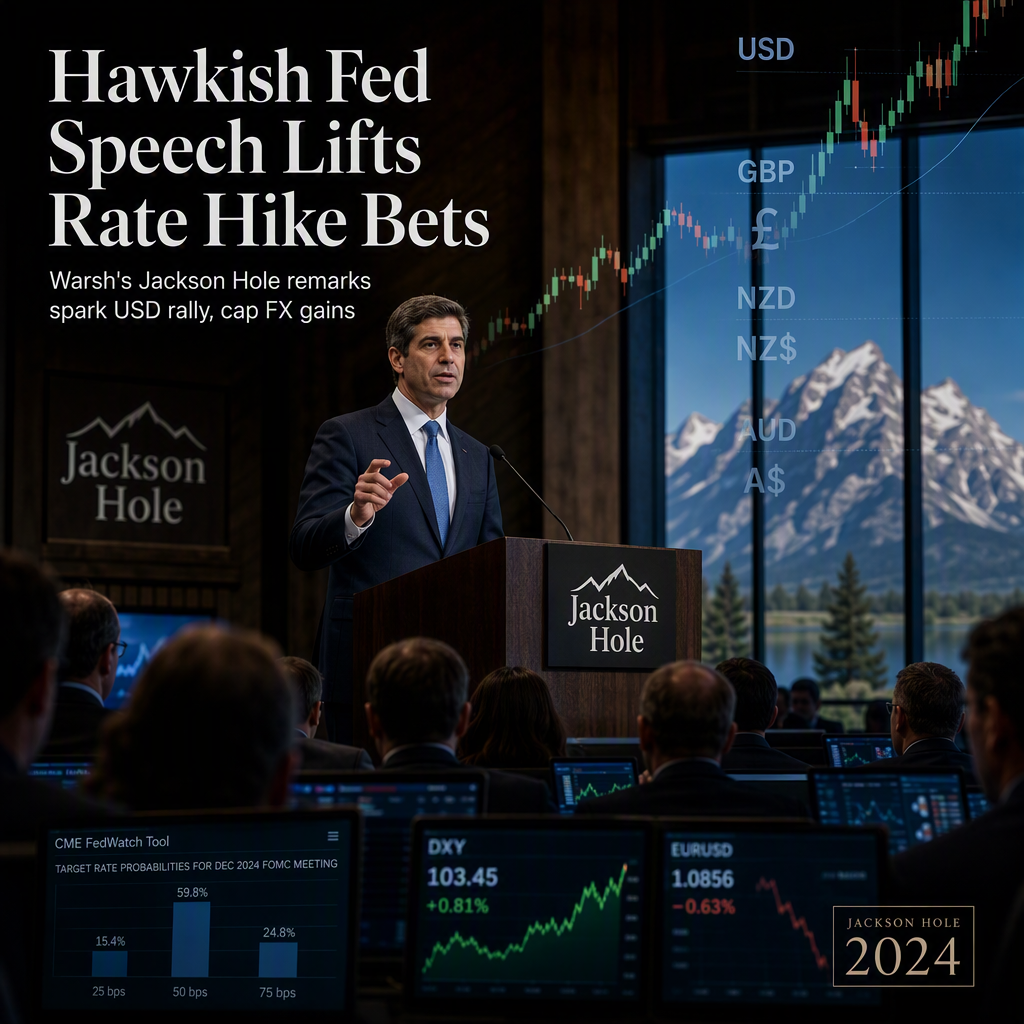
Federal Reserve Chair Kevin Warsh's unexpectedly hawkish remarks at the Jackson Hole symposium last week have significantly boosted market expectations for a US rate hike in September. Warsh emphasized the need for confidence that inflation is moving toward the target level, stating that recent inflation data was moderate but not sufficient to consider underlying trends improved. Following his speech, the probability of a Fed rate hike in September rose to 66.1%, according to CME Group FedWatch tool [1], while Scotiabank strategists noted markets are pricing a 70% chance of a 25bps hike at the September 16 meeting [2]. UOB analysts highlighted Warsh's explicit commitment to achieving price stability and his reluctance to pre-commit to future policy actions, reinforcing elevated risks of policy tightening this year [3].
This hawkish Fed stance has acted as a headwind for USD crosses. The NZD/USD pair posted modest gains around 0.5855, supported by stronger-than-expected Chinese economic data, specifically the Services PMI rising to 51.4 in August from 50.4 in July, above the consensus of 50.6 [1]. However, technical analysis suggests rallies could remain limited due to bearish momentum, with resistance at 0.5900-0.5910 and support at 0.5845 and 0.5827 [1]. Similarly, AUD/USD edged down to 0.7160, with traders reluctant to bet against the US Dollar amid the risk-off tone. Despite positive Chinese PMI data, the AUD received little boost, and Australia's trade surplus narrowed by 418 million in July to 1,923 million, with exports declining 3.3% [2].
GBP/USD traded in positive territory around 1.3490, buoyed by a weaker US Dollar. The pair maintains a mildly bullish bias above the 100-day SMA, but momentum remains subdued with resistance at 1.3550 and support at 1.3440 [3]. UK economic data showed signs of stronger growth, with BoE policymaker Catherine Mann noting a stabilised labour market and slightly stronger inflation. Markets are fully pricing a BoE rate hike by year-end, but only around 15% odds for a September increase [3].
Across all pairs, the anticipation of US August employment data and upcoming central bank speeches (Fed and BoE) are seen as key catalysts for further market moves. Technical analyses for NZD/USD and GBP/USD indicate limited upside in the near term, with tight demand zones and resistance levels capping rallies [1][3].
CONCLUSION
Fed Chair Warsh's hawkish comments have sharply increased expectations for a September US rate hike, strengthening the US Dollar and limiting upside for major USD crosses. While positive Chinese PMI data provided some support to NZD and AUD, technical and fundamental factors suggest rallies remain capped. Market participants are now focused on upcoming US employment data and central bank speeches for further direction.