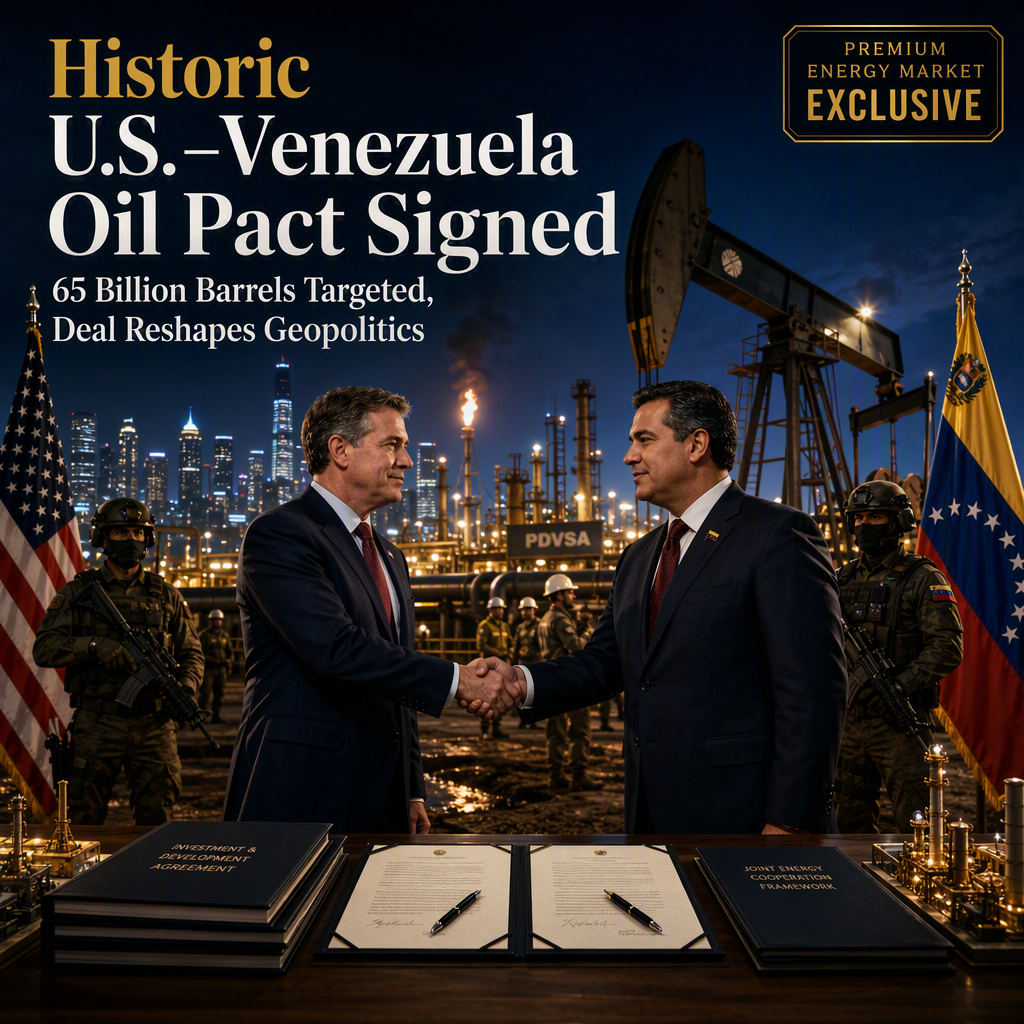
Last week, President Trump announced a historic oil partnership with Venezuela’s interim government, marking a significant shift in U.S.–Venezuela relations and the management of Venezuela’s vast oil resources [1]. The agreement was negotiated by Secretary of State Marco Rubio and Secretary of War Pete Hegseth, with confirmation of the core terms provided by Venezuela’s interim President Delcy Rodríguez [1]. The deal covers 17 strategic oil fields containing more than 65 billion barrels of reserves, sets a production target above 1.5 million barrels per day, and anticipates more than $100 billion in private investment, with large fiscal flows directed to Venezuela [1].
The pact is described as a secured U.S. interest in Venezuelan oil, which historically financed communist activities in Cuba and subversion throughout Latin America [1]. The article notes that critics from various political factions have voiced opposition: the left labels the deal as colonialism, hard-line Chavistas call it betrayal, and some opposition members question its legitimacy since it was signed by an interim government [1]. Democratic Socialists, who previously downplayed Maduro’s regime, now argue constitutional concerns over hydrocarbon management [1].
The article frames the agreement as a strategic move to prevent future foreign influence—particularly from Cuban, Russian, and Chinese intelligence services—and criminal networks that have flourished under the previous Venezuelan socialist regime [1]. It argues that a long-term U.S. commercial stake, backed by American security interests, serves as insurance against a return to communist control and makes it more difficult for future regimes to re-nationalize the industry or use oil revenues to rebuild repressive state apparatuses [1].
Market implications are significant, given the scale of the investment and the potential for increased oil production, which could impact global energy markets and shift the geopolitical balance in the Western Hemisphere [1]. The article does not provide specific analyst opinions or forward-looking statements beyond its own commentary on the strategic importance of the deal [1].
CONCLUSION
The U.S.–Venezuela oil agreement represents a major realignment of Venezuela’s energy sector, with the potential to reshape regional power dynamics and attract substantial private investment. While the deal faces criticism from multiple political factions, its scale and strategic intent signal high market impact and a possible shift in the control of Venezuelan oil resources.