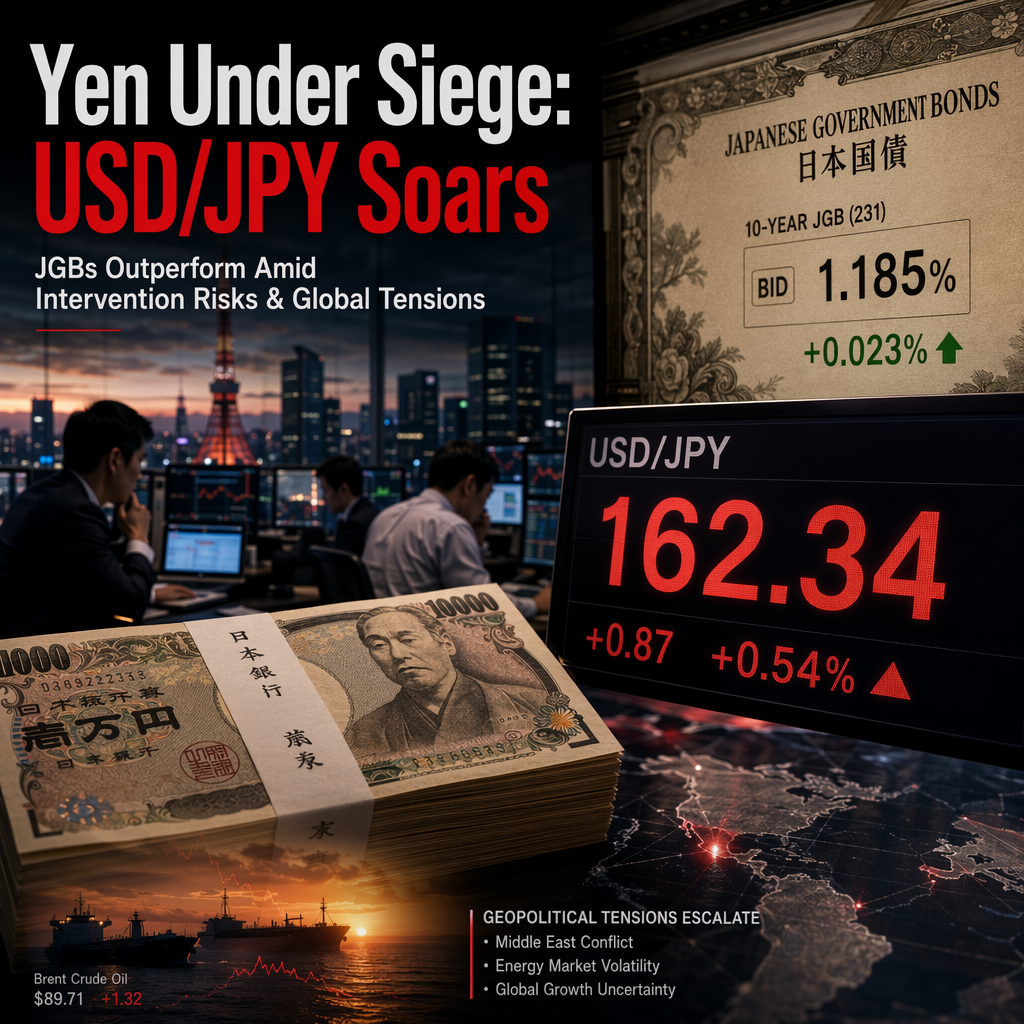
The Japanese Yen (JPY) is under significant pressure as the USD/JPY exchange rate trades near 40-year highs, with Source 1 reporting levels above 160 and Source 2 specifying levels above 162.00 [1][2]. This weakness in the Yen comes amid escalating geopolitical tensions between the US and Iran, which have driven oil prices higher and weighed on the Yen due to Japan's reliance on imported energy [1]. The inflationary impact of rising energy costs is reinforcing expectations that major central banks, including the Bank of England (BoE), may need to raise interest rates, while the Bank of Japan (BoJ) continues to lag behind its global peers in tightening policy, maintaining wide interest rate gaps that favor the British Pound (GBP) over the Yen [1].
Despite the Yen's weakness, Japanese Government Bonds (JGBs) are outperforming. Source 2 highlights strong demand at the 20-year JGB auction, where yields dropped as much as 18 basis points to 3.56% on solid investor interest. The auction's average bid-to-cover ratio reached 4.52, up from 2.97 in June and the highest since April [2]. Finance Minister Satsuki Katayama has encouraged more domestic investment, suggesting the possibility of adding government bonds to a tax-free investment program and indicating that the Government Pension Investment Fund (GPIF) portfolio could be reviewed and revised if necessary [2]. The GPIF, with assets of ¥294 trillion ($1.8 trillion), currently allocates 25% each to domestic bonds, foreign bonds, domestic equities, and foreign equities, with a deviation limit of +/-6% for domestic bonds and stocks [2].
Technical analysis from Source 1 shows GBP/JPY trading around 217.10, with buyers defending the 216.50 level and the pair maintaining a bullish structure on both the 4-hour and daily charts. The Relative Strength Index (RSI) stands at 61 on the daily chart, indicating firm positive momentum, while the Moving Average Convergence Divergence (MACD) remains positive [1]. However, traders are cautious about pushing GBP/JPY higher due to the risk of intervention by Japanese authorities as USD/JPY hovers at multi-decade highs [1].
Analyst Elias Haddad from Brown Brothers Harriman notes that Japan's large net foreign asset position, totaling roughly $3.6 trillion in Q1 or 83% of GDP, means that even modest portfolio repatriation could generate meaningful demand for both the Yen and JGBs [2].
CONCLUSION
The Japanese Yen remains under pressure as USD/JPY trades at multi-decade highs, driven by global rate differentials and higher oil prices. However, strong demand for Japanese Government Bonds and potential policy shifts to encourage domestic investment could support the Yen in the future. Market participants remain cautious, particularly regarding possible intervention by Japanese authorities.