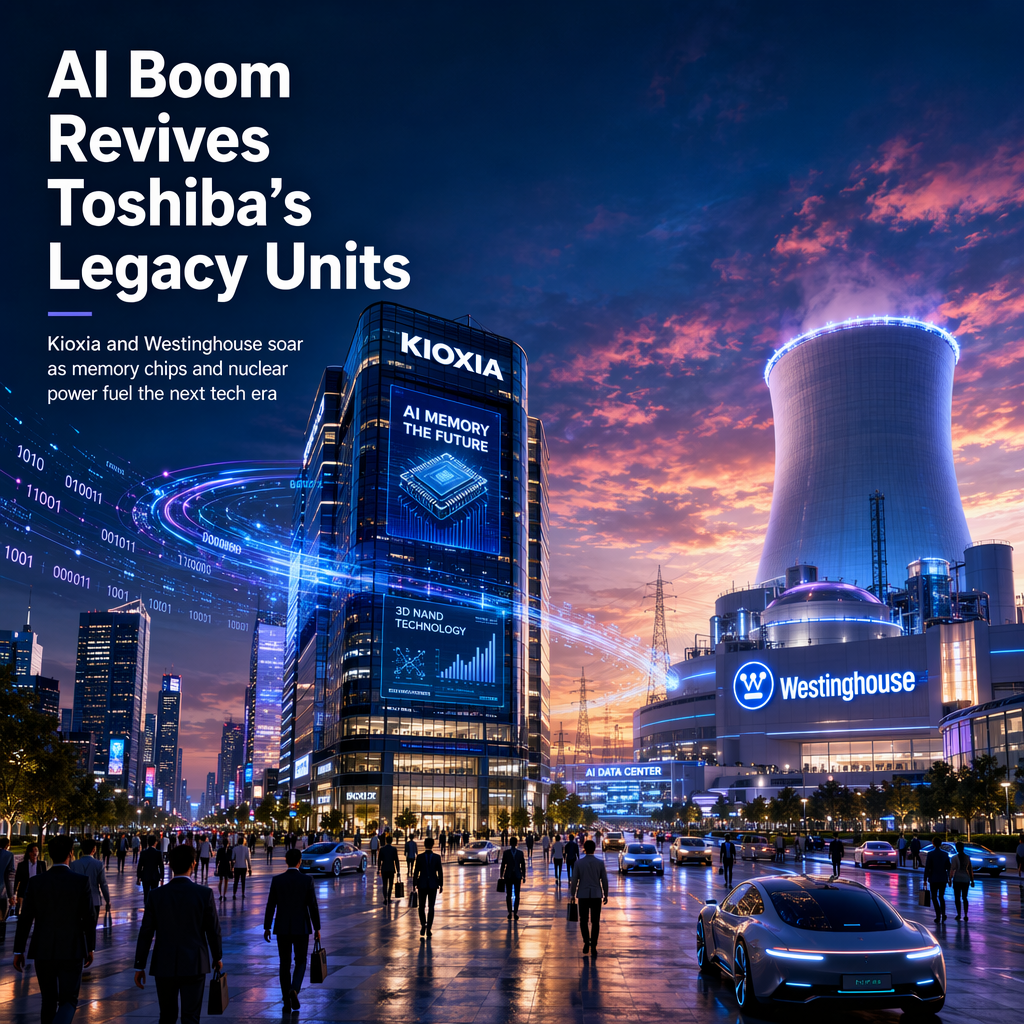
Toshiba, once a leader in memory chips and nuclear power, divested both businesses following a management crisis that began in 2016. The company sold its memory business, now known as Kioxia, and saw its U.S. nuclear unit, Westinghouse Electric, file for bankruptcy. A decade after these divestments, both Kioxia and Westinghouse have experienced significant growth, driven by the global surge in artificial intelligence applications and the resulting demand for advanced memory chips and stable energy sources [1].
Kioxia has grown into a $350 billion company, making it Japan's most valuable company, as the memory chip market experiences unprecedented demand fueled by AI [1]. Westinghouse Electric, despite its earlier bankruptcy, is now seeing renewed interest as nuclear power becomes a strategic asset for countries seeking reliable energy for data centers and AI infrastructure [1].
The article notes that the AI memory boom is prompting companies like Kioxia to adopt conservative capital expenditure strategies, opting for caution despite strong market demand. This reflects a careful approach in volatile markets, even as the sector enjoys robust growth [1].
Overall, Toshiba's divestment of its memory and nuclear power businesses has inadvertently led to the emergence of two major players in the AI era, underscoring the shifting dynamics of the global technology and energy markets [1].
CONCLUSION
Toshiba's former units, Kioxia and Westinghouse, have become central players in the AI-driven boom in memory chips and nuclear power. Their growth highlights the transformative impact of AI on technology and energy markets, and the strategic importance of these sectors in supporting future infrastructure.