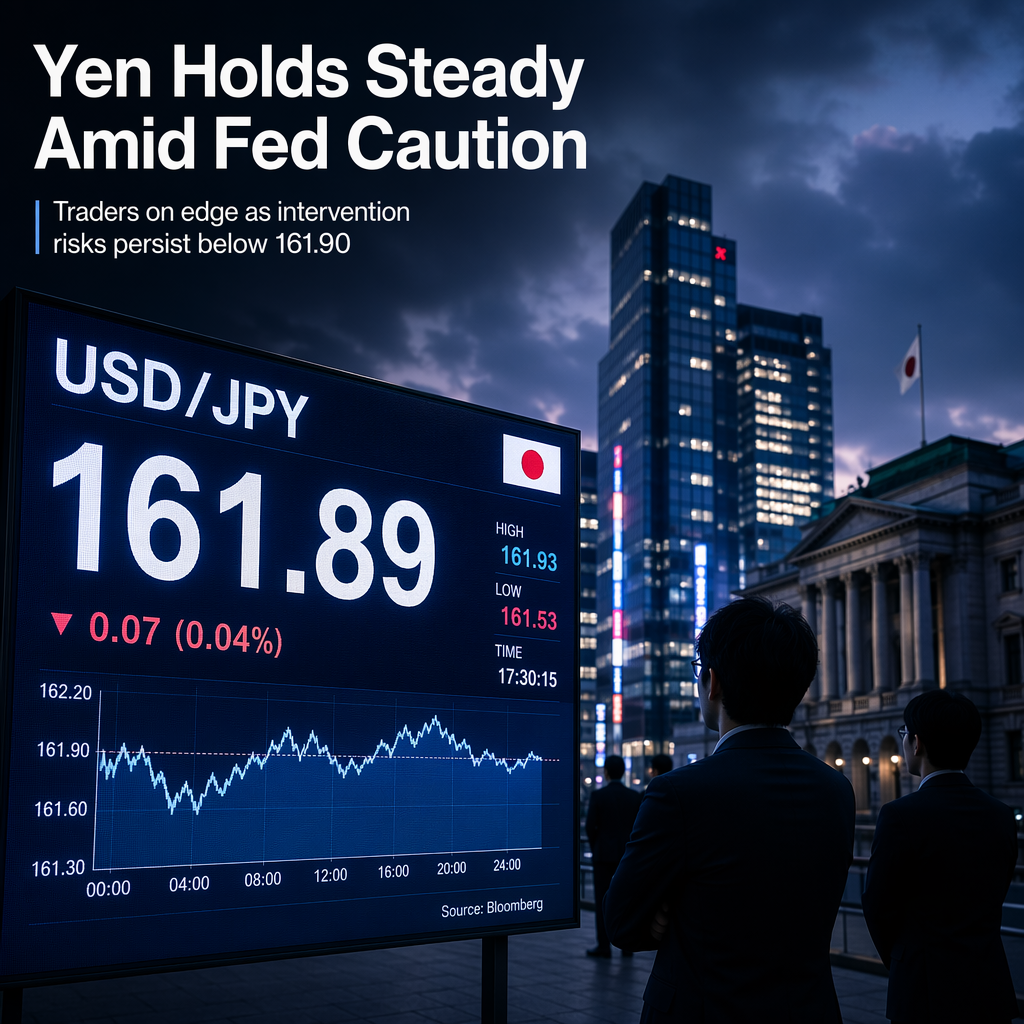
The Japanese Yen (JPY) remained subdued, trading slightly below the 161.90 level against the US Dollar (USD), as the Greenback was supported by cautious remarks from New York Fed President John Williams and ongoing concerns about US inflation. Williams stated that the US economy continues to expand at a steady, trend-like pace and that the labor market remains stable, but he emphasized that inflation is still elevated. He reinforced the need for the Federal Reserve (Fed) to maintain a restrictive policy stance, noting that future decisions will depend on incoming data and evolving risks [1].
Recent US labor data showed the ADP Employment Change 4-week average eased to 21K from 24.25K, indicating a softer pace of private hiring and suggesting cooling labor market momentum. Normally, this would weigh on the USD, but the currency avoided a deeper pullback as investors continued to price in a Fed focused on suppressing inflation [1].
On the Japanese side, the Yen found modest support due to intervention concerns after USD/JPY recently approached multi-decade highs. Japanese Finance Minister Satsuki Katayama stated that authorities remain ready to respond to excessive foreign exchange moves and are in close contact with US officials, which has kept traders cautious about pushing USD/JPY higher near the 162.00 region [1].
Technically, USD/JPY trades at 161.89 with a bullish near-term bias, remaining above both the 20-period and 100-period Simple Moving Averages (SMAs) at 161.65 and 161.50, respectively. The pair is consolidating just under recent highs, with the Relative Strength Index (RSI) easing back below 51, suggesting that momentum has normalized from prior overbought extremes. Key resistance levels are noted at 162.02, 162.18, and 162.43, while support is seen at 161.89, 161.82, and the clustered SMAs at 161.65 and 161.50 [1].
CONCLUSION
The Japanese Yen remains steady below 161.90 against the US Dollar, supported by intervention concerns and cautious Fed commentary. Market participants are closely watching for further signals from both US and Japanese authorities, with technical indicators suggesting consolidation near recent highs. The outlook remains data-dependent, with traders wary of significant moves in either direction.