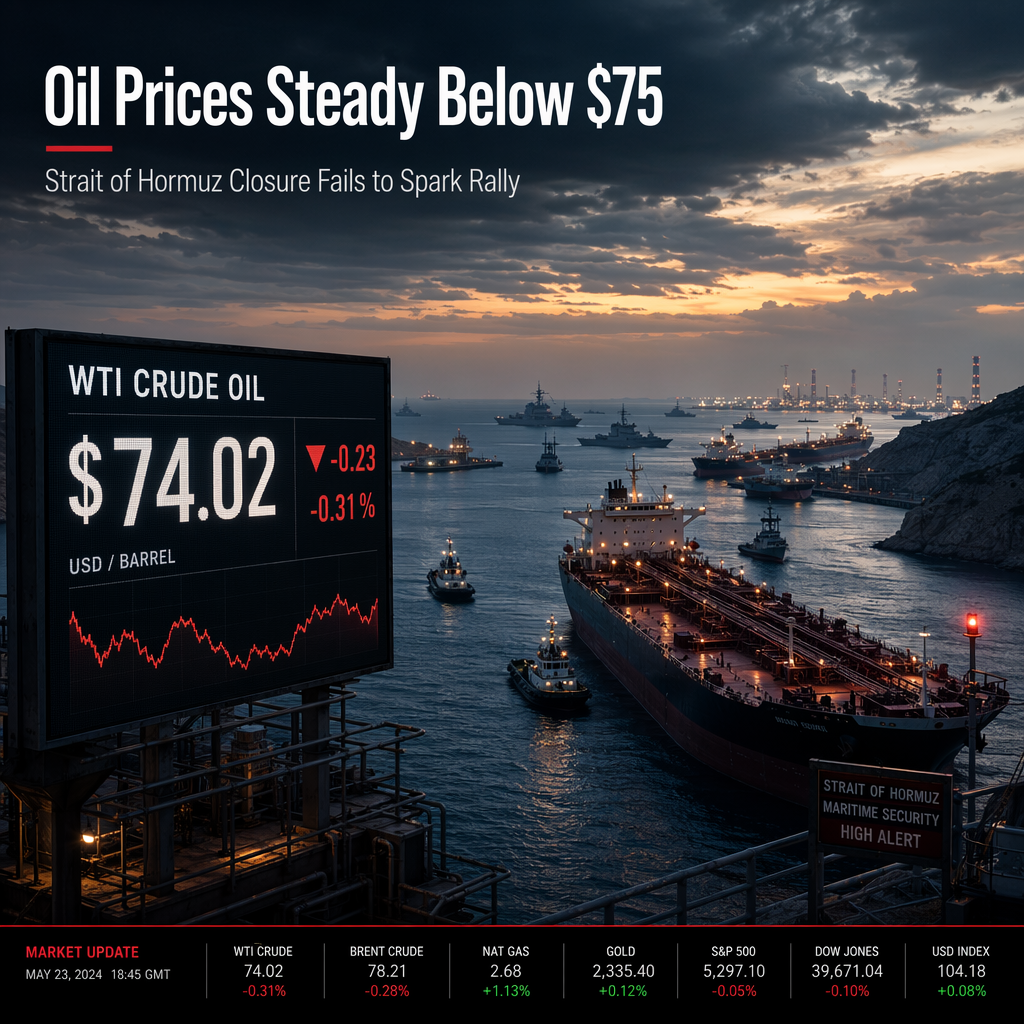
West Texas Intermediate (WTI) crude oil prices have remained below the $75.00 mark, despite escalating tensions in the Middle East and the closure of the Strait of Hormuz, a critical oil transit chokepoint. After bouncing from Friday’s levels near $71.00, WTI opened the week with a price gap but has since been capped below $75.00 and eased below $74.00 during the early European session on Monday [1].
The US and Iran intensified reciprocal attacks over the weekend, heightening geopolitical risks. However, speculative traders appear hesitant to drive a sustained crude oil rally, with investors not pricing in the likelihood of an all-out war that could push prices back to the highs seen in April and May, when WTI traded well above $100.00 per barrel [1].
An Iranian Foreign Ministry spokesperson stated that Tehran is seeking to establish a joint mechanism with Oman to address the status of the Strait of Hormuz, but claimed that US pressure on Oman is hindering these efforts. Meanwhile, traffic through the strait has dropped to its lowest level in weeks, despite US assertions that some vessels have been escorted through the waterway [1].
On the supply side, the latest US Energy Information Administration (EIA) report showed a 3 million-barrel increase in commercial US crude oil inventories for the first week of July. This inventory build has alleviated concerns about a potential oil shortage and contributed to containing the recovery in oil prices [1].
CONCLUSION
Despite heightened geopolitical risks and disruptions in the Strait of Hormuz, WTI oil prices have remained subdued, largely due to increased US crude inventories and cautious market sentiment. Investors are not yet pricing in a major supply shock, keeping oil prices below recent highs. The market remains watchful for further developments in both the Middle East and US inventory trends.