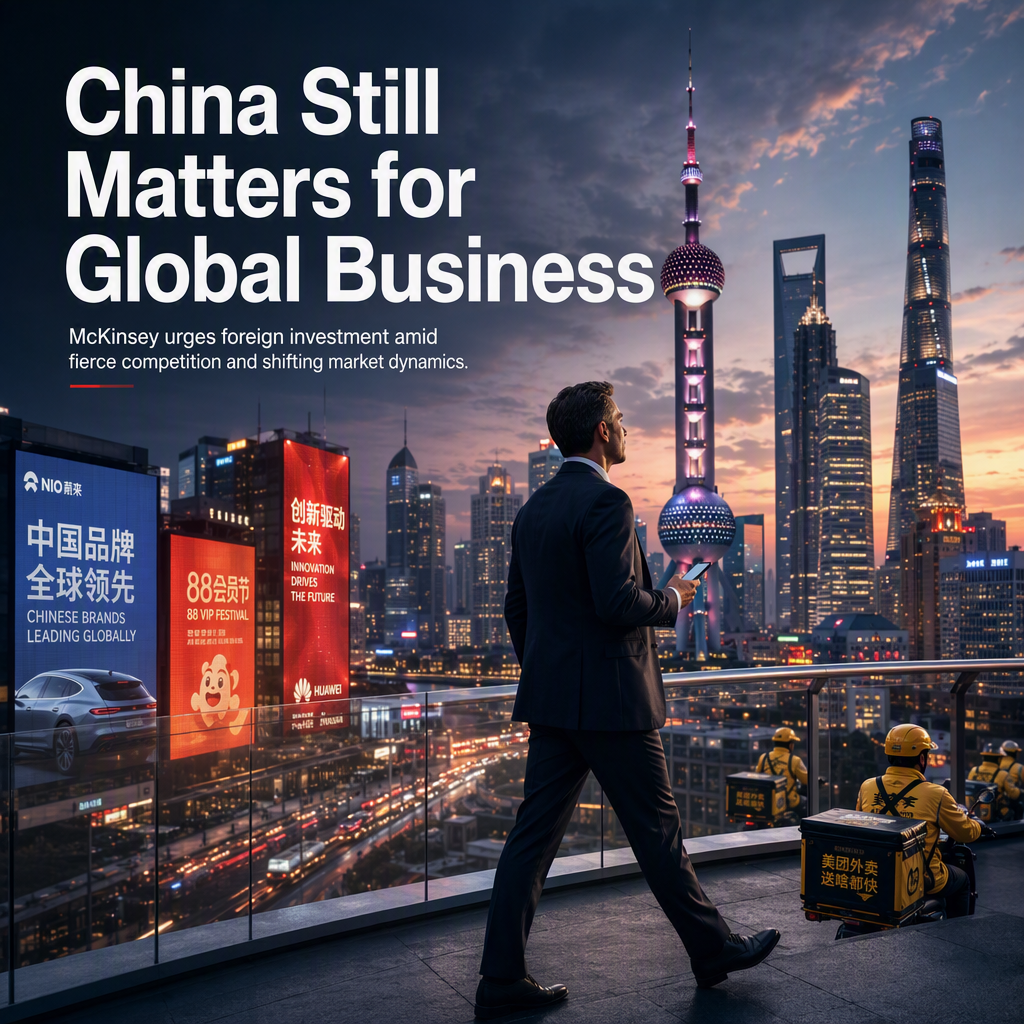
McKinsey's senior partners Nick Leung and Joe Ngai argue that China remains a crucial market for foreign businesses, despite recent challenges such as sluggish consumer demand, a prolonged real estate drag, and supply chain diversification [1]. Their new book, 'The Next China Is Still China: An Insider's Playbook for Winning in the New Era,' presents a contrarian view, rejecting the notion that China is headed for Japan-style stagnation or major decoupling from the U.S. [1]. Ngai emphasizes that the current disappointment among multinationals stems from a contrast with the past 20 years, during which foreign companies enjoyed dominant market share in China [1]. He notes that local Chinese rivals are also facing disappointment due to hyper-competition and involution in the slowing economy [1].
McKinsey highlights China's global manufacturing dominance and its investment in frontier technology as key factors supporting the country's continued relevance for international businesses [1]. Ngai advises that winning in the long term requires foreign companies to invest in China to remain relevant in its vast consumer market and to stay competitive in other countries where Chinese firms are expanding [1]. For example, Lingverse, a Chinese AI-powered educational product company, plans to launch its owl-themed reading companion in the U.S. this fall and is in talks with Florida school districts to use its device during field trips [1].
Despite rapid global growth, Chinese companies face significant challenges. Mixue, a beverage and budget drinks chain, has opened four times as many stores as Dunkin Donuts, but its shares tumbled last week after cost of sales outpaced revenue, resulting in a 14.7% profit drop in the first half of the year [1]. Since the pandemic, China's retail sales have grown at less than half the pace seen in previous years [1]. Starbucks has sold a majority stake in its local operations, and other U.S. giants have downsized amid geopolitical tensions [1].
Ngai notes that many foreign businesses are actively engaging with Chinese partners to navigate these challenges, underscoring the importance of continued investment and adaptation in the evolving Chinese market [1].
CONCLUSION
McKinsey's analysis suggests that, despite heightened competition and slower growth, China remains a vital market for foreign businesses. Long-term success will require ongoing investment and strategic adaptation to local conditions. The market impact is medium, as both foreign and Chinese companies face significant challenges but opportunities persist for those willing to innovate and invest.