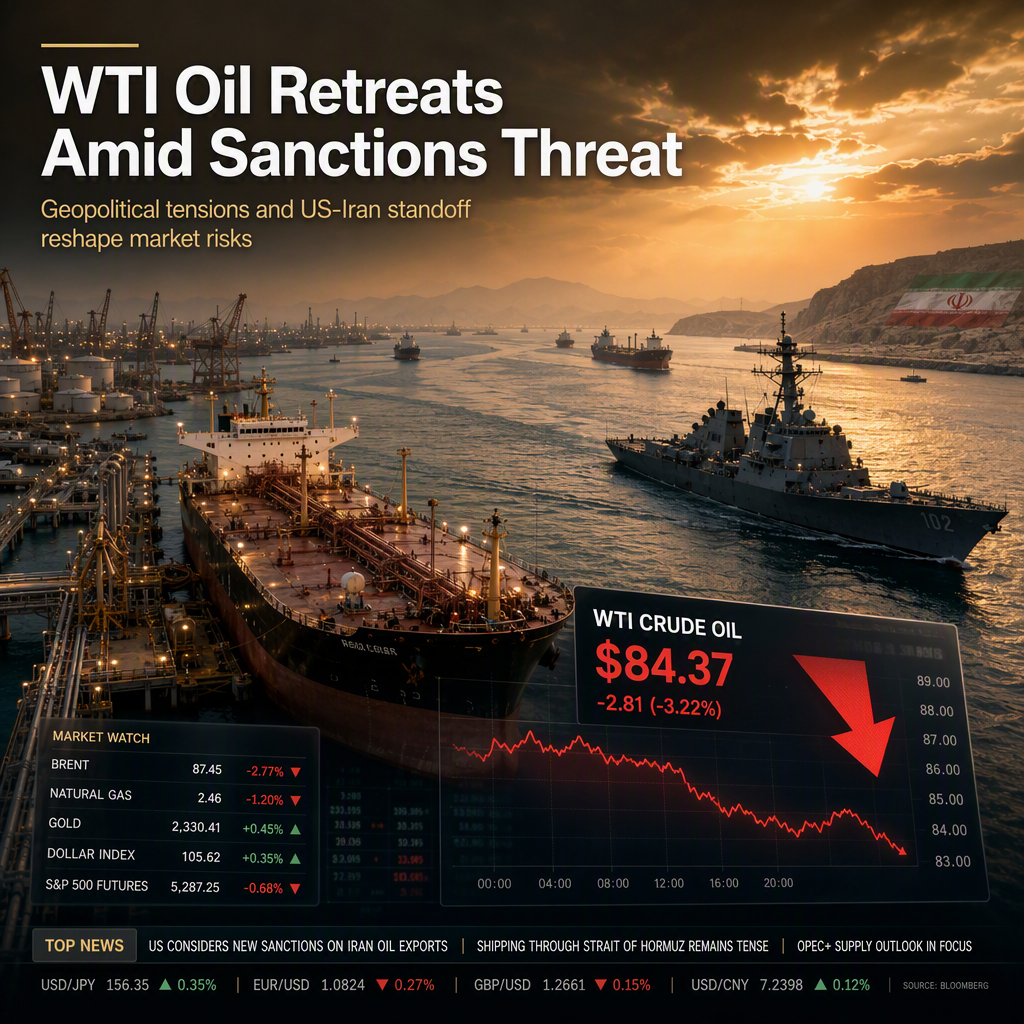
West Texas Intermediate (WTI) Oil prices declined on Monday, trading around $84.37 per barrel, marking a drop of approximately 2.28% on the day after gaining more than 5% in the previous week [1]. The pullback occurred despite persistent elevated tensions in the Middle East and ongoing heavy restrictions on shipping through the Strait of Hormuz [1]. The immediate market focus is on the anticipated announcement of new US sanctions against Iran, which is expected later on Monday [1]. In response, Tehran has warned that it could halt oil exports through the Strait of Hormuz and other routes in the Persian Gulf if Washington proceeds with its plans [1].
Strategists at BBH described the scale of Scott Bessent’s proposed campaign as the “single greatest financial offensive ever marshalled against an adversary,” targeting not only Iran but also the foreign networks that purchase and transport its oil [1]. They emphasized that China, as Iran’s largest trading partner and the buyer of roughly 90% of its oil exports, is a critical pressure point, with Beijing’s response seen as pivotal to the direction of risk sentiment in the market [1].
From a technical perspective, WTI’s recent advance met resistance at the 100-day Simple Moving Average (SMA), capping further upside near $85.64, while the price remains above the 21-day and 200-day SMAs [1]. The Relative Strength Index (RSI) is near 55 and the MACD remains in positive territory, suggesting buyers still have the upper hand, although the Average Directional Index (ADX) is relatively weak at around 19 [1]. Immediate resistance is identified near the former descending trend line at $85, with support at the 21-day SMA ($81.37), the 200-day SMA ($76.84), and a deeper support area at $68.00 [1].
No explicit analyst forecasts or forward-looking statements beyond the technical analysis and the importance of China’s reaction were provided in the article [1].
CONCLUSION
WTI Oil prices retreated after a strong rally last week, as markets await the US announcement of new sanctions against Iran and monitor potential disruptions in the Strait of Hormuz. Technical indicators suggest buyers retain some control, but resistance near $85 remains a key hurdle. The market’s next direction may hinge on China’s response to the evolving geopolitical situation.