
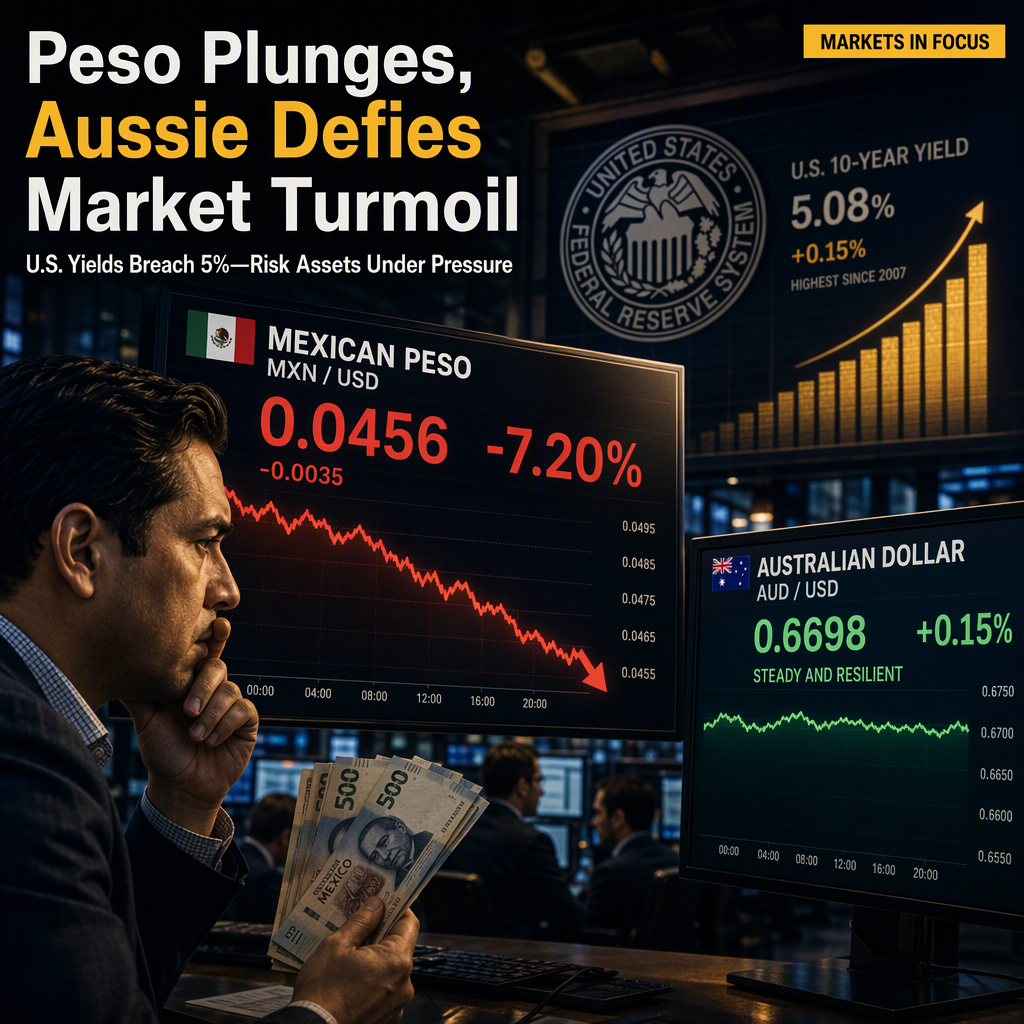
The Mexican peso has experienced a sharp decline, falling 7.2% against the U.S. dollar over the past four weeks, as U.S. long-term yields surged above the key 5% threshold [1]. This rise in U.S. yields has triggered a flight to quality, with investors and traders shifting away from riskier, high-yield currencies such as the Mexican peso [1]. Japanese investors, in particular, are reassessing the risks associated with holding high-yield currencies in the face of rising U.S. rates [1].
While the Mexican peso has come under significant pressure, the Australian dollar has demonstrated resilience, remaining relatively stable despite the broader sell-off in high-yield currencies [1]. Analysts attribute the Australian dollar's performance to its perceived stability and the strength of Australia's economic fundamentals, even as global risk aversion intensifies [1].
Market participants note that the breach of the 5% level in U.S. long-term yields is a technical milestone that has intensified risk-off sentiment and increased volatility in high-yield currency pairs [1]. Technical indicators suggest that further volatility is likely if U.S. yields continue to rise, with traders closely monitoring support and resistance levels for both the Mexican peso and the Australian dollar [1].
A Tokyo-based FX strategist commented, "With U.S. yields rising, it’s becoming increasingly difficult to justify holding riskier currencies. The Mexican peso is under pressure, and we’re seeing investors shift toward the dollar and other stable currencies" [1]. Analysts are advising a defensive trading stance, favoring the U.S. dollar and other quality assets until uncertainties over interest rates and currency volatility diminish [1].
CONCLUSION
The surge in U.S. long-term yields above 5% has led to a pronounced sell-off in high-yield currencies, with the Mexican peso dropping 7.2% against the dollar, while the Australian dollar has remained relatively stable. Market participants are adopting a cautious approach, favoring safer assets amid heightened volatility and uncertainty.